Why social engineering matters: Protecting humans and AI

Nearly 98% of cyberattacks rely on social engineering techniques, and that statistic challenges something most security teams still believe: that firewalls, endpoint detection, and zero-trust architecture are enough. They are not. The threat does not live in your code. It lives in the gap between what your systems expect and what people and AI models actually do under pressure. This article breaks down why social engineering matters more than ever in an AI-driven world, what psychological mechanisms make it so effective, and what practical steps you and your organization can take right now to build genuine resilience.
Table of Contents
- What is social engineering and why does it bypass tech defenses?
- Psychology behind social engineering: What attackers exploit
- The impact: Costs, edge cases, and real-world breaches in 2026
- Generative AI: How intelligent threats change the risk equation
- Strengthening resilience: Building hybrid human and AI defenses
- Our take: Why the human element is still your greatest asset and risk
- Strengthen your defenses with specialized AI social engineering tools
- Frequently asked questions
Key Takeaways
| Point | Details |
|---|---|
| Human and AI risk | Social engineering threatens both people and automated systems by exploiting trust, fear, and interaction patterns. |
| High prevalence | Nearly all cyberattacks use social engineering, making technical solutions alone insufficient for defense. |
| Costly consequences | The financial and reputational damage from social engineering breaches can reach millions of dollars per incident. |
| AI amplifies attacks | Generative AI enables more convincing, scalable social engineering, elevating risks on new fronts. |
| Hybrid resilience required | Combining ongoing human awareness with robust AI controls forms the strongest defense strategy. |
What is social engineering and why does it bypass tech defenses?
Social engineering is the practice of manipulating a person or an AI system into taking an action that serves an attacker’s goal, without ever needing to break encryption or exploit a vulnerability in code. The attacker is not picking the lock. They are convincing the person inside to open the door.
This is exactly why it is so effective against organizations with mature technical defenses. You can spend millions on intrusion detection systems and still lose a breach because one employee clicked a link in a convincingly worded email. Technical controls are designed to block known attack patterns. Social engineering creates a new pattern every time, one that exploits something far harder to patch: human judgment.
“Social engineering accounts for 36% of cybersecurity incidents globally, making it the top initial access vector by exploiting trust and psychology rather than technical weaknesses.”
This means more than one in three breaches starts not with a zero-day exploit, but with a well-crafted message. The technical barriers that most organizations have invested heavily in protecting are simply bypassed at the human layer. And with AI security risks growing, AI systems themselves are now legitimate targets of these same manipulation techniques.
Common attack formats include:
- Phishing emails that appear to come from a trusted executive, vendor, or IT department
- Urgency-based messages warning that an account will be locked or a payment will fail unless immediate action is taken
- Consent pop-ups in OAuth flows that ask for permissions that look routine but grant broad data access
- Vishing (voice phishing) where attackers impersonate IT support or HR to extract credentials verbally
- Pretexting where the attacker builds a fictional but convincing backstory to justify an unusual request
Each of these tactics works because it is designed to trigger a specific psychological response before the target has time to think critically. That is not an accident. It is the strategy.
Psychology behind social engineering: What attackers exploit
Attackers are not just technically skilled. They are applied psychologists. The most effective social engineering campaigns succeed because they are built on the same psychological principles that influence all human decisions, whether someone is buying a product or approving a wire transfer.
The core principles attackers exploit include trust, reciprocity, authority, urgency, fear, curiosity, and social proof. Each one can be weaponized individually or layered together for a more convincing attack.
| Psychological principle | How attackers exploit it | Real-world example |
|---|---|---|
| Authority | Impersonating executives or regulators | “CEO fraud” wire transfer requests |
| Urgency | Creating artificial time pressure | “Your account will be suspended in 2 hours” |
| Fear | Threatening consequences for inaction | Fake IRS notices or ransomware warnings |
| Curiosity | Enticing with unusual content | Malicious attachments labeled “Q3 bonuses” |
| Trust | Mimicking known contacts or brands | Spoofed emails from IT support |
| Social proof | Suggesting others have already complied | “Your team has already completed this form” |
| Reciprocity | Offering something small to create obligation | Free tool download that precedes a request for credentials |
What makes this more complex in AI-driven environments is that AI systems are also susceptible to some of these patterns. Large language models can be manipulated through authority-framing in prompts, making them behave as if they received instructions from a trusted source. Pattern misrecognition, where the model classifies a manipulated input as legitimate because it superficially resembles valid instructions, is the AI equivalent of human trust exploitation.

A solid social engineering defense workflow has to account for both sides of this problem, training humans on the psychological levers and hardening AI systems against prompt manipulation simultaneously.
Pro Tip: Do not design security awareness training around generic “don’t click links” advice. Map your training scenarios directly to the psychological principles listed above. When employees understand why an attack works on them emotionally, they are far more likely to pause and verify before acting.
The impact: Costs, edge cases, and real-world breaches in 2026
Understanding the psychology makes it clear how potent these attacks are. Now look at what they actually cost when they succeed.
The average social engineering breach costs an organization $4.45 million, while phishing alone averages $4.91 million per incident. These numbers include direct financial loss, regulatory fines, forensic investigation, system recovery, and reputational damage. They do not fully capture the operational downtime or the long-term erosion of customer trust.
| Breach type | Average cost | Avg. time to identify and contain |
|---|---|---|
| Phishing | $4.91 million | 295 days |
| Business email compromise | $5.01 million | 308 days |
| Social engineering (general) | $4.45 million | 270 days |
| Insider threat (manipulated) | $4.18 million | 317 days |
The recovery window is just as alarming as the cost. Nearly 300 days is almost a full year of operating with a compromised environment before full containment.
One of the most instructive recent cases involves the Drift Protocol breach. North Korean threat actors built convincing fake professional identities over several months, gradually earning trust within the target organization before executing a $285 million theft. The attack combined long-game identity fabrication with real-time MFA phishing relay attacks and OAuth consent abuse.
Here is how that attack unfolded, step by step:
- Attackers created detailed fake professional profiles on LinkedIn and other professional networks, complete with verifiable work histories
- They engaged with the target organization’s team over several months, building perceived credibility
- When the time came, they used these trusted identities to initiate a conversation that triggered a fake MFA request
- A real-time relay intercepted the victim’s one-time passcode and authenticated the attacker’s session simultaneously
- OAuth consent was abused to grant persistent access, well beyond the initial session
The lesson here goes beyond technical controls. No firewall would have stopped step one, two, or three. Only informed human judgment or behavioral monitoring could have caught this. This is why phishing defense for AI teams must integrate long-game awareness, not just single-message detection.
Generative AI: How intelligent threats change the risk equation
Generative AI has fundamentally shifted the economics and scale of social engineering. Before large language models, running a convincing spear-phishing campaign against a specific executive required research, writing skill, and manual effort. Now those barriers are nearly gone.
Generative AI enhances attacks by making them more realistic, more personalized, and fully automated. An attacker can now produce thousands of individually tailored phishing emails by feeding in scraped LinkedIn and social media data. The writing quality, tone, and context match is often indistinguishable from a real colleague.
The new attack types now in active use include:
- Deepfake video and audio impersonating executives in live or recorded calls to authorize fraudulent transactions
- Automated spear-phishing that personalizes messages at scale using target-specific professional context
- Voice clone scams where an attacker synthesizes a known person’s voice to make urgent financial or access requests
- AI-generated pretexting that builds elaborate false narratives in real-time conversation to extract credentials
- Prompt injection attacks targeting AI assistants embedded in enterprise tools, instructing them to leak data or execute unauthorized actions
That last point deserves special attention. Prompt injection is the AI equivalent of phishing. An attacker embeds malicious instructions inside content that an AI assistant will process, a document, an email, a web page, and the AI executes those instructions as if they came from a trusted user. The assistant becomes the unwitting accomplice.
This is not a theoretical risk. It is already being exploited against enterprise tools with embedded AI assistants. A solid defense workflow for AI teams now needs to include prompt validation layers as a standard architectural control.
Pro Tip: Treat your AI assistant’s input surface the same way you treat user input in a web application. Validate, sanitize, and monitor what goes in. Any content an AI processes from an external source should be treated as potentially adversarial until proven otherwise.
Strengthening resilience: Building hybrid human and AI defenses
With the AI threat landscape evolving at this pace, no single control category is sufficient. Resilience requires hybrid human-AI defenses that combine cultural awareness with architectural controls built specifically for how modern organizations actually operate.
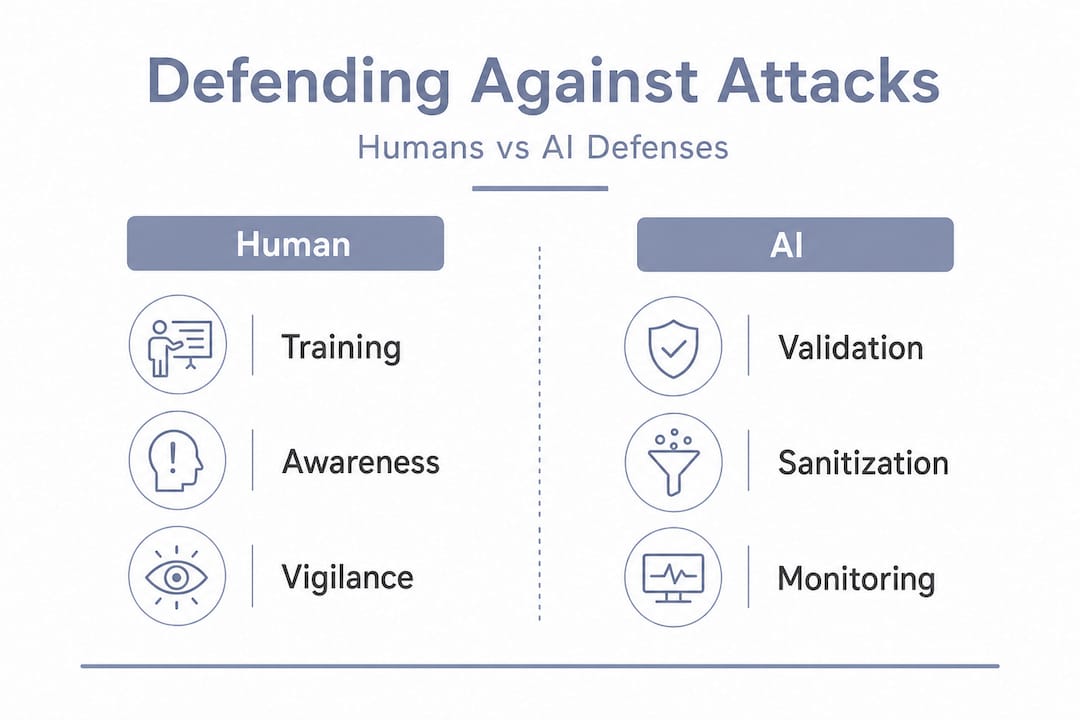
The organizations that fare best after a social engineering attempt share a common characteristic: security is not treated as an IT problem. It is treated as a shared organizational responsibility, and that starts with leadership modeling the behavior they want to see from their teams.
Key steps to build that resilience include:
- Ongoing, scenario-based employee training that uses real attack simulations rather than one-time videos. The frequency and realism of training matter significantly.
- Robust identity and access management, including phishing-resistant MFA methods like hardware keys or passkeys, replacing SMS-based codes that are vulnerable to relay attacks
- Prompt monitoring and input validation for all AI agents and assistants operating in your environment, treating adversarial input as a first-class threat
- Behavioral analytics that flag unusual patterns, such as access requests outside normal hours or from new devices, even when credentials check out
- AI-specific red team exercises where your security team attempts to manipulate your own AI tools through prompt injection and social context abuse
- Cross-functional security ownership that pulls IT, product, compliance, and leadership together with shared metrics and accountability
Investing in AI transparency and trust frameworks within your organization also builds the cultural substrate that makes all these technical controls more effective. When people understand why trust must be verified and not assumed, they become active contributors to security rather than passive risks.
Building an AI team defense workflow that connects your human resilience program to your AI security controls is not optional anymore. And your phishing resilience for teams strategy needs to account for AI-generated content that is orders of magnitude more convincing than what defenders trained on five years ago.
Our take: Why the human element is still your greatest asset and risk
Here is the uncomfortable truth that most vendors, consultants, and conference talks avoid saying clearly: no amount of technology fully eliminates social engineering risk, because social engineering is not fundamentally a technology problem.
Organizations that have suffered the most damaging breaches in recent years were often well-funded and technically sophisticated. They had endpoint protection, multi-factor authentication, and security operations centers. What they lacked was a culture where people felt empowered to question unusual requests, even when those requests came from apparent authority figures.
The Drift Protocol case is a perfect illustration. The attackers did not break anything technical for months. They built relationships. They played the long game, knowing that at some point, a human on the other side would make a decision based on trust rather than verification. That is not a technology gap. That is a cultural and behavioral gap.
We see organizations invest heavily in tools after a breach and then rebuild the same vulnerability because the underlying habits never changed. A new SIEM platform does not help when your CFO still approves wire transfers based on a WhatsApp message from someone claiming to be the CEO.
The most resilient organizations we work with treat security awareness not as a compliance checkbox but as an ongoing practice. They run regular simulated attacks, they debrief on near-misses, and they reward the right behavior, pausing and verifying, rather than penalizing the people who get tricked.
The same logic applies to AI systems. Building and maintaining social engineering workflows that include both human and AI oversight is not a one-time project. It is a continuous operating discipline. The threat is always learning. Your defenses need to learn faster.
Strengthen your defenses with specialized AI social engineering tools
The tactics covered in this article are not theoretical. They are active, they are evolving, and they are already inside some organizations right now waiting to be triggered.
Thepitstop.ai was built specifically for this moment. Whether you need to test your people, assess your AI agents, or establish cryptographic trust between human operators and autonomous systems, we have the tools to get you there. Start with a free social engineering assessment to benchmark your current resilience, review our AI agent liability gap analysis to understand where your exposure is growing, or explore the Infinity Protocol for AI trust to establish verifiable, secure relationships between your AI systems and your human teams. Every tool is free to access and built for the threats that are actually active right now.
Frequently asked questions
What are the most common forms of social engineering attacks in 2026?
Phishing and spear-phishing remain dominant, now joined by deepfake audio and video impersonation, real-time MFA relay attacks, and OAuth consent abuse targeting enterprise authentication flows.
Why does social engineering work even with strong technical defenses?
It targets human psychology and AI input surfaces rather than code vulnerabilities, meaning technical controls are bypassed at the point of human or AI decision-making rather than at the network or endpoint layer.
How much does a typical social engineering breach cost organizations?
The average breach costs $4.45 million across all social engineering types, with phishing-specific incidents averaging $4.91 million, not counting indirect costs like reputational damage and customer churn.
Can AI itself fall victim to social engineering tactics?
Yes. Through prompt injection and adversarial input, attackers can manipulate AI assistants into leaking data or executing unauthorized actions, making AI-targeted social engineering a critical and growing category of risk that demands architectural controls alongside human awareness training.