Why securing AI supply chains protects your systems

You can lock down every line of model code your team writes, enforce strict access controls, and pass every internal security review. But if a poisoned dataset sneaked into your training pipeline two steps upstream, or a compromised package quietly replaced a legitimate one during your last dependency update, your well-secured model can still betray you. AI supply chains extend far beyond code to include pre-trained model weights, training datasets, ML frameworks, inference infrastructure, and third-party plugins. This article breaks down where the real threats live and what you can do to stop them before they reach production.
Table of Contents
- The anatomy of the AI supply chain: Why it’s uniquely risky
- How supply chain attacks compromise AI systems
- Foundations of securing the AI supply chain: Provenance and integrity
- Best practices for building resilient and secure AI supply chains
- The uncomfortable truth about securing AI supply chains
- How The Pitstop strengthens AI supply chain security
- Frequently asked questions
Key Takeaways
| Point | Details |
|---|---|
| AI supply chains are complex | They include models, data, code, infrastructure, and third-party plugins—all potential risk points. |
| Trust boundaries are multi-layer | Even secure internal code can be bypassed if upstream models or datasets are compromised. |
| Attacks are rising | AI supply chain compromise rates have quadrupled since 2020, requiring urgent attention. |
| Provenance is your ally | Tracing origins and changes to all AI assets is the best defense against hidden threats. |
| Security demands process and tools | Build resilience with proactive controls, automated monitoring, and a culture of supply chain verification. |
The anatomy of the AI supply chain: Why it’s uniquely risky
Traditional software supply chains are complex enough. AI supply chains are in a different category entirely. They layer all the familiar software risks (third-party packages, CI/CD pipelines, container images) on top of entirely new attack surfaces: datasets that encode learned behavior, pre-trained weights that carry invisible biases or backdoors, and model hubs where trust is often assumed rather than verified.
According to the AI Supply Chain Security Guide, the attack surface for modern AI systems spans models, datasets, runtime infrastructure, and plugins, which makes every layer a potential entry point. Here is how each segment introduces unique risk:
| Layer | Traditional software risk | AI-specific risk |
|---|---|---|
| Source code | Malicious commits, backdoors | Poisoned training scripts |
| Dependencies | Typosquatting, outdated packages | Compromised ML libraries (e.g., PyTorch, TensorFlow) |
| Datasets | Not applicable | Data poisoning, mislabeled or backdoored samples |
| Pre-trained models | Not applicable | Embedded backdoors, adversarial weights |
| CI/CD pipelines | Build-time injection | Model artifact tampering mid-pipeline |
| Runtime/containers | Container escapes, misconfig | GPU driver exploits, inference API abuse |
| Third-party plugins | Plugin hijacking | Third-party AI plugins calling unverified endpoints |
The trust boundaries in AI supply chains multiply faster than most teams realize. When you pull a pre-trained model from a public hub, you are implicitly trusting every contributor who touched that model, every dataset it learned from, and every library used to serialize its weights. None of those trust assumptions are explicit in your codebase. They are invisible.
The core challenge: In traditional software, a dependency is a block of verifiable code. In AI, a dependency can be a dataset that shapes learned decision logic in ways that no static analysis tool will ever catch.
High-risk components to audit first:
- Pre-trained model weights downloaded from public repositories
- Fine-tuning datasets sourced from third parties or web scraping
- ML framework versions (PyTorch, Hugging Face Transformers, ONNX Runtime)
- Serialization formats (e.g., Pickle files, which can execute arbitrary code on load)
- Third-party inference APIs and orchestration tools
- CI/CD runner configurations and secrets management
Understanding your AI agent liability starts with mapping these layers. If you have not already reviewed AI agent liability guidance in the context of supply chain risk, that is a logical starting point for project managers building their risk register.
With the scope of supply chains established, let’s examine how attackers exploit these new risks.
How supply chain attacks compromise AI systems
Supply chain attacks against AI systems have moved from theoretical concern to documented reality. The IBM 2026 X-Force Threat Intelligence Index shows measurable growth in supply chain compromises, with attackers increasingly targeting CI/CD environments and build pipelines as the most efficient route to downstream victims. Compromise the build environment once, and you reach every organization that installs the resulting artifact.
The OWASP Top 10 for LLM Applications identifies supply chain vulnerabilities as a leading integrity risk: compromised components, services, or datasets can silently undermine system behavior in ways that are nearly impossible to detect after deployment.
A real incident that should be on every AI project manager’s radar:
The LiteLLM supply chain attack demonstrated exactly how dangerous these compromises can be. A malicious ".pthfile was introduced into the LiteLLM package on PyPI. Because Python automatically executes.pth` files on interpreter startup, any developer or system that installed the compromised version immediately began exfiltrating sensitive credentials and data without any visible indication that something was wrong. No warning. No crash. Just a silent, automated data theft.

| Attack type | Entry point | Effect on AI system |
|---|---|---|
| Data poisoning | Training/fine-tuning dataset | Model learns incorrect or malicious behavior |
| Model backdoor | Pre-trained weights | Hidden trigger causes specific misclassification |
| Package compromise | PyPI/npm dependency | Code execution, credential theft |
| CI/CD injection | Build pipeline | Tampered model artifacts in production |
| Plugin hijacking | Third-party integrations | Data exfiltration, prompt manipulation |
How a typical AI supply chain attack unfolds:
- Attacker identifies a widely used AI package or dataset with weak access controls
- Malicious code or data is injected (via a typosquatted package, a compromised maintainer account, or a pull request that slips through review)
- The compromised artifact is downloaded by downstream teams during routine dependency updates or model pulls
- The malicious component executes silently in the target environment, whether during training, inference, or model loading
- Data is exfiltrated, model behavior is corrupted, or a persistent backdoor is established for future exploitation
Statistic worth noting: The attack surface for organizations deploying LLM-based systems is dramatically larger than most security teams account for, because LLM apps pull from a web of services, datasets, and plugin ecosystems that evolve constantly.
Pro Tip: Set up automated alerts for any dependency version changes in your ML pipeline. A package that updates silently overnight is a red flag worth investigating before it reaches your training or inference environment.
For context on what these breaches look like in practice, reviewing documented breach case studies can help your team understand the full impact of supply chain failures before they become your organization’s story.
Given these high-impact risks, how can organizations reduce their exposure and build more resilient AI systems?
Foundations of securing the AI supply chain: Provenance and integrity
Provenance sounds technical, but the concept is simple: it is the ability to trace where every artifact in your AI pipeline came from, who modified it, and whether it matches what was originally produced. Without provenance, your supply chain is a black box. With it, you have a verifiable audit trail that turns opaque trust assumptions into documented, checkable facts.
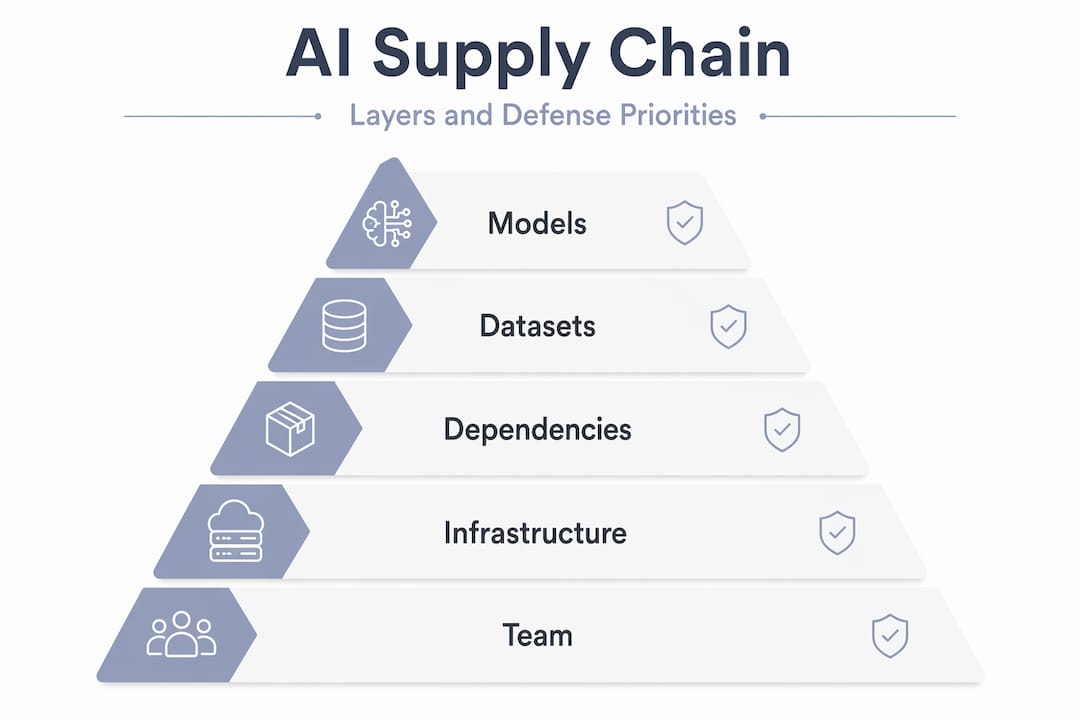
Google’s AI supply chain security guidance frames provenance as the core mechanism for enabling integrity and traceability across AI components. When you know exactly where a model came from and can verify its checksum against a signed record, data poisoning and model tampering become dramatically harder to hide.
The IC3/CSI guidance on AI security reinforces this point directly: organizations must protect data integrity and provenance to prevent attackers from manipulating the learned decision logic embedded in model weights. This is not abstract advice. An adversary who can alter even a small portion of a training dataset can reliably produce a model that behaves correctly on standard benchmarks but fails in specific, attacker-controlled scenarios.
Why this matters: Data poisoning attacks often leave no fingerprints in your model code. The malicious influence is baked into the weights themselves. Provenance is the only way to trace the contamination back to its source.
Practical methods for verifying provenance in your AI pipeline:
- Digital signatures on model artifacts: Sign model weights and datasets at creation time. Verify signatures before loading any artifact into training or inference.
- Software Bill of Materials for AI (AI-SBOMs): Maintain a structured inventory of every component in your AI system, including datasets, model versions, library versions, and their known provenance.
- Cryptographic hashing: Store SHA-256 hashes of every training dataset, model checkpoint, and dependency. Validate hashes at every pipeline stage.
- Immutable audit trails: Log every transformation applied to a dataset or model artifact, from initial download through fine-tuning to deployment.
- Signed container images: Ensure the inference containers your models run in are signed and verified against a trusted registry.
Building solid defense workflows around provenance is not just a technical task. It requires team alignment on what counts as a trusted source, who can approve new dependencies, and what triggers a provenance review.
Pro Tip: Embed provenance checks directly into your CI/CD pipeline as mandatory gates. If a model artifact or dataset cannot be verified against a signed record, the pipeline halts. This makes provenance enforcement automatic rather than dependent on individual vigilance.
Strong provenance controls also reinforce your phishing defenses for AI systems, because many supply chain attacks begin with a social engineering attempt targeting the human operators who manage model repositories and dependency configurations.
Now that we know why provenance matters, what practical steps can your organization take to build supply chain resilience?
Best practices for building resilient and secure AI supply chains
The IC3/CSI AI security guidance is explicit: organizations should treat all AI system components and data resources as supply chain elements, applying the same integrity controls you would to application code. That means provenance tracking, version control, and active monitoring across every layer, not just the code your developers write.
Core steps for securing your AI supply chain:
- Build a complete AI asset inventory. Map every model, dataset, framework, plugin, and external service your AI systems depend on. You cannot protect what you have not cataloged.
- Enforce dependency pinning and lockfiles. Do not allow floating version references in ML frameworks or AI libraries. Pin exact versions and review upgrades deliberately.
- Implement provenance enforcement at every pipeline stage. Require signed artifacts, maintain AI-SBOMs, and validate cryptographic hashes before any component is used in training or inference.
- Apply runtime controls and anomaly detection. Monitor inference behavior for unexpected outputs that might indicate a backdoored model. Set baselines and alert on deviations.
- Run regular vulnerability scans across all AI dependencies. Extend your existing vulnerability management program to cover ML-specific packages, model serialization libraries, and inference infrastructure.
- Conduct vendor and model hub assessments. Before pulling any pre-trained model or dataset from a third-party source, assess the source’s security practices, access controls, and review history.
- Practice least privilege for CI/CD systems. Build environments and deployment pipelines should have minimal access to production systems and secrets. Compromise of a build runner should not mean compromise of production.
Quick wins your team can implement this week:
- Audit your current list of pre-trained models and verify their checksums against official sources
- Review which team members have push access to model repositories and apply the principle of least privilege
- Add SHA-256 validation steps to your existing CI/CD pipeline for model artifacts
- Subscribe to security advisories for your primary ML frameworks (PyTorch, TensorFlow, Hugging Face)
- Review AI attack surface reduction strategies to identify gaps your current controls may be missing
Common pitfalls to avoid:
- Treating model hubs as inherently trustworthy because they are popular
- Skipping provenance checks under time pressure, especially during rapid iteration cycles
- Failing to update model-specific SBOMs when fine-tuning with new data
- Ignoring the human operators who configure and maintain AI pipelines as part of the threat model
Pro Tip: Run vulnerability scans that explicitly include third-party AI components, not just your application code. Most standard SAST tools miss ML-specific risks like unsafe deserialization in model loading routines or outdated GPU driver dependencies.
Securing the AI supply chain is an ongoing process, both mindset and toolset. Here’s why conventional wisdom isn’t enough.
The uncomfortable truth about securing AI supply chains
Here is something most security frameworks understate: traditional code scanning and static analysis tools were built for a world where the risk lives in the code. In AI systems, the risk increasingly lives in the data. A model trained on a clean codebase but a poisoned dataset can behave perfectly in every test environment and fail catastrophically in production in a way that looks like a model quality issue rather than a security incident.
Trust boundaries in AI supply chains span several layers, and integrity breaks can be injected upstream even when your own model code is entirely correct. This is the uncomfortable reality that many organizations are not operationally prepared for.
The systemic risk created by shared open source model and dataset ecosystems deserves more attention. When thousands of organizations fine-tune from the same base model or pull from the same dataset repository, a single compromise upstream creates a systemic vulnerability across all of them simultaneously. The scale of blast radius in AI supply chains has no real analog in traditional software security.
Real resilience requires two things working together: auditable provenance that makes tampering detectable, and a team mindset that anticipates upstream surprises rather than assuming external sources are trustworthy by default. If your organization’s AI agent liability posture does not account for compromised upstream components, you have a gap that technical controls alone cannot close. Pair provenance enforcement with cryptographic trust approaches that extend verification beyond the boundary of your own infrastructure.
How The Pitstop strengthens AI supply chain security
Knowing the risks is only half the equation. Acting on them, systematically and continuously, is where most organizations struggle. At The Pitstop, we built our platform specifically because the security tools designed for traditional software miss the most dangerous surfaces in AI-driven systems.

Our OWASP LLM vulnerability coverage mapping gives AI project managers a direct view of which supply chain and integrity risks their systems are exposed to, mapped to the exact OWASP categories that matter most for LLM deployments. For teams that want to address the human side of supply chain security, our free social engineering assessment tests how well your operators hold up against the phishing and pretexting attacks that often initiate supply chain compromises. And the Infinity Protocol cryptographic protection provides a trust layer that extends verifiable, cryptographic assurance across AI agent and human operator interactions. Run a scan, take the assessment, and see exactly where your supply chain resilience stands today.
Frequently asked questions
What counts as part of the AI supply chain?
It includes models, datasets, dependencies, runtime environments, and third-party tools affecting your AI system. The AI supply chain extends beyond code to models, datasets, runtime, and plugins, making every layer a potential attack surface.
What is the main risk of unsecured AI supply chains?
Attackers can inject vulnerabilities or malicious logic into upstream data, models, or dependencies, leading to breaches even if your own code is not at fault. Supply chain vulnerabilities in LLM applications allow compromised components or datasets to undermine system integrity without triggering typical security alerts.
How does provenance help secure the AI supply chain?
Provenance provides traceable records that let you verify artifacts’ integrity and detect tampering or poisoning early. Provenance is a core mechanism for securing AI supply chains because it makes integrity verifiable at every stage.
What incident shows the risk of compromised AI packages?
The LiteLLM package on PyPI was compromised through a malicious .pth file that automatically exfiltrated credentials and data whenever the interpreter started, affecting any team that installed the package without independent verification.
Why are CI/CD pipelines targeted in AI supply chain attacks?
They control build and deployment for all components, so a compromise here lets attackers inject malicious code or model artifacts across every downstream consumer. Attackers target CI/CD environments specifically because a single build environment compromise multiplies their reach across every organization using the resulting artifacts.