Why Assess Social Engineering: A 2026 Guide for Leaders

Your firewall passed its last audit. Your endpoint detection is current. Your patch cycle is disciplined. And yet, about 60% of breaches still trace back to the human element. That gap exists because most security programs measure what machines do and largely ignore what people do under pressure. Understanding why assess social engineering as a deliberate practice matters is the first step toward closing that gap. This article covers what a real assessment looks like, what it reveals that a phishing click rate never will, and how to put findings to work inside your risk management program.
Table of Contents
- Key takeaways
- Why assess social engineering: what it actually means
- The risk visibility that technical tools miss
- Why 2026 makes social engineering risk assessment more urgent
- Turning assessment results into security improvements
- My take on what organizations consistently get wrong
- Assess, certify, and build lasting resilience with Thepitstop
- FAQ
Key takeaways
| Point | Details |
|---|---|
| Assessments go beyond phishing | Full social engineering assessments test multiple vectors and link failures to attacker objectives, not just email clicks. |
| Human gaps feed your risk register | Assessment findings translate into documented likelihood and impact scenarios for prioritized enterprise risk management. |
| Evolving tactics raise the stakes | Attackers now use public employee data to personalize multi-channel campaigns, making realistic scenario testing urgent. |
| Findings drive targeted fixes | Results identify whether failures stem from policy, behavior, or technical controls so remediation is precise. |
| Continuous cycles build resilience | Single assessments produce data; repeated assess-train-reassess cycles produce measurable reduction in human risk exposure. |
Why assess social engineering: what it actually means
Many security teams conflate social engineering assessment with sending a phishing email and counting who clicked. That is a metric. It is not an assessment. A true social engineering assessment is a controlled, multi-vector exercise designed to mimic real attacker behavior across the full range of human attack surfaces.
Those vectors include:
- Phishing (email-based deception targeting credentials or malware delivery)
- Vishing (voice calls impersonating IT support, vendors, or executives)
- Smishing (SMS-based lures, increasingly used for MFA bypass)
- Physical access attempts (tailgating, badge cloning scenarios, hostile visitor tests)
- Impersonation (in-person or remote identity fraud targeting help desks or approval workflows)
The distinction matters operationally. Phishing simulations produce limited metrics like click rates, but they do not tell you whether an attacker could have actually achieved their objective after that click. A full assessment traces the path: the lure worked, the credential was surrendered, the help desk reset the account without proper verification, and access was granted. That chain of failures is what leaders need to see.
Pro Tip: Before scoping your assessment, define attacker objectives first. Ask: “What would a motivated adversary actually want?” Then build scenarios that test whether your people and processes would stop them from getting it.
Ethical controls are non-negotiable. Every scenario must operate within a written rules of engagement document that defines authorized targets, off-limits personnel, and escalation procedures. Without that structure, you are not running an assessment. You are running an incident.
The risk visibility that technical tools miss
Technical vulnerability scanners are excellent at what they do. They find unpatched software, misconfigured services, and exposed ports. What they cannot find is the accounts payable specialist who will wire funds to a fraudulent vendor after a convincing phone call, or the help desk agent who bypasses identity verification for a caller who sounds frustrated and authoritative.
Social engineering exploits seams in approval and verification processes, including help desk workflows, HR and finance approval chains, and contractor access procedures. These are business process vulnerabilities. No scanner touches them.
“The human element is not a soft problem. It is a documented, measurable risk vector that belongs in your enterprise risk register with the same rigor you apply to CVEs.”
NIST recommends integrating assessment results as documented likelihood and impact scenarios directly into enterprise risk registers. That framing transforms a narrative finding (“employees clicked on phishing emails”) into a prioritized risk item with a probability estimate, a potential business impact, and assigned ownership for remediation. That is the difference between an awareness report and a risk management artifact.
The importance of social engineering assessment becomes clearest when you map findings to control layers. A well-run assessment will tell you whether a failure was rooted in a policy that nobody follows, a behavior under pressure that training never addressed, or a technical control that was bypassed because no process enforced it. Those three categories require entirely different remediation responses. Bundling them into “security awareness training” wastes both budget and time.
Understanding trust and permission reach is equally critical. When a trusted employee or system is compromised through social engineering, the attacker inherits that entity’s permissions and relationships. Assessments that probe identity verification gaps and least-privilege enforcement reveal how far that inherited access could travel, which is often much further than leadership assumes.

Why 2026 makes social engineering risk assessment more urgent
Attacker tradecraft has shifted. The reconnaissance phase that once took days of manual work now takes minutes. Publicly available data from LinkedIn profiles, corporate websites, conference speaker lists, and data broker records allows attackers to build detailed target profiles before sending a single message.
Here is what that looks like in practice for a mid-size organization:
- An attacker identifies a finance director’s name, direct report structure, and current vendor relationships from public sources.
- They craft an email impersonating the CFO, referencing a real vendor by name and citing a time-sensitive payment request.
- They follow up with a phone call from a spoofed number, applying urgency and authority pressure.
- The finance director, working under deadline pressure, approves the transfer.
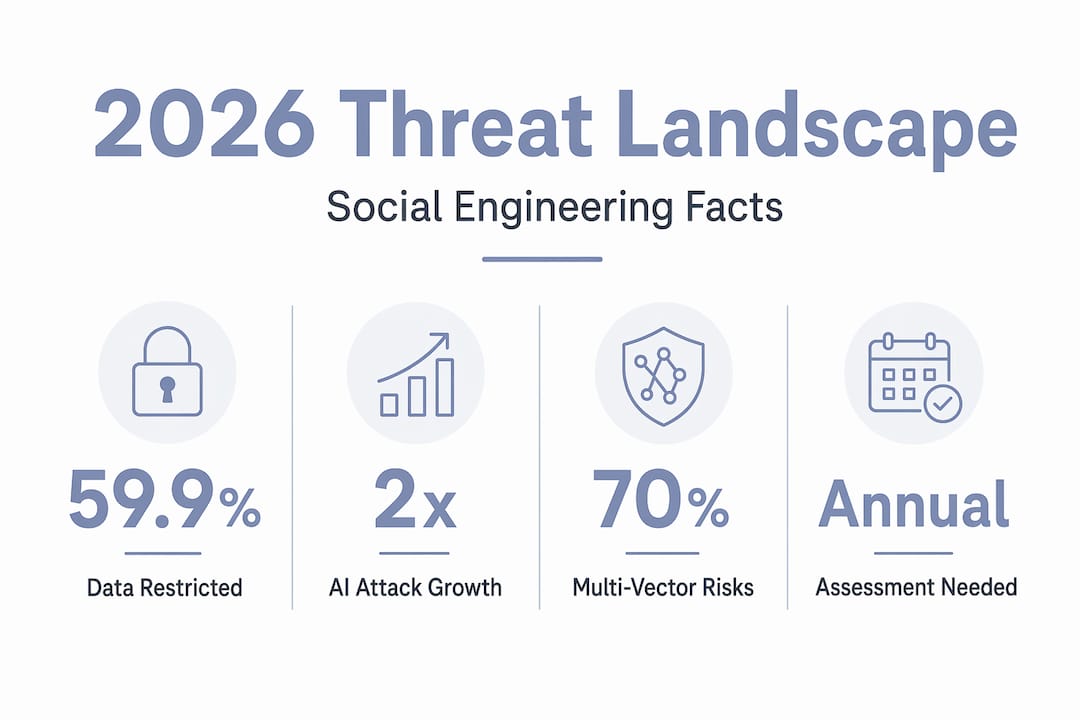
About 59.9% of organizations already limit employee data exposure in recognition of exactly this threat pattern. The ones that do not are handing attackers a free reconnaissance platform. Social engineering risk assessment needs to account for this reality. Scenarios built around generic phishing templates do not reflect how targeted attacks actually operate in 2026.
Pro Tip: Request an open-source intelligence (OSINT) component as part of your assessment scope. A good assessor will show you exactly what an attacker could learn about your organization and key personnel before ever sending a message. That pre-attack view is often the most sobering deliverable in the entire report.
The defense guide for phishing in 2026 developed by Thepitstop reflects this reality, showing how AI-assisted attacks demand a new level of scenario realism in testing programs.
Turning assessment results into security improvements
Assessment findings without a remediation plan are just documentation of failure. The real value of social engineering testing is what happens after the report lands.
A structured output from any credible assessment should separate findings into three distinct categories:
| Finding type | What it reveals | Remediation response |
|---|---|---|
| Behavior gap | Employees made poor decisions under simulated pressure | Targeted, scenario-based training with feedback loops |
| Process gap | Approval or verification workflows were bypassed | Process redesign, mandatory verification checkpoints |
| Technical gap | Controls could be circumvented by social means | Technical hardening, enforcement mechanisms, monitoring rules |
Assessment reports identify which controls failed and differentiate the root cause precisely. That granularity is what makes them worth the investment. Without it, remediation defaults to the path of least resistance, which is usually another round of security awareness training that addresses behavior gaps but leaves process and technical gaps untouched.
Specific improvements that assessments consistently surface include:
- Hardening help desk verification procedures with out-of-band identity confirmation
- Adding callback verification requirements for financial wire requests above set thresholds
- Introducing stepped approval chains that interrupt rushed single-approver decisions
- Improving physical access controls at entry points where tailgating attempts succeeded
The benefits of social engineering testing compound over time. A single assessment produces a snapshot. A program built on the assess-train-reassess cycle produces a trend line. That trend line is what you bring to the board to demonstrate measurable reduction in human risk exposure. Translating findings into repeatable risk scenarios with assigned likelihood and impact ratings enables continuous monitoring, not just periodic reporting.
Thepitstop’s approach to building a social engineering defense workflow provides a practical structure for teams that want to operationalize this cycle rather than treat assessment as a point-in-time project.
My take on what organizations consistently get wrong
I’ve watched security teams invest in assessments, receive solid reports, and then do nothing with the findings that actually mattered. The phishing click rate gets shared with leadership. The process gap findings sit in an appendix. Six months later, the same verification seams are exploited in a real incident.
The most dangerous assumption in this space is that social engineering risk lives in the inbox. In my experience, the highest-value findings almost always come from business process touchpoints that the security team did not own. Help desks, finance workflows, facilities access. These are operated by people who receive minimal security oversight and are structurally rewarded for being helpful and fast. That is a perfect attacker surface.
What I’ve found is that leaders who treat assessment results as a management tool rather than a compliance artifact drive far better outcomes. Social engineering testing is a measurement discipline that tells you whether awareness has actually translated into behavioral and process resilience. When the CISO uses that data to hold process owners accountable for specific verification failures, the culture changes. When the data disappears into a security team folder, nothing changes.
The uncomfortable reality is that most organizations’ trust boundaries are far more permeable than their technical architecture suggests. A well-scoped assessment will show you exactly where those seams are. What you do with that knowledge is the real test.
— Nicholas
Assess, certify, and build lasting resilience with Thepitstop
Thepitstop built its SERA™ Certification specifically for organizations that want to move beyond one-off tests toward a recognized, repeatable social engineering resilience standard. The certification program structures your assessment program, validates your organization’s human and process controls, and produces a credential that communicates security posture credibly to partners and stakeholders. For teams also managing AI agent risk, Thepitstop’s free security scan extends that coverage across your full attack surface. Both tools are built to integrate with existing risk management frameworks, so findings feed directly into the prioritization work your security program already owns.
FAQ
What is a social engineering assessment?
A social engineering assessment is a controlled, multi-vector test that simulates attacker behavior across phishing, vishing, physical access attempts, and impersonation to identify human, process, and physical security weaknesses. Unlike single-channel phishing simulations, it links test outcomes to attacker objectives and documents which control layers failed.
Why is assessing social engineering risk different from running phishing tests?
Phishing tests measure click rates on a single channel. A full social engineering risk assessment traces whether an attacker could have achieved a real objective across multiple vectors, identifies root causes in behavior, process, and technical controls, and produces findings that belong in an enterprise risk register.
How often should organizations evaluate social engineering vulnerabilities?
Most security frameworks recommend assessing at least annually, with targeted reassessments after significant organizational changes such as acquisitions, workforce restructuring, or new system deployments. The more effective model is a continuous assess-train-reassess cycle that produces trend data rather than isolated snapshots.
What do assessment findings actually change in an organization?
Findings drive three categories of improvement: targeted behavior training for decision-making gaps, process redesign for bypassed verification workflows, and technical hardening for controls that social means circumvented. Separating these categories prevents organizations from defaulting to training as the answer to every finding.
How do you evaluate social engineering readiness without disrupting operations?
Effective assessments operate under a written rules of engagement document that defines authorized targets, scenario boundaries, and escalation procedures. Vulnerability assessment services and professional assessment providers use these controls to run realistic tests without creating genuine security incidents or operational disruption.