Why AI security matters: risks, breaches, and resilience

A stop sign misclassified as a yield sign. A medical scan that misses a malignancy. These aren’t science fiction scenarios — they’re documented consequences of adversarial input perturbations that require no sophisticated attack infrastructure, just a small, calculated change to the data an AI system sees. For cybersecurity professionals managing AI deployments, this is the uncomfortable reality: the most dangerous threats to AI are often the quietest ones.
Table of Contents
- Understanding the new threat landscape: Why AI needs security
- The real risks: Attack types and how they breach AI systems
- AI-generated code: Why it’s a double-edged sword for security
- Building security and resilience: Best practices and frameworks
- Beyond controls: Why AI security is about resilience, not just prevention
- Partner with The Pitstop: Upgrade your AI security and resilience
- Frequently asked questions
Key Takeaways
| Point | Details |
|---|---|
| AI faces unique threats | AI systems are vulnerable to attacks that traditional software rarely encounters, such as subtle input manipulation and multi-agent leaks. |
| Data poisoning is hard to spot | Just a handful of tampered samples can impact models for months before detection, making ongoing vigilance essential. |
| AI-generated code increases risk | Relying solely on AI for code creates more vulnerabilities and critical bugs compared to human developers. |
| Frameworks enable resilience | Implementing risk management frameworks and continuous human oversight builds true organizational security resilience. |
| Resilience trumps prevention | No control prevents every attack, so resilient teams that can detect, adapt, and recover are vital. |
Understanding the new threat landscape: Why AI needs security
AI systems don’t operate on fixed rules like traditional software. They learn patterns from data, and that learning process is both their strength and their greatest vulnerability. When you write a rule-based firewall policy, you know exactly what it will do. When you deploy a machine learning model, its behavior emerges from billions of weighted parameters shaped by training data you may never fully audit. That’s a fundamentally different attack surface.
The distinction matters because attackers have figured this out. They aren’t just trying to break your perimeter. They’re targeting the learning process itself, the data pipelines feeding your models, the prompts your agents receive, and the trust relationships between AI components. AI agent security isn’t a niche concern anymore — it’s the central battleground for enterprise risk.
Consider the attack categories reshaping this space:
- Adversarial attacks: Carefully crafted inputs that exploit blind spots in a model’s decision boundary, causing confident wrong predictions
- Data poisoning: Corrupting training data to embed backdoors or bias model behavior before deployment
- Prompt injection: Hijacking AI agent instructions through malicious content embedded in user inputs or external data sources
- Jailbreaks: Bypassing safety guardrails through clever conversational strategies, often across multiple turns
- Supply chain attacks: Compromising third-party models, datasets, or AI libraries before they reach your environment
What makes these threats distinct is that small input perturbations cause erroneous outputs that a model delivers with high confidence. Standard monitoring alerts you to system crashes or anomalous traffic, not to a model quietly misclassifying inputs it was designed to handle.
The adoption stakes are enormous. According to recent research, security concerns are the #1 barrier to scaling agentic AI at 62%, ahead of cost, talent gaps, and regulatory compliance. Organizations that solve this aren’t just safer — they gain a genuine competitive advantage in deploying AI at scale.
Proper AI governance for enterprises requires frameworks that go beyond patching CVEs. You need policies for model provenance, data lineage, agent permissions, and human override mechanisms built into your security culture from day one.
Pro Tip: When evaluating AI vendors or open-source models, treat model cards and training data documentation as security artifacts, not marketing materials. Missing provenance is a red flag.
The real risks: Attack types and how they breach AI systems
Knowing that threats exist is one thing. Understanding exactly how attackers execute them, and why your existing controls likely miss them, is where the real work begins.
Adversarial attacks have moved well beyond academic proof-of-concept. In computer vision systems, imperceptible pixel-level noise causes misclassifications with potentially fatal consequences in autonomous vehicles or medical imaging. In natural language processing, subtle word substitutions flip sentiment analysis or bypass content moderation. These attacks can be generated algorithmically, meaning adversaries don’t need deep AI expertise to deploy them at scale.
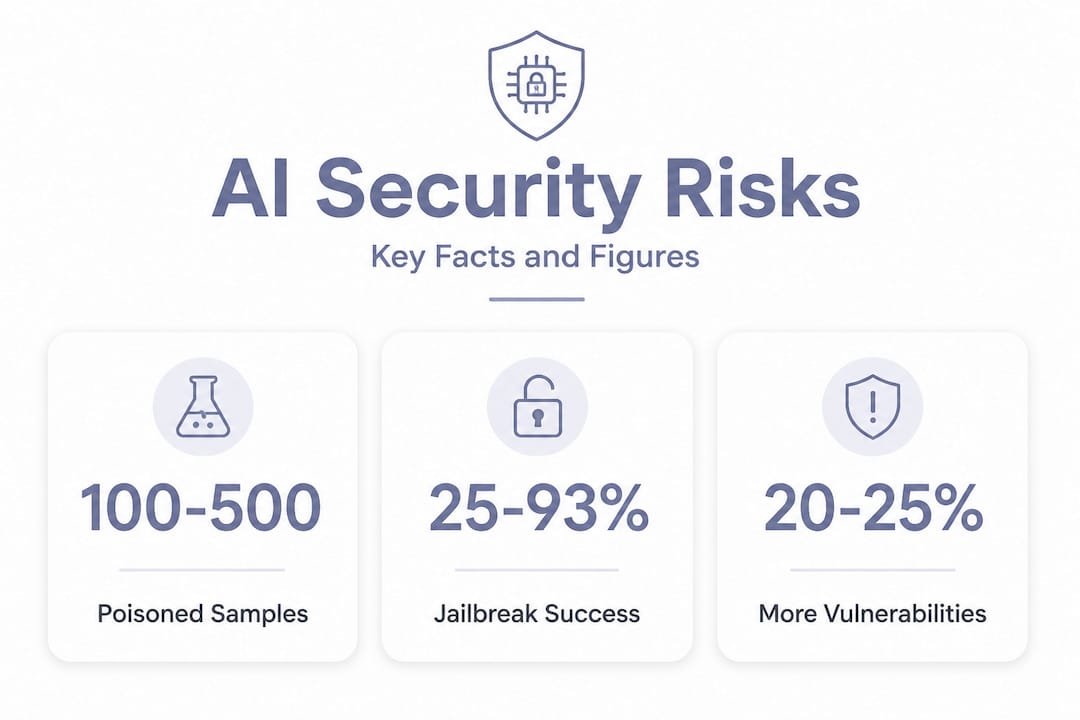
Data poisoning is arguably the most insidious category. Poisoned training samples as few as 100 to 500 examples can compromise AI models with success rates at or above 60% across architectures including CNNs, LLMs, and federated learning systems. The attacker doesn’t need access to your production system. They just need to influence your training pipeline, whether through contributed datasets, fine-tuning data, or feedback loops that incorporate user interactions.

Multi-turn jailbreaks represent a rapidly evolving threat. Open-weight LLMs face 25.86% to 92.78% jailbreak success rates in multi-turn conversations, a figure 2x to 10x higher than single-turn attacks. Each conversational turn lets the attacker probe and refine their approach. Enterprise deployments using AI agents for customer service, internal helpdesks, or code review are all exposed.
One of the most underappreciated risks sits inside your own AI infrastructure. Research shows that sensitive data leakage in multi-agent LLM systems occurs primarily through internal channels, specifically inter-agent messages, accounting for 68.8% of leakage events. You’re focused on external exfiltration. The real exposure is happening in the message passing between your own agents.
Here’s how the major attack types compare across key risk dimensions:
| Attack type | Detection difficulty | Deployment impact | Typical dwell time |
|---|---|---|---|
| Adversarial input | High | Immediate, targeted | Real-time |
| Data poisoning | Very high | Broad, persistent | 6 to 12 months |
| Prompt injection | Medium | Varies by agent scope | Session-based |
| Multi-turn jailbreak | Medium | Policy bypass, data exposure | Hours to days |
| Inter-agent data leak | High | Internal confidentiality breach | Ongoing |
Reviewing AI agent liability research should be on every security team’s reading list before your next agentic deployment. Understanding where liability sits when an agent misbehaves shapes how you architect controls and escalation paths.
“The most dangerous AI attacks don’t announce themselves. They operate within normal-looking interactions, exploiting the statistical nature of machine learning to achieve outcomes that no rule-based system would allow.”
Here’s a practical prioritization framework for AI-specific threat response:
- Map your AI data pipelines and identify every ingestion point where external data touches model training or fine-tuning
- Instrument inter-agent communication with logging and anomaly detection, not just API gateway monitoring
- Red team your agents using multi-turn jailbreak techniques before production deployment
- Establish baseline behavior profiles for each AI component so deviations trigger alerts
- Implement human-in-the-loop checkpoints for high-stakes AI decisions, not just the ones that feel obvious
AI-generated code: Why it’s a double-edged sword for security
Your AI security strategy can’t stop at the model layer. The code your developers write with AI assistance introduces its own category of vulnerability, and the numbers are striking.
AI-generated code carries a 20 to 25% higher likelihood of security vulnerabilities and produces 1.5 to 1.7 times more critical bugs per pull request compared to human-written code. Developers using AI coding assistants ship faster. They also ship riskier code, often without realizing it.
The core problem is that AI code generators optimize for functional correctness, not security. They’ll produce working code that passes unit tests while embedding patterns that experienced security engineers would immediately flag.
The most common categories of AI-generated code risks include:
- Missing security checks: Authentication bypasses, improper input validation, and insufficient authorization logic that the code assistant treats as optional
- Hardcoded secrets: API keys, database credentials, and tokens embedded directly in source code rather than referenced from secure vaults
- Unsafe dependencies: Outdated or vulnerable libraries pulled in because the training data reflected older patterns
- Race conditions and logic flaws: Subtle timing vulnerabilities and business logic errors that emerge from code generation without full context
- Overprivileged functions: Code that requests or assumes broad permissions because the AI defaulted to the most capable approach
Here’s the security risk profile when comparing AI-assisted and human-written code:
| Risk category | AI-generated code | Human-written code |
|---|---|---|
| Security vulnerability rate | 20 to 25% higher | Baseline |
| Critical bugs per PR | 1.5x to 1.7x more | Baseline |
| Secret exposure incidents | Significantly elevated | Lower with review |
| Dependency currency | Often outdated | Manually managed |
| Security check completeness | Frequently incomplete | Context-dependent |
The speed advantage of AI-assisted development compounds the risk. When a developer can generate a working API endpoint in minutes, the pressure to ship overrides the instinct to review. Security teams that don’t adapt their code review processes and tooling to account for AI-generated patterns will find themselves permanently behind.
Pro Tip: Run your AI-generated code through a dedicated AI code security scan before any pull request merges. Static analysis tools trained on human code patterns miss AI-specific vulnerability signatures — you need tooling built for this specific threat model.
Fast development cycles also mean fewer opportunities for manual audit. Security teams need automated scanning integrated directly into CI/CD pipelines, with specific rule sets targeting the vulnerability patterns most common in AI-generated output. This isn’t about slowing development down — it’s about making security invisible in the workflow.
Building security and resilience: Best practices and frameworks
Knowing the threat landscape and having a framework to respond to it are two different things. Here’s how security teams can move from awareness to operational readiness.
The NIST AI RMF provides the most robust publicly available structure for AI risk management, built around four functions: Govern, Map, Measure, and Manage. Each function addresses a distinct layer of organizational AI risk.
Govern establishes the policies, roles, and accountability structures that make AI risk management repeatable. This means defining who owns AI security decisions, what approval processes exist for deploying new models, and how incidents involving AI are reported and escalated.
Map requires you to inventory your AI systems, understand their context of use, and identify potential harms. For cybersecurity teams, this translates directly into threat modeling exercises for each AI component in your stack.
Measure introduces metrics and monitoring to assess AI behavior against expected performance. Beyond accuracy metrics, security teams need behavioral baselines, anomaly thresholds, and red team exercise results tracked over time.
Manage closes the loop with response plans, mitigation strategies, and continuous improvement processes. This is where your incident response playbooks for AI-specific events live.
Alongside the NIST framework, here are the practical steps cybersecurity professionals should prioritize today:
- Monitor internal agent communications, not just external API traffic. Inter-agent message logging is a gap in most enterprise SIEM configurations
- Implement cryptographic trust mechanisms for agent-to-agent communication so that rogue or compromised agents can be identified and isolated
- Run regular human resilience assessments alongside technical controls. Social engineering targeting operators of AI systems is increasing significantly
- Conduct adversarial testing on AI models quarterly, not just at initial deployment
- Build model version control into your security processes so you can roll back to known-good states after a poisoning event
| Security practice | Primary benefit | Implementation priority |
|---|---|---|
| NIST AI RMF adoption | Structured governance | High |
| Inter-agent communication monitoring | Insider data leak prevention | High |
| Adversarial red teaming | Proactive vulnerability discovery | Medium |
| Human resilience training | Social engineering defense | High |
| AI code security scanning | Vulnerability reduction in deployment | High |
The AI liability best practices outlined in structured guidance make clear that governance and technical controls are inseparable. You can’t manage liability for an AI system you haven’t mapped and measured.
Pro Tip: Don’t wait for a formal framework rollout to start monitoring agent behavior. Deploy logging on your highest-risk agents first, even if your governance structure isn’t finalized. Imperfect visibility beats no visibility every time.
Beyond controls: Why AI security is about resilience, not just prevention
Here’s an uncomfortable truth that most AI security guidance glosses over: prevention will fail. Not because the tools are inadequate or your team isn’t skilled enough, but because adversarial AI threats are adaptive by nature. Every control you deploy teaches adversaries what to avoid next time.
The real strategic advantage doesn’t come from building higher walls. It comes from building organizations that absorb and recover from breaches without catastrophic consequence. This is a fundamentally different security posture, and most enterprise security programs haven’t made the shift.
Consider where actual critical breaches originate. It’s rarely the sophisticated nation-state adversary with zero-day exploits. It’s the AI agent that was given slightly too many permissions. The developer who trusted AI-generated authentication code without reviewing it. The operator who didn’t question why the AI was requesting access to a dataset outside its scope. These are day-to-day AI decisions, not exotic attack scenarios, and they represent the real threat surface.
Cultural resilience means empowering every person who interacts with AI systems to challenge, question, and intervene. It means training operators to recognize when an AI agent’s behavior is off, even slightly. It means creating psychological safety for employees to raise concerns about AI outputs without fear of being dismissed as obstructing progress.
The organizations that will weather the next generation of AI threats aren’t necessarily the ones with the most sophisticated detection tooling. They’re the ones where a junior analyst feels empowered to pause an automated workflow because something seems wrong. That human judgment, cultivated and trusted, is something adversaries cannot adversarially train against.
Read the full perspective on agent liability and resilience to understand how organizational culture intersects with technical architecture in building durable AI security programs.
Partner with The Pitstop: Upgrade your AI security and resilience
The risks covered in this guide aren’t abstract. They’re happening in production AI environments right now, and most organizations are working from incomplete visibility and outdated frameworks.
Thepitstop.ai was built specifically for this moment. The platform offers automated tools that assess your AI agents for prompt injection, data exfiltration risks, and supply chain vulnerabilities, while simultaneously testing your human operators against phishing and social engineering scenarios. You can earn the SERA™ Certification to formally credential your resilience against social engineering. The Infinity Protocol™ establishes cryptographic trust between agents and humans, closing the inter-agent communication gap. And the SIEM Dashboard gives your team unified visibility across your full AI attack surface. Start with the free scans and build from there.
Frequently asked questions
What makes AI security risks different from traditional IT security threats?
AI systems can be compromised by subtle changes to training data or inputs, causing unexpected behaviors not seen in traditional software. Unlike rule-based systems, AI erroneous outputs can emerge from statistically normal-looking inputs, making detection with conventional monitoring tools extremely difficult.
Why is it difficult to detect data poisoning attacks in AI models?
Data poisoning can succeed with as few as 100 to 500 altered samples and may remain dormant for months before the compromised behavior surfaces in production. Poisoning success rates of 60% or higher across major architectures mean attackers need very little access to cause significant harm.
How does AI-generated code impact cybersecurity?
AI-generated code carries a 20 to 25% higher likelihood of security vulnerabilities and 1.5 to 1.7 times more critical bugs per pull request than human-written code, driven by optimization for functional output over security-conscious design.
What AI risk management framework is recommended for organizations?
The NIST AI RMF is the recommended starting point, providing four structured functions: Govern, Map, Measure, and Manage, each addressing a distinct layer of AI risk across the organization.
Why is human resilience critical in AI security?
Automated security tools cannot catch every AI misbehavior, especially when attacks exploit subtle behavioral drift or social engineering against operators. Human judgment, trained to recognize when AI systems are acting outside expected parameters, remains the last line of defense when technical controls fall short.