What Is Phishing Simulation: a 2026 Guide for Leaders

Phishing simulation is one of the most direct tools available for measuring where your human defenses actually break down. Yet many organizations either skip it entirely or run a single campaign once a year and call it done. This guide explains what phishing simulation is, how it works operationally, and how to build a program that produces real behavior change rather than just a click-rate report. Whether you are assessing your current program or starting from scratch, the details here apply directly to what you are trying to accomplish.
Table of Contents
- Key takeaways
- What phishing simulation means in practice
- How phishing simulations work
- Channel comparison: email, voice, and SMS
- Benefits of running phishing simulations
- Practical tips for running an effective program
- My take on what most programs get wrong
- How Thepitstop strengthens your simulation efforts
- FAQ
Key takeaways
| Point | Details |
|---|---|
| Simulation is not optional | Phishing simulations identify human vulnerabilities before attackers do, making them a proactive security control. |
| Multi-channel coverage matters | Voice and SMS phishing simulations show 40% higher click rates than email, so email-only programs leave measurable gaps. |
| Behavior change is the real goal | Reducing click rates is secondary. The primary goal is faster reporting, higher reporting rates, and lasting behavioral change. |
| Programs must be continuous | A single simulation tells you almost nothing. Repeatable, phased programs generate the data needed to actually reduce risk. |
| Measurement drives improvement | KPIs like time-to-report and reporting volume matter more than click rates when optimizing program effectiveness. |
What phishing simulation means in practice
Phishing simulation, also called simulated phishing or phishing attack simulation, is a controlled security exercise in which an organization sends realistic but fake phishing messages to its own employees to test how they respond. The industry term for the broader practice is “security awareness training,” and phishing simulation is its most operationally rigorous component.
This is not a prank. It is a structured measurement tool. The goal is not to catch employees making mistakes. The goal is to surface vulnerabilities, improve reporting behavior, and give security teams the data they need to target training where it matters most. Phishing simulations help identify human vulnerabilities before real attackers exploit them, which positions them as a proactive control rather than a reactive one.

Understanding what is social engineering helps put simulation in context. Social engineering is the practice of manipulating people rather than systems to gain unauthorized access or information. Phishing is the most common form. Simulations test whether your employees can recognize and resist that manipulation under realistic conditions.
A well-designed phishing simulation program serves four distinct goals:
- Detection accuracy: Measuring how many employees click on simulated phishing links or submit credentials
- Reporting behavior: Tracking how many employees report suspicious messages and how quickly
- Behavior change: Using simulation results to deliver targeted micro-learning that shifts long-term habits
- Risk reduction: Reducing the probability that a real phishing attack leads to a breach or financial loss
Modern programs also extend well beyond email. Simulated vishing (voice phishing) and smishing (SMS phishing) campaigns address attacker methods that purely email-focused programs miss entirely. The training focuses on helping staff recognize and report phishing across all channels, not just their inboxes.
How phishing simulations work
The simulation lifecycle follows four repeatable phases: strategic planning, attack crafting, controlled deployment, and outcome measurement. Each phase feeds into the next, and the program only generates useful data when all four are executed consistently over time.
-
Strategic planning. Define your objectives before building anything. Decide which employee groups to target, what attacker scenarios are most relevant to your industry, and how you will measure success. Planning with business context means choosing scenarios that reflect actual threats your organization faces, not generic templates.
-
Attack crafting. Realistic lures are what separate useful simulations from ones employees immediately ignore. Effective phishing tests use believable sender names, credible pretexts, and formatting that matches legitimate communications employees receive daily. The DOJ platform supports realistic email crafting alongside target management and time-bound deployment, which reflects how seriously well-resourced programs treat this phase.
-
Controlled deployment. Send campaigns in waves rather than blasting the entire organization at once. This prevents word from spreading across teams before others have been tested, and it lets you compare results across departments and roles. Set campaign parameters carefully: frequency, timing, and channel mix all affect both realism and fairness to employees.
-
Outcome measurement and learning. This is where most programs leave value on the table. Tracking who clicked matters, but reducing time-to-report and increasing reporting rates using integrated alert buttons matters more for actual defense. When an employee reports a simulation quickly, it validates that your detection culture is working. Micro-learning triggered immediately after a failed test reinforces the lesson at the moment it is most likely to stick.
Pro Tip: Add a one-click “Report Phishing” button directly to your email client rather than asking employees to forward suspicious messages manually. Frictionless reporting dramatically increases reporting volume and cuts the time between detection and defender response.
Channel comparison: email, voice, and SMS
Most phishing awareness programs still center almost entirely on email. That was a reasonable starting point five years ago. It is a meaningful gap today.
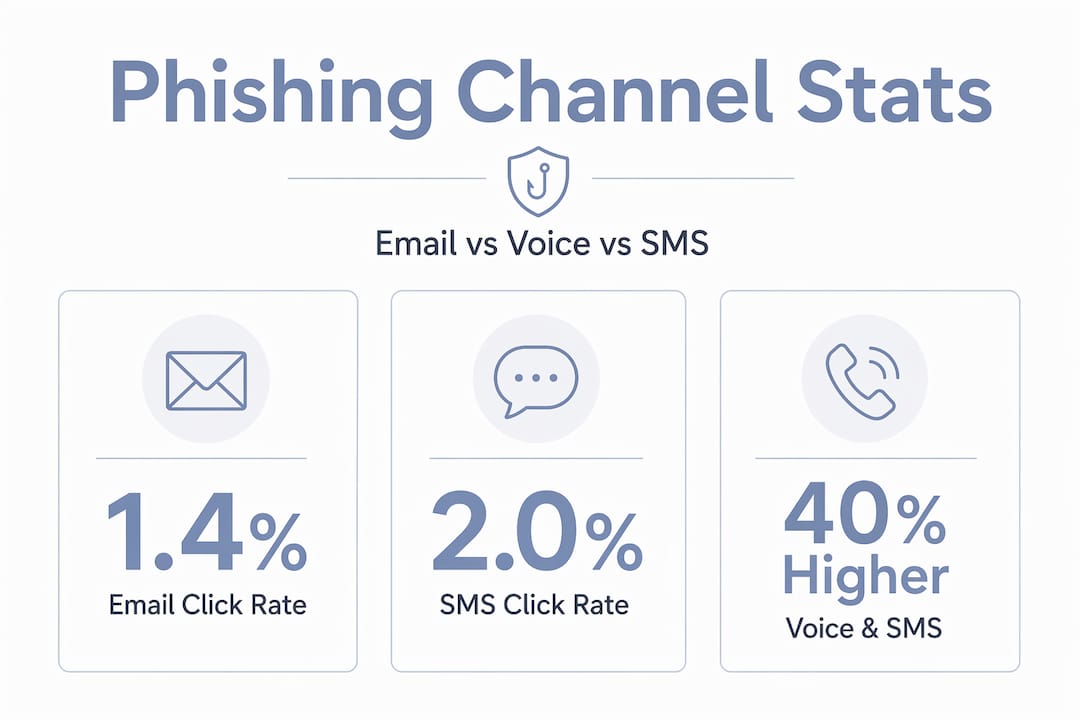
| Channel | Median click rate | Key risk | Simulation consideration |
|---|---|---|---|
| Email phishing | 1.4% | Volume and scale | Most mature tooling available |
| Voice (vishing) | 2%+ | High persuasion under time pressure | Requires script design and call infrastructure |
| SMS (smishing) | 2%+ | Mobile context reduces scrutiny | Link-based lures work differently on mobile |
Voice and SMS simulations carry a 40% higher median click rate than email simulations. That gap reflects something real about how people process these channels. Phone calls create urgency. Text messages arrive in a personal space. Both conditions reduce the critical thinking that protects people in lower-stakes email interactions.
Real attackers already know this. Multi-channel synchronized attacks are standard practice in advanced phishing campaigns. An attacker might send an email, follow up with a text, and then call the target, each message reinforcing the others. An organization running email-only simulations is measuring its defenses against a version of the threat that no longer reflects current attacker behavior.
Expanding your program to include voice and SMS simulations is not just about covering more channels. It is about measuring phishing risk comprehensively in a way that actually reflects the threat your employees face. The tooling is more specialized, but the investment is justified by the risk data it produces. You can learn more about the full range of techniques in play by reviewing the types of phishing methods your employees are most likely to encounter.
Benefits of running phishing simulations
The case for phishing simulation training comes down to one simple premise: employees cannot defend against something they have never encountered. Simulations create safe practice conditions where a mistake costs nothing but teaches a great deal.
Here is what consistent simulation programs actually produce:
- Vulnerability identification before a breach. Simulations expose which departments, roles, or individuals are highest risk. A finance team that consistently fails payment-themed lures tells you exactly where to focus reinforcement training.
- Measurable behavior change. Organizations that run phishing simulation programs over 12 months typically see significant drops in click rates. More importantly, they see increased reporting rates, which means employees are actively participating in defense rather than passively avoiding mistakes.
- Safe failure. Clicking a simulated phishing link carries no real consequence. Clicking a real one can cost your organization millions. Simulations let your employees make and learn from mistakes in a zero-stakes environment.
- Training precision. Without simulation data, security training is generic. With it, you can send targeted micro-learning to exactly the employees who need it, based on what they actually did wrong.
- Compliance support. Many regulatory frameworks now recognize simulated phishing exercises as part of a defensible security awareness program.
Pro Tip: Track your reporting rate alongside your click rate. A program where 60% of employees report the simulation is more valuable than one where only 10% click it. Reporting speed and volume are what feed your incident response team in a real attack.
Practical tips for running an effective program
Moving from understanding phishing simulation to actually running one requires deliberate decisions at each stage. These recommendations reflect what separates programs that shift behavior from ones that just generate a quarterly report.
- Set clear, measurable objectives from day one. Know whether you are optimizing for lower click rates, higher reporting rates, better reporting speed, or some combination. Vague goals produce vague results.
- Craft scenarios that reflect your actual threat environment. A healthcare organization should simulate insurance portals and patient record notifications. A financial services firm should test wire transfer approvals and compliance alerts. Relevance increases both realism and learning transfer.
- Integrate automated feedback loops. When an employee clicks a simulated link, they should immediately receive a short, non-shaming explainer that shows them what the lure contained and how to spot it next time. Delayed feedback loses most of its value.
- Run campaigns continuously, not annually. A repeatable simulation program with structured stages produces data you can actually trend over time. One campaign per year produces a snapshot, not a program.
- Use advisory support when available. Programs like the IMDA Singapore initiative offer simulated phishing campaigns plus post-assessment advisory sessions, which demonstrates that expert interpretation of results is as valuable as the data itself.
- Build a resilient simulation workflow that connects your simulation platform to your incident response process so real reports and simulated ones flow through the same channels.
My take on what most programs get wrong
I have watched a lot of phishing simulation programs get rolled out with good intentions and produce almost no lasting change. The most common failure is not technical. It is cultural.
Most programs measure who clicked and then move on. The click rate becomes the headline metric, and if it goes down year over year, leadership declares success. But a lower click rate does not mean your organization is more resilient. It may just mean employees have learned to ignore suspicious links without actually understanding why those links were suspicious, or how to report them effectively.
What I have found actually matters is the reporting side. When your employees start actively flagging suspicious messages, even when they are not sure if it is real, that is when you know the program is working. That behavior is the one that actually protects you during a real attack. Click rates are a lagging indicator of a single decision. Reporting rates are a leading indicator of organizational vigilance.
The other thing I have seen teams consistently underestimate is the multi-channel threat gap. Running email simulations and calling it done is like testing your building’s locks but leaving the windows open. Voice and SMS are where attackers are increasingly successful, and most organizations have never tested their employees on those channels at all.
The uncomfortable truth about phishing simulation is that it requires ongoing commitment. Not a campaign. A program. That distinction is what separates organizations that reduce real risk from ones that produce compliance documentation.
— Nicholas
How Thepitstop strengthens your simulation efforts
Phishing simulations are most effective when they connect to a broader security posture that covers both your human operators and the AI agents working alongside them. Thepitstop was built specifically for that environment. The SERA™ Certification is a free social engineering resilience assessment that gives individuals and teams a credentialed benchmark for how they perform against real-world manipulation tactics, including phishing. For organizations looking to assess the full attack surface, the Free AI Agent Security Scan evaluates both machine and human vulnerabilities in one place. Start with a free phishing awareness check to see where your team stands before your next simulation campaign.
FAQ
What is phishing simulation in simple terms?
Phishing simulation is a controlled exercise where an organization sends realistic fake phishing messages to its own employees to test whether they recognize and report them. The goal is behavior change and risk reduction, not punishment.
How does phishing simulation work step by step?
A phishing simulation follows four phases: planning objectives, crafting realistic attack scenarios, deploying campaigns to targeted employee groups, and measuring outcomes including click rates and reporting rates. Follow-up micro-learning is triggered based on individual results.
What are the main benefits of phishing simulation?
The core benefits include identifying vulnerable employees before attackers do, improving reporting rates and detection culture, enabling targeted training based on real behavior data, and supporting regulatory compliance requirements.
Is email the only channel for phishing simulations?
No. Voice and SMS simulations are increasingly important because phone-based phishing carries higher click rates than email and better reflects how modern attackers coordinate multi-channel campaigns.
How often should an organization run phishing simulations?
Organizations should run phishing simulations continuously throughout the year rather than once annually. A repeatable simulation program generates trend data over time and produces measurable, lasting behavior change that a single annual campaign cannot achieve.