What Is Ethical AI Usage? a Guide for Professionals

Ethical AI usage is the practice of designing, developing, and deploying artificial intelligence systems in compliance with human rights, fairness, transparency, and accountability principles throughout the entire AI lifecycle. The industry standard term for this discipline is responsible AI, though “ethical AI usage” captures the same core mandate: AI systems must not cause harm, must be explainable, and must remain under meaningful human control. The UNESCO Recommendation on AI Ethics sets the global normative standard, framing ethical AI as a governance problem requiring auditable systems, impact assessments, and lifecycle oversight. The NIST AI Risk Management Framework (AI RMF 1.0) translates those principles into operational governance. Together, these two frameworks define what constitutes ethical AI for practitioners working across technology, policy, and ethics today.
What is ethical AI usage and why does it matter?
Ethical AI usage rests on five non-negotiable properties: fairness, transparency, accountability, privacy, and proportionality. These are not aspirational values. They are operational requirements embedded in binding and voluntary frameworks that governments, regulators, and enterprises now enforce or audit against.

The UNESCO Recommendation identifies ten core principles for ethical AI, covering human dignity, data protection, environmental sustainability, and the right to meaningful explanation of automated decisions. Fairness and non-discrimination sit at the center of this list. An AI system that produces biased hiring recommendations or discriminatory credit scores violates ethical AI standards regardless of its technical accuracy.
Transparency and explainability require that AI systems produce outputs humans can interrogate. A loan denial generated by a black-box model fails this standard. Explainability does not mean publishing source code. It means affected individuals and oversight bodies can understand why a decision was made and challenge it if necessary.
The proportionality principle from UNESCO restricts AI use to what is strictly necessary for a legitimate aim. This prevents mission creep, where a system deployed for fraud detection quietly expands into behavioral profiling. Proportionality is the ethical AI principle most frequently ignored in practice, and it is the one most likely to generate regulatory liability.
- Fairness: AI outputs must not discriminate based on race, gender, disability, or other protected characteristics.
- Transparency: Decision logic must be accessible to affected parties and oversight bodies.
- Accountability: A named human or organization must be responsible for every AI system’s outcomes.
- Privacy: Personal data must be protected throughout the AI lifecycle, not just at the point of collection.
- Proportionality: AI deployment must be limited to what is necessary and appropriate for its stated purpose.
Pro Tip: Map each AI system in your organization against these five properties before deployment. Any gap is a governance risk, not just an ethical concern.
Which global frameworks govern responsible AI practices?
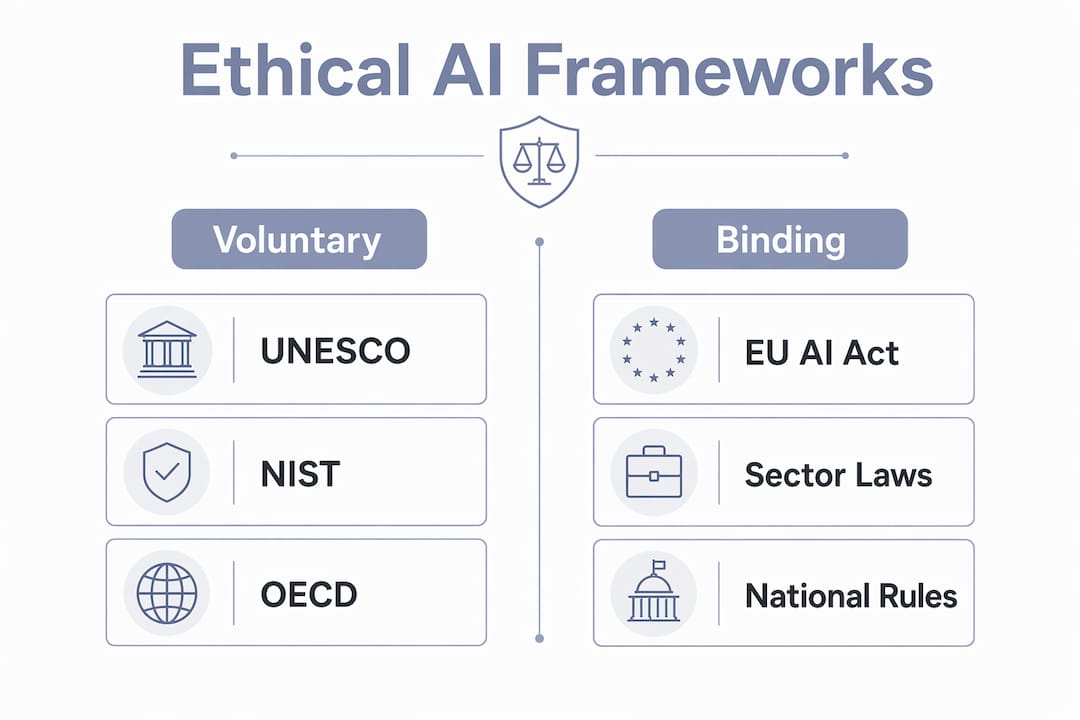
Four frameworks dominate the global conversation on AI ethics guidelines: the UNESCO Recommendation, the OECD AI Policy Initiative, the NIST AI RMF, and the EU AI Act. Each operates at a different level of authority and specificity.
| Framework | Type | Scope | Key Mechanism |
|---|---|---|---|
| UNESCO Recommendation | Normative (voluntary) | Global, all sectors | Governance, impact assessment, lifecycle oversight |
| OECD AI Policy Initiative | Policy endorsement | OECD member states | Stakeholder participation, monitoring, evaluation |
| NIST AI RMF 1.0 | Voluntary, scalable | U.S. and international enterprise | Govern, Map, Measure, Manage functions |
| EU AI Act | Binding regulation | EU and global market access | Risk classification, human oversight, conformity assessment |
The OECD endorsement of UNESCO’s framework spans 11 policy areas including data governance, labor, health, and education. This endorsement signals that ethical AI is no longer a niche concern. It is a cross-sector policy priority for the world’s largest economies. The OECD’s emphasis on stakeholder participation means civil society, affected communities, and technical experts must all have a seat at the governance table.
The NIST AI RMF organizes ethical AI governance into four functions. Govern establishes the organizational culture, policies, and accountability structures. Map identifies AI risks in context. Measure assesses those risks quantitatively and qualitatively. Manage implements controls and monitors outcomes. The framework is voluntary but has become the de facto standard for U.S. federal contractors and is increasingly referenced in international procurement requirements.
The EU AI Act introduces binding obligations tied to risk classification. High-risk AI systems, covering areas like biometric identification, critical infrastructure, and employment decisions, face the most stringent requirements. Article 14 of the EU AI Act mandates human oversight as a system feature, not a policy statement. This distinction matters enormously for engineers and product teams. Oversight must be designed into the product.
Voluntary frameworks like NIST AI RMF and UNESCO’s Recommendation build the ethical foundation. Binding regulations like the EU AI Act enforce it. Organizations operating globally need both.
How does human oversight work in ethical AI systems?
Human oversight is the mechanism by which people monitor, understand, and intervene in AI system behavior to prevent harm. The EU AI Act Article 14 defines this with precision: oversight must enable users to detect anomalies, understand the system’s capabilities and limitations, and halt or override operations when necessary.
The critical insight from Article 14 is that oversight must be engineered into the system’s interfaces and workflows. A policy document stating “a human reviews all outputs” does not satisfy this requirement unless the interface actually enables that review. Logging, authority limits, and override functions must be built features, not afterthoughts. Understanding end user roles in AI safety is directly tied to how well these interfaces are designed.
Effective human oversight in practice requires:
- Monitoring dashboards that surface anomalies and flag outputs outside expected parameters in real time.
- Capability documentation that tells operators exactly what the AI can and cannot do, preventing over-reliance.
- Override and stop functions that any authorized user can trigger without technical expertise.
- Multi-person verification for high-risk decisions, such as medical diagnoses or criminal risk assessments, where a single reviewer is insufficient.
- Audit logs that record every AI decision, the data inputs used, and the human actions taken in response.
Automation bias is the primary failure mode when oversight is weak. This is the tendency for humans to defer to AI outputs even when those outputs are wrong. The EU AI Act’s design requirements exist precisely to counteract this tendency by making disagreement with the AI the path of least resistance, not the exception.
Pro Tip: Test your oversight interfaces with non-technical staff. If they cannot detect an anomaly or trigger an override in under 60 seconds, the interface fails the EU AI Act standard.
What are best practices for implementing ethical AI governance?
Governance is where ethical AI principles become real. UNESCO frames ethical AI as a governance problem requiring operational evidence: impact assessments, audit records, and due diligence artifacts that persist across the AI lifecycle. Principle statements without documentation are not governance. They are marketing.
The NIST AI RMF implementation presents a known challenge: embedding risk measures into continuous enterprise controls while AI models change rapidly. Organizations that treat the AI RMF as a one-time compliance exercise consistently fail this test. The framework requires integration into day-to-day operations, not annual reviews.
Practical governance mechanisms that work:
- Impact assessments before deployment: Identify who the system affects, what harms are plausible, and what mitigations are in place. Document this formally.
- Audit trails throughout the lifecycle: Every model update, data change, and output anomaly should be logged with timestamps and responsible parties named.
- Stakeholder engagement programs: The OECD’s policy framework treats stakeholder participation as mandatory, not optional. Include affected communities, not just internal teams.
- Governance committees with real authority: Ethics review boards that cannot halt a deployment are theater. Give them veto power.
- Continuous monitoring protocols: AI systems drift. A model that was fair at launch may become biased as the world changes. Schedule regular re-evaluation.
Transparency tools like model cards and datasheets for datasets help communicate AI behavior to external stakeholders. These must be balanced against legitimate privacy and security concerns. Publishing a model card that reveals exploitable system details creates a different kind of risk. Understanding data exfiltration risks in AI systems is part of responsible disclosure practice.
The European Commission’s 2026 guidelines for AI in education demonstrate how sector-specific governance works in practice. The guidelines address GDPR compliance, EU AI Act obligations, and AI literacy for educators simultaneously. This multi-layered approach, combining legal compliance with practical tooling and training, is the model every sector should follow.
Key takeaways
Ethical AI usage requires governance mechanisms that make fairness, transparency, and accountability auditable across the entire AI lifecycle, not just at the design stage.
| Point | Details |
|---|---|
| Define before deploying | Map every AI system against fairness, transparency, accountability, privacy, and proportionality before launch. |
| Use authoritative frameworks | UNESCO Recommendation, NIST AI RMF, and EU AI Act provide the governance structure organizations need. |
| Engineer human oversight | Oversight must be a built system feature with monitoring dashboards, override functions, and audit logs. |
| Document everything | Impact assessments and audit trails are the evidence that ethical AI governance actually happened. |
| Engage stakeholders continuously | Diverse participation from technical and social perspectives is required, not optional, per OECD standards. |
Why governance beats principles every time
I have spent years watching organizations publish AI ethics statements that read beautifully and change nothing. The pattern is consistent: a principles document gets approved, a press release goes out, and the engineering team ships the same system they were already building. The principles had no teeth because they had no process attached to them.
What actually works is treating ethical AI the same way you treat financial controls. You do not publish a statement saying “we value accurate accounting.” You build ledgers, audits, reconciliation processes, and sign-off requirements. The NIST AI RMF’s Govern function exists for exactly this reason. It forces organizations to ask who is accountable, what the escalation path is, and how decisions get documented.
The interdisciplinary piece is harder than most teams expect. Lawyers, ethicists, affected community representatives, and engineers rarely share a vocabulary. I have seen technically sound AI systems fail ethical review because no one on the team understood the social context of the deployment. And I have seen ethically well-intentioned systems create real harm because the engineers did not understand the regulatory constraints. The only fix is building teams where those disciplines work together from day one, not in sequential handoffs.
The EU AI Act has done something valuable here. By making human oversight a legal requirement with engineering specifications, it forces the conversation between product teams and compliance teams that should have been happening all along. Regulation is not the enemy of innovation. It is the forcing function that makes ethical AI governance a real organizational priority rather than a footnote.
— Nicholas
How Thepitstop supports your ethical AI compliance
Ethical AI governance requires more than a policy framework. It requires tools that test whether your AI systems and the humans operating them actually meet the standards you claim to uphold.

Thepitstop provides free, automated security assessments built for exactly this gap. The AI Agent Liability Gap white paper maps the governance risks most organizations overlook when deploying autonomous AI systems, drawing directly on the frameworks covered in this article. For hands-on evaluation, the free AI Agent Security Scan tests your AI systems against real attack surfaces including prompt injection, data exfiltration, and supply chain vulnerabilities. If your organization needs to demonstrate oversight readiness to regulators or auditors, Thepitstop’s SERA™ Certification and security tooling give you the documented evidence that governance is operational, not theoretical.
FAQ
What is the simplest definition of ethical AI usage?
Ethical AI usage means developing and operating AI systems in ways that respect human rights, prevent discrimination, and maintain transparency and accountability throughout the system’s lifecycle. The UNESCO Recommendation on AI Ethics provides the most widely recognized global definition.
How does the EU AI Act define human oversight?
The EU AI Act Article 14 defines human oversight as a mandatory system feature for high-risk AI, requiring interfaces that allow users to detect anomalies, understand AI capabilities and limitations, and execute overrides or stop functions without technical barriers.
What is the NIST AI RMF and who should use it?
The NIST AI Risk Management Framework is a voluntary, scalable governance framework organized around four functions: Govern, Map, Measure, and Manage. It is designed for any organization developing or deploying AI and is the de facto standard for U.S. federal contractors and internationally referenced procurement requirements.
What is the proportionality principle in AI ethics?
The proportionality principle, defined by UNESCO, requires that AI systems be used only to the extent necessary for a legitimate and clearly defined purpose. It prevents AI deployments from expanding beyond their original scope in ways that create unintended harms or rights violations.
How do impact assessments support ethical AI governance?
Impact assessments document who an AI system affects, what harms are plausible, and what mitigations are in place before deployment. UNESCO and NIST both treat these assessments as lifecycle artifacts, meaning they must be maintained and updated as the system evolves, not completed once and filed away.