What Is AI Security? a Guide for IT Pros in 2026

Most organizations treating AI security as “just another security layer” are already behind. What is AI security, exactly? At its core, AI security protects AI systems including models, data, inference pipelines, and infrastructure from threats that compromise confidentiality, integrity, or availability. That definition sounds manageable until you realize it covers everything from training datasets and retrieval pipelines to prompt interfaces and deployment APIs. This guide cuts through the confusion, maps the full threat surface, and gives IT professionals, executives, and researchers a structured framework for securing AI systems end to end.
Table of Contents
- Key takeaways
- What AI security really means
- The AI security lifecycle
- Key challenges and emerging threats
- Best practices and governance frameworks
- My perspective on where AI security actually breaks down
- How Thepitstop can help you act on this
- FAQ
Key takeaways
| Point | Details |
|---|---|
| AI security spans the full stack | Protecting AI means securing data, prompts, APIs, and infrastructure, not just the model itself. |
| Lifecycle phases require distinct controls | Security controls must match the development, deployment, and operational phase of each AI system. |
| Agentic AI multiplies risk | Autonomous agents with broad permissions can cause far wider damage from a single compromise. |
| Inventory before you secure | You cannot apply least privilege or consistent monitoring without first cataloging all AI assets. |
| Governance frameworks exist and apply now | NIST, AWS, and other frameworks provide tested, phased guidance for AI security programs today. |
What AI security really means
The phrase “AI security” gets used to describe three completely different things, and mixing them up leads to misaligned programs and wasted budget. The first meaning is securing AI systems themselves. The second is using AI as a tool to improve cybersecurity operations. The third is understanding AI as an attack enabler in the hands of adversaries. This article focuses on the first: securing AI systems end to end.
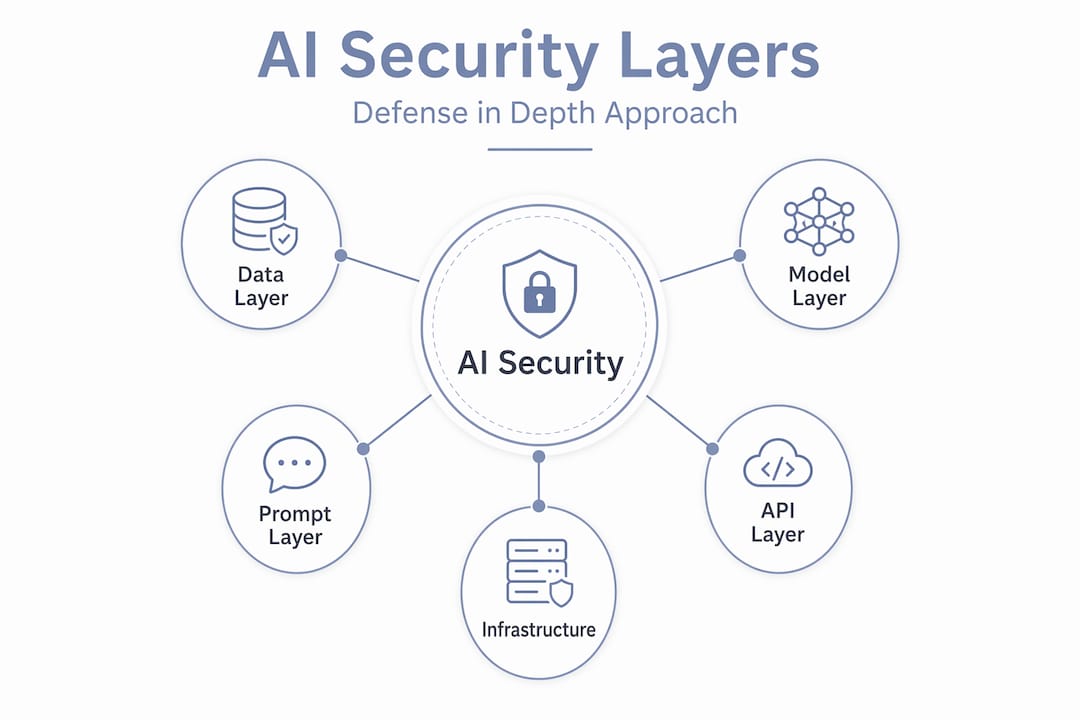
Most incidents occur around the model rather than inside it, which means your threat model must extend far beyond the neural network. The real attack surface includes training data, prompt inputs, retrieval tools, output channels, APIs, logs, and the infrastructure underneath all of it.
Here is what you are actually protecting across a typical AI system:
- Model layer: The trained model weights, hyperparameters, and architecture details that attackers can steal or manipulate through model inversion or extraction attacks.
- Training data: The datasets used to train or fine-tune a model, which are vulnerable to poisoning attacks that corrupt model behavior at the source.
- Prompt and retrieval layer: The instructions, context, and retrieved documents fed to the model at inference time, which are prime targets for prompt injection and retrieval injection.
- APIs and tool integrations: External services the model calls or outputs to, including databases, code interpreters, and third-party APIs, each of which expands the attack surface.
- Deployment infrastructure: The servers, containers, orchestration layers, and network configurations that host and route the AI system.
- Logs and observability data: Audit trails and monitoring outputs that, if tampered with or left unsecured, enable undetected abuse.
Defense-in-depth is the only architecture that holds here. A single guardrail at the prompt layer cannot compensate for poisoned training data or an over-privileged API key.
Pro Tip: Start your AI security review by drawing a data-flow diagram that traces every input into the model and every output from it. Gaps in that diagram are gaps in your security coverage.
The AI security lifecycle
AI systems do not stay static. They move through distinct phases, and the right security controls differ significantly at each stage. The AWS AI Security Framework structures this as three phases across three layers, giving teams a practical model for matching controls to context.
The four operational phases most organizations encounter are:
- Development and validation: Threat modeling, data provenance checks, model testing, and red-team exercises happen here. Vulnerabilities caught at this stage cost a fraction of those discovered in production.
- Deployment: Identity controls, access policies, network segmentation, and initial guardrails get applied. This phase establishes the security baseline the system will carry into operation.
- Operation: Continuous monitoring for anomalous behavior, model drift, and abuse patterns runs throughout this phase. Incident response playbooks should already be active.
- Decommissioning: Model weights, fine-tuning data, stored prompts, and API credentials must be securely deleted or revoked to prevent data exfiltration after a system retires.
The table below maps the three AWS framework layers against the types of controls relevant at each phase:
| Layer | Development controls | Operational controls |
|---|---|---|
| Infrastructure | Secure build environments, dependency scanning | Network segmentation, workload isolation |
| Identity and data | Access scoping, data lineage tracking | Least privilege enforcement, secret rotation |
| AI application | Adversarial testing, content filtering setup | Guardrail monitoring, output auditing |
Threat modeling and red-teaming early in AI development are among the highest-leverage activities a team can invest in. Catching a prompt injection vulnerability in a test environment is straightforward. Catching it after a production breach is expensive.
Key challenges and emerging threats
Understanding what AI security means in practice requires confronting the specific attack categories that make AI systems different from traditional software. These are not theoretical scenarios. They are active exploit patterns with documented real-world cases.

Adversarial and model-level attacks include data poisoning, where malicious samples inserted into training data cause a model to behave incorrectly on specific trigger inputs. Model theft via repeated querying can reconstruct a proprietary model’s behavior from its outputs alone. Jailbreaks bypass safety constraints through carefully crafted prompts.
Prompt and retrieval injection deserves special attention. Injection attacks often originate outside the model via untrusted documents, external data tools, or compromised retrieval sources, not from the user’s input directly. A retrieval-augmented generation (RAG) system that fetches documents from the web and passes them to a model without sanitization is a wide-open attack channel.
Supply chain risks represent a growing and underappreciated exposure. AI supply-chain guidance advocates data lineage tracking, curated model registries, reproducible pipelines, and provenance logging to prevent poisoning or backdoors introduced upstream. When you pull a pretrained model from a public registry and fine-tune it without verification, you inherit every vulnerability its creator introduced, intentionally or not.
“Most AI security incidents involve inputs to and outputs from the AI models, indicating the importance of securing retrieval pipelines and interaction layers, not just the core model.” — Red Hat AI Security Blog
Agentic AI creates a category of risk that scales with the system’s permissions. Microsoft Security warns against “everything agent” patterns where a single autonomous agent holds broad permissions across tools, databases, and APIs. A compromised agent with that kind of access scope can exfiltrate data, send messages, modify records, and trigger downstream workflows before any human notices.
Pro Tip: When deploying an AI agent, ask yourself: “What is the worst thing this agent could do with its current permissions?” If that answer is alarming, scope the permissions down before deployment, not after an incident.
Only 24% of generative AI projects are currently secured properly, and 97% of organizations that experienced AI-related breaches lacked proper access controls. These numbers reflect a systemic failure to treat AI security with the same rigor applied to traditional application security.
Securing prompts, RAG pipelines, and the real attack surface of AI systems is not optional at this point. It is a baseline expectation for any production AI deployment.
Best practices and governance frameworks
Knowing the threat landscape matters less than having a repeatable process for addressing it. Here is what effective AI security programs actually do, grounded in leading frameworks.
Start with asset inventory
Inventorying all AI assets including models, endpoints, prompts, retrieval sources, and agent permissions is the prerequisite for everything else. You cannot apply least privilege, consistent monitoring, or targeted testing without knowing what you have. This step is unglamorous and almost always skipped. That is precisely why it shows up repeatedly in post-incident analyses.
Apply zero trust to AI systems
Treat every AI component as untrusted by default. The benefits of AI security automation are only realized when automated controls are actually scoped to specific permissions and behaviors. Every model, every agent, and every integration should be granted only the minimum access it needs to perform its function. Nothing more.
Effective guardrails include input validation, output filtering, and runtime enforcement such as least privilege and two-person rule confirmations for high-risk actions. Guardrails block, redact, rewrite, or route risky actions. But guardrails alone cannot compensate for poor architecture or absent monitoring.
Use TEVV as your testing standard
NIST’s ITL AI Program promotes testing, evaluation, verification, and validation (TEVV) under a risk-based approach to foster AI security and trust. TEVV is not a one-time checkbox. Applied correctly, it runs throughout the AI lifecycle from pre-deployment red-teaming to ongoing production evaluation.
Build governance that keeps pace with deployment
The comparison below summarizes the major governance frameworks and their primary focus:
| Framework | Primary focus | Best suited for |
|---|---|---|
| NIST AI RMF | Risk management and trustworthy AI | Federal agencies, regulated industries |
| AWS AI Security Framework | Phased controls across system layers | Cloud-native AI deployments |
| ISO/IEC 42001 | AI management systems and compliance | Enterprise-wide AI governance |
| MITRE ATLAS | Adversarial threat modeling for AI | Red teams, security researchers |
Compliance with these frameworks does not guarantee security, but it does force teams to ask the right questions at the right moments. The benefits of AI security training become concrete when staff understand not just the tools but the reasoning behind the controls.
Pro Tip: Pick one framework to anchor your AI security program and map your existing controls to it before trying to satisfy multiple standards simultaneously. Depth beats breadth at the start.
My perspective on where AI security actually breaks down
I’ve watched organizations stand up sophisticated AI systems with thorough model cards, well-documented APIs, and real investment in content filtering. Then they go live with no inventory of what the agent can actually access and no monitoring on its outbound calls. The guardrails look solid on a diagram. In practice, they’re protecting the wrong thing.
What I’ve found is that most AI security failures are not technical failures at their root. They are prioritization failures. Teams move fast to ship models, and security gets treated as a final review gate rather than a continuous design input. The model ships. The permissions never get scoped down. The monitoring never gets wired up. And the first real signal of a problem is a breach notification.
The benefits of AI agent certification and structured security assessments are real, not because they generate badges, but because they force systematic examination of the things teams skip when they’re moving quickly. I’ve seen the AI Agent Liability Gap white paper shift how executives frame the risk conversation. That framing change is often what unlocks real budget and real action.
My honest take: AI security is not harder than traditional application security. It is harder to scope correctly. The attack surface moves. The model’s behavior can drift. An input that was benign last month might be exploitable today. That’s why the governance and monitoring infrastructure matters as much as the controls themselves. Speed without structure is just accelerated risk.
— Nicholas
How Thepitstop can help you act on this
AI security principles matter most when you can apply them to your specific systems and teams. Thepitstop was built specifically for this: securing both AI agents and the humans who operate them across the full attack surface.

The free AI Agent Security Scan gives you an automated baseline assessment of your AI agent’s security posture, covering prompt injection exposure, permission scope, and output risks. The SERA™ Certification assesses and certifies human operator resilience against social engineering, a consistently underestimated vector in AI security breaches. For organizations building trust between AI agents and human operators at scale, the Infinity Protocol™ provides cryptographic verification for agent-human pairs. Start with the free scan and the AI Agent Liability Gap white paper to understand where your current exposure actually sits.
FAQ
What is the AI security definition?
AI security refers to the practice of protecting AI systems, including models, training data, inference pipelines, prompts, and infrastructure, from threats that compromise confidentiality, integrity, or availability.
What is security in AI automation specifically?
Security in AI automation means applying access controls, monitoring, guardrails, and governance to autonomous AI systems so they cannot be manipulated, abused, or cause unintended harm through their automated actions.
Why does integrated security for AI matter more than point solutions?
Because AI security incidents span multiple layers from data to prompts to infrastructure, addressing only one layer leaves the others exposed. Integrated security closes the gaps between components.
What are the benefits of AI security automation?
AI security automation enables continuous monitoring, faster anomaly detection, and consistent policy enforcement at scale, capabilities that manual processes cannot match as AI system complexity grows.
What are the benefits of AI agent certification?
Certification programs create a structured baseline for assessing agent security maturity, force teams to document permissions and threat models, and provide executives with auditable evidence of security posture across deployed AI systems.