Ways to Test Human Cyber Resilience in 2026

Human error remains the most exploited entry point in modern attacks. With around 60% of breaches involving a human element, your organization’s technical defenses are only as strong as the people operating within them. Testing human cyber resilience is not a compliance checkbox. It is an ongoing discipline that requires realistic scenarios, measurable outcomes, and the kind of feedback that actually changes behavior. This article breaks down the most effective ways to test human cyber resilience today, from phishing simulations to continuous behavioral analytics, and gives you a framework for choosing the right mix.
Table of Contents
- Key takeaways
- 1. Ways to test human cyber resilience: establishing your criteria first
- 2. Phishing simulations and social engineering penetration testing
- 3. Tabletop exercises and discussion-based simulations
- 4. Adversary simulation and red teaming with a human focus
- 5. Continuous monitoring and behavioral analytics
- 6. Comparison of human cyber resilience testing methods
- My honest take on what actually builds human resilience
- Strengthen your human resilience posture with Thepitstop
- FAQ
Key takeaways
| Point | Details |
|---|---|
| Human factor drives breaches | Around 60% of breaches involve human error, making human resilience testing non-negotiable. |
| Realism determines test value | Tests using current attack vectors like deepfakes yield far more useful data than generic phishing emails. |
| Feedback loops build resilience | Without diagnostic follow-up and no-blame coaching, periodic tests produce resentment, not improvement. |
| Continuous monitoring fills gaps | Behavioral analytics provide between-test insights that point-in-time assessments miss entirely. |
| Method mix matters most | No single testing method covers every dimension. Combining approaches gives the clearest picture of human resilience. |
1. Ways to test human cyber resilience: establishing your criteria first
Before selecting any testing method, you need a clear framework for what “effective” actually means for your organization. Not all cyber resilience testing methods carry equal diagnostic value, and the wrong choice wastes resources while giving false confidence.
The most productive criteria to evaluate any human resilience test against are:
- Behavioral measurability: Does the test produce data beyond pass/fail? Reporting rates, time-to-detection, and error patterns matter far more than completion statistics.
- Realism and relevance: Risk-aligned scenarios tied to an employee’s actual workflow outperform generic templates every time.
- Frequency and fatigue management: Testing too often without purpose burns goodwill. Testing too rarely leaves gaps open for months.
- Scalability: A method that works for a 50-person team may collapse at 5,000 employees without the right tooling.
- Diagnostic feedback capability: The test should generate insight you can act on, not just a score to report upward.
Pro Tip: Define two or three specific behavioral outcomes you want to shift before designing any test. Without clear before-and-after metrics, you cannot demonstrate program value to leadership or improve the program over time.
2. Phishing simulations and social engineering penetration testing
Phishing simulations are the most widely used method for assessing human cyber resilience, and also the most frequently misused. When designed well, they reveal how employees recognize, respond to, and report suspicious communication. When designed as checkboxes, they breed resentment and teach employees to game the system rather than develop genuine judgment.
Social engineering tests produced severe findings in 77% of cases, making them among the highest-impact methods available for uncovering real vulnerabilities. The types of simulations worth running include:
- Email phishing campaigns: Vary the sophistication from generic lures to highly targeted spear-phishing that mimics internal communications.
- Voice phishing (vishing): Tests telephone-based deception, a vector that email-focused programs completely miss.
- AI-generated deepfakes: As AI-driven attacks become standard in real threat actor playbooks, simulations using synthetic audio or video expose a newer class of human vulnerability.
- Physical pretexting: Tests whether staff challenge unknown individuals attempting to access secure areas or systems.
The critical pitfall to avoid is frequency-driven checkbox testing that triggers training fatigue. Employees who receive poorly-timed, repetitive simulations start to feel surveilled rather than supported, and that psychological shift undermines every other security culture initiative you run.
Pro Tip: After any failed simulation, replace the gotcha message with a short, non-punitive coaching module specific to the tactic used. The behavior change happens in the moment directly after the miss, not three weeks later in a training portal.
For teams building this capability from scratch, a structured phishing simulation workflow reduces setup time and produces more consistent measurement across campaigns.

3. Tabletop exercises and discussion-based simulations
Tabletop exercises test something phishing simulations cannot: how your people think, communicate, and coordinate during an active incident. These are structured, discussion-based scenarios where participants talk through their response to a simulated attack without any live system exploitation.
ENISA’s cybersecurity exercise methodology outlines a six-phase lifecycle that gives these exercises real structure and measurable value:
- Initiation: Define scope, stakeholders, and high-level objectives aligned to organizational risk.
- Design: Build the scenario around realistic threat actors and plausible attack paths relevant to your sector.
- Preparation: Brief facilitators, prepare injects (simulated events that force decisions), and confirm participant roles.
- Execution: Run the exercise, with a facilitator introducing injects and observing decision-making in real time.
- Evaluation: Score outcomes against SMART objectives defined in the design phase.
- After-action review: Produce a structured report identifying specific process and decision gaps with remediation steps.
The particular strength of tabletop exercises is that they expose process failures, not just individual knowledge gaps. You discover that the incident response team does not know who has authority to isolate a compromised system, or that the communications chain between IT and legal breaks down under pressure. That kind of gap is invisible in a phishing simulation report.
4. Adversary simulation and red teaming with a human focus
Red team exercises go further than any single simulation method by combining technical exploitation with deliberate human-targeting tactics. The goal is to replicate how a real threat actor would move through your environment, and a significant portion of that movement relies on manipulating people.
Red team adversary simulations have shown that organizations consistently underestimate how far a social engineering chain can reach once an initial human error is exploited. Key elements of a human-focused red team engagement include:
- Pretexting and impersonation: Operators pose as vendors, IT support, or executives to test whether employees verify identity before granting access or sharing credentials.
- AI-enhanced deception: Using synthetic voice or email content that mirrors known internal contacts creates a level of realism that standard phishing templates cannot achieve.
- Tailgating and physical access: Tests whether security culture extends beyond the screen into physical environments.
- Measuring dwell time awareness: How long does it take for a human to detect or report anomalous behavior once a simulated attacker has access?
The value of red teaming for measuring cybersecurity awareness is that it tests behavior under conditions that feel genuinely threatening, not obviously artificial. Employees who perform perfectly in scheduled simulations sometimes respond very differently when an unknown caller knows their manager’s name and references a real project. That gap between trained behavior and real-world behavior is exactly what red teams are designed to find.
5. Continuous monitoring and behavioral analytics
Point-in-time tests give you a snapshot. Continuous monitoring gives you a movie. The difference matters enormously when evaluating cyber threat response across a workforce that changes, grows, and faces new threats between formal exercises.
Cyber hygiene metrics and behavioral analytics from security tooling offer ongoing visibility into how employees actually behave rather than how they behave when they know they are being tested. Useful signals include:
| Behavioral signal | What it reveals |
|---|---|
| Phishing report rates over time | Trend in proactive threat identification |
| Credential reuse across systems | Password hygiene and policy compliance |
| Anomalous access patterns | Insider risk indicators or compromised accounts |
| Security alert response time | Human speed and accuracy in evaluating real alerts |
| MFA bypass attempts or failures | Friction tolerance and authentication behavior |
The challenge with this approach is not technical. It is organizational. Employees need to understand what is being monitored and why, otherwise behavioral analytics programs erode the trust that security culture depends on. Transparent communication about what data is collected, how it is used, and who sees it is not optional.
Pro Tip: Treat behavioral analytics data as a diagnostic tool for program design, not a performance management instrument. When employees believe monitoring is punitive, they mask behavior rather than improve it, which makes the data actively misleading.
6. Comparison of human cyber resilience testing methods
No single method covers all dimensions of human resilience, and the right combination depends on your organization’s size, maturity, and risk profile. The table below compares the primary approaches across the criteria that matter most to security leaders.
| Method | Realism | Resource intensity | Behavioral insight depth | Measurement clarity | Best for |
|---|---|---|---|---|---|
| Phishing simulations | Medium to high | Low to medium | Individual response patterns | High | Broad workforce baseline |
| Tabletop exercises | Medium | Medium | Team decision-making and coordination | Medium | Leadership and response teams |
| Red team adversary simulation | Very high | High | Full chain human vulnerability | Medium | Mature organizations, regulated sectors |
| Continuous behavioral analytics | Ongoing real-world | Medium to high | Trend analysis and compliance | High | Sustained program intelligence |
For organizations early in their human resilience maturity, phishing simulations combined with at least one annual tabletop exercise gives the most return per resource invested. As maturity increases, layering in red team exercises and continuous monitoring produces a picture that is genuinely hard for attackers to exploit. Building an integrated program is not about running every method simultaneously. It is about sequencing them so each one informs the next, and feeding insights from personal cyber resilience assessments back into training design.
For a broader view of how human and AI risk intersect in this context, the AI agent security risks discussion at Thepitstop is worth reviewing before designing your next program.
The deep tech security sector offers additional context on how lifecycle-based exercises fit into broader organizational security maturity models, particularly for teams operating in regulated or high-risk environments.
My honest take on what actually builds human resilience
I have watched organizations run quarterly phishing simulations for three years straight and emerge with no meaningful change in click rates. The problem is almost never the simulation tool. It is the assumption that exposure to the test is the same as building resilience.
What I have seen work is treating every failed test as a data point that feeds a coaching conversation, not a compliance report. When an employee clicks a simulated phishing link, the most valuable thing you can do in the next 90 seconds is deliver a specific, non-punishing explanation of the tactic used. The behavioral window closes fast.
The harder challenge I keep encountering is organizational culture. Security teams often have no budget authority over the training that follows their test findings. You can identify every human vulnerability in the organization and still have no path to fixing it because the person who owns the learning management system does not report to the CISO. That structural disconnect is where most human resilience programs quietly die.
I am genuinely optimistic about where behavioral analytics and AI-assisted threat simulation are heading. The ability to personalize simulation difficulty based on an individual’s observed behavior patterns, rather than their job title, is a significant leap. It shifts testing from a spray-and-pray exercise to something that actually meets people where they are. The organizations that get ahead of this will treat human resilience data the same way they treat vulnerability scanner output: continuously, contextually, and with a clear remediation workflow attached.
— Nicholas
Strengthen your human resilience posture with Thepitstop
Testing human cyber resilience is only half the equation. Acting on what you find is where most programs stall.
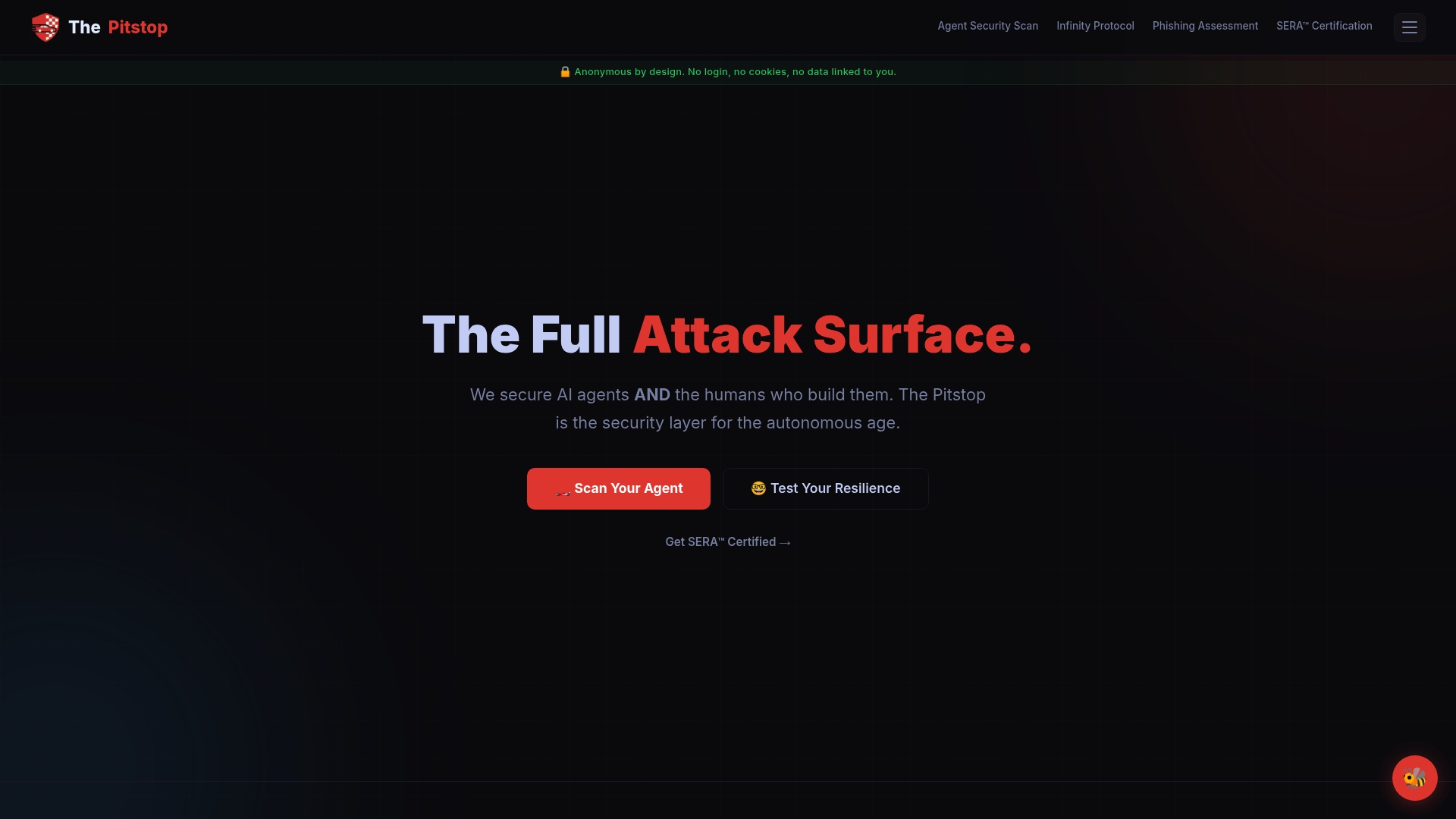
Thepitstop offers free, automated tools built specifically for organizations that need evidence-based resilience assessment without a six-month procurement cycle. The SERA™ Certification gives cybersecurity teams a credentialed, structured way to assess and validate social engineering resilience at the individual and organizational level. For teams operating in AI-driven environments, the free AI agent security scan integrates human and machine-layer assessment in a single workflow. If you want deeper analysis of where human liability and AI risk converge, the AI liability white paper is a practical starting point for structuring your program.
FAQ
What are the most effective ways to test human cyber resilience?
The most effective methods combine phishing simulations, tabletop exercises, and adversary simulation with continuous behavioral monitoring. Each method reveals different dimensions of human resilience, and no single approach provides a complete picture.
How often should organizations run human resilience tests?
Phishing simulations work best on a rolling basis with varied scenarios rather than fixed quarterly schedules. Tabletop exercises should run at least annually, with red team engagements reserved for high-maturity organizations or regulated environments that require deeper validation.
What makes a phishing simulation genuinely useful?
A simulation is useful when it produces behavioral data and feeds directly into targeted coaching. Simulations designed only as compliance checkboxes trigger training fatigue and teach employees to avoid the test rather than recognize real threats.
How does red teaming differ from phishing simulations for human resilience testing?
Red teaming tests the full chain of human vulnerability under realistic attack pressure, including physical access, AI-enhanced deception, and impersonation. Phishing simulations test a narrower slice of individual recognition and reporting behavior at scale.
What role does behavioral analytics play in assessing human cyber resilience?
Behavioral analytics provides continuous insight into real-world human decision-making between formal test cycles. It tracks signals like reporting rates, authentication behavior, and alert response times, giving security teams trend data that point-in-time tests cannot capture.