The Role of Zero Trust in AI Security in 2026

Zero Trust for AI is defined as the application of continuous verification, least privilege access, and breach assumption across every component of the AI lifecycle, including agents, models, training data, and inference endpoints. Traditional perimeter security fails completely against AI systems because the attack surface extends far beyond users and devices. Microsoft, NVIDIA, and the U.S. Department of Defense have each published updated frameworks in 2026 that treat AI agents as distinct identities requiring their own governance controls. The role of zero trust in AI is no longer theoretical. It is the operating model that separates organizations managing AI risk from those creating it.
What are the core Zero Trust principles for AI security?
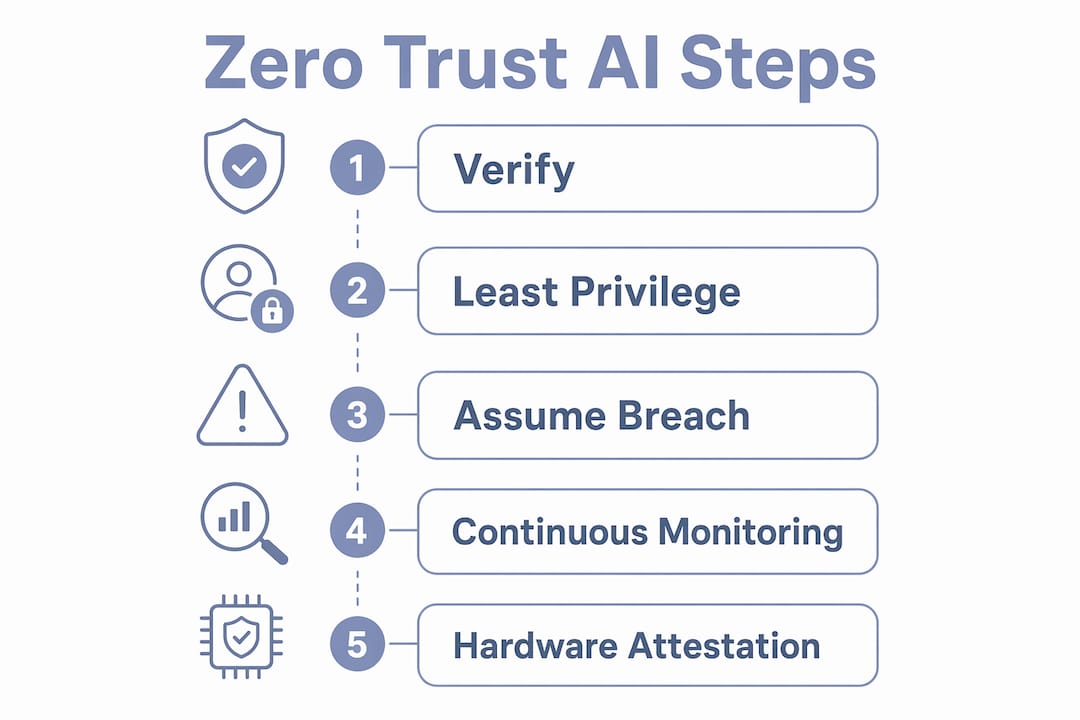
Zero Trust for AI extends the three foundational principles of traditional Zero Trust directly into the AI lifecycle: verify explicitly, apply least privilege, and assume breach. Each principle takes on new meaning when applied to AI systems, where the actors include autonomous agents, large language models, and automated pipelines rather than just human users.
Explicit verification in AI means continuously authenticating every request made by an AI agent, every model inference call, and every data access event. A model querying a database is not automatically trusted because it ran successfully yesterday. Continuous verification catches behavioral drift, compromised model weights, and unauthorized tool calls before they escalate.

Least privilege applied to AI is more granular than most teams expect. It covers not just which data a model can read, but which prompts it can receive, which tools it can invoke, and which outputs it can write. Policy-driven access controls enforce these boundaries at the model, prompt, and data layer simultaneously. Overpermissioned models are one of the most common and most exploitable misconfigurations in production AI deployments.
Assuming breach is the principle that matters most for agentic AI. Prompt injection attack rates remain high without layered safety mitigations, which means any AI agent connected to external tools or data sources should be treated as a potential attack vector at all times. Monitoring, anomaly detection, and automated response are not optional additions. They are baseline requirements.
Pro Tip: Map every AI agent’s permissions before deployment using the same IAM tooling you apply to human users. Agents with unconstrained tool access are the fastest path to lateral movement in an AI-enabled environment.
How does hardware-backed Zero Trust protect confidential AI workloads?
NVIDIA’s zero-trust foundation for confidential AI factories shifts the trust boundary away from infrastructure administrators and onto hardware-backed Trusted Execution Environments (TEEs). This is a fundamental architectural change. It means that even a privileged system administrator cannot inspect model weights, training data, or inference outputs at runtime.
TEEs create isolated memory regions where AI workloads execute. The host operating system, hypervisor, and cloud provider infrastructure are all excluded from that trust boundary. For organizations handling regulated data, proprietary model IP, or classified inference workloads, this is the only architecture that eliminates insider threat risk at the hardware level.
Remote attestation is the mechanism that makes this work in practice. Before any decryption key is released to a workload, the Key Broker Service validates the integrity of the enclave cryptographically. If the environment has been tampered with, the keys are never released and the workload cannot proceed. This prevents plaintext model exposure even from administrators with root access.
| Protection layer | Mechanism | Threat addressed |
|---|---|---|
| Hardware TEE | Isolated encrypted memory region | Insider inspection of model weights |
| Remote attestation | Cryptographic enclave integrity check | Tampered or compromised runtime |
| Key Broker Service | Conditional key release post-validation | Unauthorized decryption of AI secrets |
| Confidential computing | Encrypted memory at runtime | Host-level data exfiltration |
Pro Tip: If your AI workloads process regulated data such as PHI or financial records, treat hardware attestation as a compliance requirement, not a performance tradeoff. The overhead is measurable; a breach is not recoverable.
What unique AI trust boundaries challenge traditional Zero Trust?
AI systems don’t fit neatly into traditional security models because the trust relationships are dynamic, multi-hop, and often invisible to conventional network controls. Three specific challenges define where standard Zero Trust implementations break down when applied to AI.
The first is the transaction boundary problem. NIST SP 800-207 identifies multi-hop tool calls in AI workflows as creating implicit trust between pipeline components. When an AI agent calls a tool, which calls an API, which queries a database, each hop inherits the trust of the previous one unless each relationship is made explicit and verified independently. This is how a single compromised tool call becomes a full pipeline compromise.
The second challenge is agentic identity governance. Cisco advocates treating AI agents as unique IAM identities linked to human principals, with scoped permissions and action-level enforcement. Most organizations still manage AI agents under shared service accounts, which makes attribution impossible and least privilege unenforceable. Each agent needs a distinct identity, a defined capability scope, and continuous observability.
The third challenge is behavioral enforcement. Network and identity controls alone cannot catch an AI agent that has been manipulated through prompt injection to exfiltrate data within its authorized scope. Behavioral monitoring must detect anomalies at the action level, not just the access level. The practical implementation involves three layers working together:
- Scoped, per-call, cryptographically verifiable identities for every AI agent interaction
- Behavioral baselines established during controlled testing, with automated alerts on deviation
- Human approval gates for high-risk actions such as file deletion, external API calls, or credential access
These three controls together address what standard zero trust controls miss when applied to AI’s dynamic behavior. You can learn more about mitigating specific attack vectors in AI data exfiltration controls.
How do federal strategies implement Zero Trust for AI?
The DoD Zero Trust strategy applies directly to AI systems, with specific controls mapped to authentication, workload identity, data classification, microsegmentation, and behavioral telemetry. Federal AI security programs use PIV/FIDO2 MFA for inference requests, SPIFFE/SPIRE workload identity for model endpoints, and policy-as-code for automated enforcement. This is the most operationally mature Zero Trust for AI framework currently in production.
The comparison below shows how federal Zero Trust controls map to AI-specific security requirements:
| Federal control | AI application | Maturity target |
|---|---|---|
| PIV/FIDO2 MFA | Authentication for inference API requests | Advanced |
| SPIFFE/SPIRE workload identity | Unique identity per model endpoint | Optimal |
| Data classification and DLP | Training data, model weights, and prompt content | Advanced |
| Microsegmentation | Isolation of AI training and inference environments | Advanced |
| Behavioral analytics | Anomaly detection and automated quarantine of AI agents | Optimal |
Data classification is the control that most organizations underinvest in. Training data, model weights, and prompt content each carry different sensitivity levels and require different handling policies. Treating all three as equivalent creates both over-restriction and under-protection simultaneously.
Automated quarantine of anomalous AI activity is the federal program’s most forward-looking requirement. When a model endpoint begins generating outputs that deviate from its behavioral baseline, the system isolates it without waiting for human review. This is the Zero Trust assessment automation principle applied at the AI workload level. For IT and security teams building toward these maturity targets, the cryptographic trust role in federal AI deployments is worth examining in detail.
Key takeaways
Zero Trust secures AI systems by enforcing continuous verification, least privilege, and breach assumption across agents, models, data, and hardware, with each layer addressing a distinct attack surface that traditional controls cannot reach.
| Point | Details |
|---|---|
| Extend all three principles to AI | Verify explicitly, apply least privilege, and assume breach must cover agents, prompts, and model endpoints. |
| Hardware TEEs eliminate insider risk | NVIDIA’s confidential AI architecture prevents plaintext model exposure even from administrators with root access. |
| Treat AI agents as distinct IAM identities | Shared service accounts make attribution impossible; each agent needs scoped, verifiable permissions. |
| Address the transaction boundary problem | Multi-hop tool calls require per-hop verification, not inherited trust from the initiating agent. |
| Federal maturity targets are the benchmark | DoD controls including SPIFFE/SPIRE, behavioral analytics, and automated quarantine define the current operational standard. |
Why most teams are implementing Zero Trust for AI backwards
Most security teams I work with apply Zero Trust to AI as an afterthought. They secure the perimeter, lock down the network, enforce MFA for human users, and then deploy AI agents under a shared service account with broad database access. That is not a Zero Trust posture for AI. That is a traditional perimeter model with an AI agent sitting inside the trusted zone.
The insight that changed how I think about this came from watching how agentic workflows actually fail in practice. The breach rarely comes from outside the perimeter. It comes from a manipulated agent operating within its authorized scope, doing exactly what it was told to do by a malicious prompt. Network controls see nothing. Identity controls see an authorized service account. Only behavioral monitoring catches the deviation, and only if you established a baseline before the agent went live.
The hardware attestation piece is where I see the biggest gap between what organizations know they should do and what they actually implement. Most teams treat TEEs as a specialized capability for classified environments. NVIDIA’s architecture makes the case that any organization running proprietary model weights or processing regulated data should treat hardware-backed isolation as a baseline requirement. The threat is not theoretical. Administrators with root access to AI infrastructure represent a real insider risk, and cryptographic attestation is the only control that addresses it structurally.
My practical recommendation: build your Zero Trust for AI program in three phases. Start with identity. Give every agent a distinct IAM identity with scoped capabilities. Then add behavioral monitoring with defined baselines. Then layer in hardware protections for your highest-sensitivity workloads. Trying to implement all three simultaneously is how programs stall. Trying to skip identity governance and go straight to hardware is how you end up with well-protected agents that are still overpermissioned.
— Nicholas
Secure your AI agents with Thepitstop
Implementing Zero Trust for AI requires more than policy documents. It requires tools that can assess your actual security posture across agents, models, and human operators simultaneously.
Thepitstop provides free, automated tools built specifically for this challenge. The AI Agent Security Scan evaluates your AI environment against Zero Trust principles, identifying overpermissioned agents, unverified tool call chains, and behavioral monitoring gaps before attackers find them. For teams building toward a formal security framework, the AI Agent Liability Gap white paper maps the full AI lifecycle against Zero Trust controls, covering data ingestion, training, deployment, and inference with specific recommendations for each phase.
FAQ
What is Zero Trust for AI?
Zero Trust for AI is the application of continuous verification, least privilege, and breach assumption to every component of the AI lifecycle, including agents, models, training data, and inference endpoints. Microsoft defines it as extending traditional Zero Trust principles to new AI-specific trust boundaries.
How does Zero Trust address prompt injection in AI systems?
Zero Trust mitigates prompt injection through layered defenses including policy enforcement at the prompt layer, behavioral monitoring to detect anomalous outputs, and human approval gates for high-risk agent actions. Assuming breach as a baseline posture means these controls are active before an attack occurs, not after.
Why can’t traditional Zero Trust controls secure AI agents?
Traditional controls secure users and devices but cannot enforce least privilege at the prompt, tool call, or model output level. AI agents require distinct IAM identities with scoped capabilities and action-level behavioral monitoring, which standard network and identity controls do not provide.
What is SPIFFE/SPIRE and why does it matter for AI security?
SPIFFE/SPIRE is a workload identity framework that assigns cryptographically verifiable identities to software workloads, including AI model endpoints. Federal programs use it to enforce Zero Trust at the model level, ensuring each inference endpoint has a unique, attestable identity rather than relying on shared credentials.
How do hardware TEEs improve AI security beyond software controls?
Trusted Execution Environments create isolated encrypted memory regions where AI workloads execute, preventing inspection by the host OS, hypervisor, or administrators. NVIDIA’s confidential AI architecture uses remote attestation to release decryption keys only after enclave integrity is verified, protecting model weights and regulated data at runtime.