The Role of Threat Modeling in AI Security

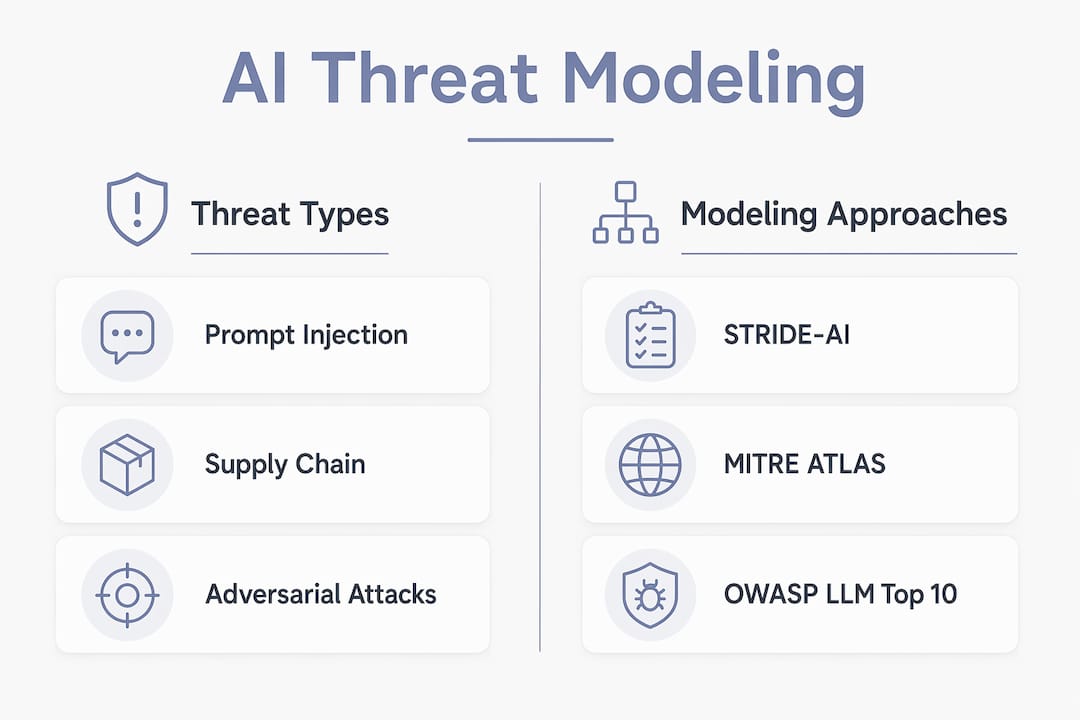
Threat modeling in AI is defined as a structured process of identifying, analyzing, and prioritizing security threats to AI systems before they cause real damage. The role of threat modeling in AI goes far beyond traditional software security. AI systems introduce attack surfaces that standard tools never anticipated: adversarial prompts, poisoned training data, autonomous agent behavior, and supply chains that extend from code all the way to model artifacts. Frameworks like STRIDE-AI, NIST AI RMF, and MITRE ATLAS now give security teams a shared vocabulary for these risks. Without structured threat assessment in AI, organizations are defending systems they do not fully understand.
What role does threat modeling play in AI security?
Threat modeling in AI is the discipline that maps what can go wrong, who would cause it, and how to stop it before deployment. The industry term for this practice is AI threat modeling, and it draws from established software security methods while adding layers specific to machine learning systems. STRIDE-AI threat modeling reduces indirect prompt injection attack success rates from 80% to 15%. That single data point shows why structured threat assessment in AI is not optional for any team running production AI.
AI systems face threat categories that traditional software never encountered. Adversarial prompts manipulate model outputs without touching the underlying code. Data poisoning corrupts model behavior at the training stage, long before deployment. Model theft extracts proprietary capabilities through repeated queries. Agentic AI introduces a new category entirely: autonomous insider threats from AI agents that execute tool calls, modify files, and interact with external APIs without human approval on every action.

The attack surface for AI also extends into the supply chain. Legacy supply chain audits are insufficient because AI supply chains extend beyond code to data pipelines and model artifacts. A compromised dataset or a tampered model checkpoint can undermine every security control applied at the application layer.
Common AI threats and modeling approaches
| AI Threat | Threat Modeling Approach |
|---|---|
| Prompt injection | STRIDE-AI spoofing and tampering analysis |
| Data poisoning | PASTA data flow and integrity mapping |
| Model theft | MITRE ATLAS adversarial tactic mapping |
| Agentic insider risk | MAESTRO autonomous behavior analysis |
| Supply chain compromise | OWASP LLM Top 10 dependency review |
Pro Tip: Map your AI system’s trust boundaries before selecting a framework. MITRE ATLAS covers adversarial tactics, OWASP LLM Top 10 covers application failure modes, and NIST AI RMF covers governance. You need all three working together, not just one.
How do you model threats in AI effectively?
Effective AI threat modeling starts at the design phase, not after deployment. Threat modeling is most valuable during design; fixing architectural flaws post-deployment is expensive and disruptive. Teams that wait until a system is live face the worst possible combination: high remediation cost and active exposure.
The process follows a sequence that any AI developer or security professional can apply:
- Define the system scope. Document every component: model, training data sources, APIs, user interfaces, and agent capabilities. Include data flows and trust boundaries.
- Identify threat actors. Consider external attackers, malicious insiders, compromised third-party models, and adversarial users who probe the system through normal interaction.
- Apply a structured methodology. Use STRIDE-AI for spoofing, tampering, repudiation, information disclosure, denial of service, and elevation of privilege. Layer MITRE ATLAS for adversarial machine learning tactics. Apply OWASP LLM Top 10 for application-level failure modes.
- Prioritize by risk. Score threats by likelihood and impact. Focus mitigation resources on high-probability, high-damage scenarios first.
- Define mitigations and owners. Every identified threat needs a named mitigation and a team member responsible for it. Unowned risks get ignored.
- Update continuously. Threat models must be updated with every meaningful change: new integrations, revised authentication flows, model version upgrades, or new deployment contexts.
Frameworks like NIST AI RMF, MITRE ATLAS, and OWASP are complementary tools, not standalone methods. Using only one framework leaves blind spots. NIST AI RMF provides governance structure. MITRE ATLAS maps attacker tactics. OWASP LLM Top 10 catalogs the most common application failures. Together, they cover governance, offense, and defense in a way no single framework achieves alone.
Pro Tip: Run a tabletop exercise with your AI developers, security team, and a business stakeholder before finalizing your threat model. Developers know what the system does. Security knows how it breaks. Business stakeholders know what data is most valuable to an attacker.
What are the biggest challenges in AI threat modeling?
No threat model is perfect, and AI makes that reality more pronounced. A NIST mathematical proof confirms that no finite rule set can secure AI against all adversarial prompts. This is not a failure of effort. It is a mathematical property of the problem. The realistic goal is shifting the economic equilibrium: making attacks expensive enough that most adversaries move on to easier targets.
The specific challenges AI teams face include:
- Dynamic model behavior. AI systems do not behave identically across inputs. A threat model built on static assumptions breaks when the model encounters novel prompts or contexts.
- Agentic autonomy. AI agents that call external tools, browse the web, or write and execute code require new analytical security layers beyond anything traditional software threat models address.
- Automated tool limitations. Automated threat modeling tools support initial coverage but never replace human expert review. Custom architectures and unconventional threat scenarios require human judgment that no automation currently provides.
- Incomplete framework coverage. Any single framework misses categories covered by others. Teams that rely on STRIDE alone miss adversarial ML tactics cataloged in MITRE ATLAS.
- Organizational silos. AI developers, data scientists, and security teams often work in separate workflows. Threats that cross those boundaries go unmodeled.
The solution to most of these challenges is operational discipline: continuous monitoring, scheduled red teaming against the live system, and a rapid response process when new threat patterns emerge. Reviewing AI security best practices for IT teams provides a practical baseline for structuring that discipline across the organization.
How does threat modeling fit into an AI security strategy?
Most organizations deploying AI lack dedicated security strategies and do not perform full threat modeling before production. That gap represents both a risk and an opportunity. Teams that build threat modeling into their AI governance process gain a structural advantage over competitors who treat security as an afterthought.
The benefits of embedding threat modeling into organizational AI security strategy include:
- Earlier, cheaper fixes. Design-phase mitigations cost a fraction of post-deployment patches.
- Compliance alignment. NIST AI RMF and emerging regulatory frameworks require documented risk assessments. A formal threat model satisfies that requirement.
- Incident response readiness. A current threat model tells your response team exactly where to look when something goes wrong.
- Cross-team alignment. The threat modeling process forces AI developers, security professionals, and business leaders to agree on what the system does, who uses it, and what data it touches.
NIST AI RMF provides the governance structure that makes threat modeling outputs usable at the enterprise level. It maps directly to risk management, compliance documentation, and incident response planning. Threat modeling generates the findings. NIST AI RMF provides the structure to act on them.
Formal ownership matters as much as the process itself. Every threat model needs a named owner who updates it when the system changes. Without ownership, threat models become stale documents that give false confidence. Pair that ownership with a documentation standard and a review cadence tied to your AI deployment pipeline. For teams building or operating AI agents, understanding the full scope of agentic AI liability is a necessary starting point for any threat modeling program.
Key takeaways
Effective AI threat modeling requires structured frameworks, continuous updates, and human oversight working together across the full AI attack surface.
| Point | Details |
|---|---|
| Start at design phase | Threat modeling at design costs far less than fixing post-deployment architectural flaws. |
| Use multiple frameworks | STRIDE-AI, MITRE ATLAS, and OWASP LLM Top 10 together cover governance, tactics, and application failures. |
| Continuous updates are required | Update your threat model with every new integration, model version, or authentication change. |
| Human review is non-negotiable | Automated tools provide initial coverage; human experts catch unconventional and custom threats. |
| Agentic AI needs new layers | AI agents acting autonomously require security analysis beyond traditional software threat models. |
Why I think most AI threat models fail before they start
I have watched teams build thorough, well-documented threat models and then file them away. The model gets created, reviewed once, and never touched again. Six months later the AI system has three new integrations, a new model version, and a different authentication flow. The threat model still describes the original architecture. That document is not a security asset anymore. It is a liability, because it creates confidence that no longer matches reality.
The shift I keep pushing for is treating threat modeling as a production discipline, not a compliance artifact. Every time your AI system changes in a meaningful way, the threat model changes too. That requires a different kind of ownership than most security teams are used to. It is not a project. It is a practice.
The other blind spot I see consistently is the human side of the equation. Teams model the AI system thoroughly and completely ignore the operators who run it. Prompt injection attacks often succeed not because the model is undefended but because a human operator was socially engineered into feeding the attacker’s payload into the system. Your threat model needs to include the humans in the loop, not just the machine.
The teams that get this right share one trait: they treat threat modeling as a cross-functional conversation, not a security team deliverable. When AI developers, security professionals, and business stakeholders all own a piece of the model, it stays current and it stays honest.
— Nicholas
How Thepitstop supports your AI threat modeling program
Thepitstop builds the tools that make AI threat modeling operational rather than theoretical. The free AI Agent Security Scan gives your team an immediate read on your current attack surface, covering prompt injection exposure, data exfiltration risks, and supply chain vulnerabilities. For teams working through OWASP LLM Top 10 coverage, the OWASP LLM coverage mapping tool maps your system directly against the most common AI application failure modes.

For organizations building agentic AI, the AI Agent Liability white paper covers the specific risks that autonomous agents introduce and how to structure your threat modeling program around them. Thepitstop’s tools are free to start and built specifically for the AI attack surface, not adapted from legacy software security frameworks.
FAQ
What is threat modeling in AI?
Threat modeling in AI is a structured process for identifying, analyzing, and prioritizing security threats specific to AI systems, including adversarial prompts, data poisoning, and agentic behavior. It uses frameworks like STRIDE-AI, MITRE ATLAS, and OWASP LLM Top 10 to map risks before deployment.
Why is threat modeling important for AI systems?
AI systems face unique threats that traditional software security tools do not cover. Structured threat modeling reduces attack success rates significantly; STRIDE-AI has been shown to cut indirect prompt injection success from 80% to 15%.
What frameworks are used for AI threat modeling?
The most widely used frameworks are STRIDE-AI, MITRE ATLAS, OWASP LLM Top 10, NIST AI RMF, MAESTRO, and PASTA. Each covers a different layer of risk, so effective programs combine multiple frameworks rather than relying on one.
When should AI threat modeling happen?
Threat modeling is most effective during the design phase of an AI system. Starting early reduces remediation costs and allows teams to build mitigations into the architecture rather than patching them on after deployment.
Can automated tools replace human threat modeling?
Automated tools provide useful initial coverage but cannot replace human expert review. Custom architectures and unconventional threat scenarios require human judgment that current automation does not provide.