The Role of Partnerships in Cybersecurity: 2026 Guide

Cybersecurity partnerships are defined as structured or trust-based collaborations between organizations that pool threat intelligence, technical expertise, and operational resources to defend against attacks no single entity can counter alone. The role of partnerships in cybersecurity has never been more consequential. Threat actors operate across borders, exploit AI systems, and move faster than any solo security team can track. Initiatives like NATO’s non-commercial tech alliances, Project QuiltWorks, and the AI Proving Grounds Consortium prove that collective defense is now the baseline expectation, not a bonus strategy. Organizations that treat partnerships as optional are already behind.
How do different types of cybersecurity partnerships function?
Cybersecurity partnerships fall into three broad categories: public-private partnerships (PPPs), industry coalitions, and informal collaboration networks. Each serves a distinct purpose and operates under different governance rules.
Public-private partnerships integrate government agencies with corporate security teams. The Ukraine conflict demonstrated this clearly. Corporate expertise integrated into national defense frameworks acted as a force multiplier, giving military cyber units access to commercial threat intelligence at speed. This model works because governments bring legal authority and national intelligence, while companies bring agility and technical depth.

Industry coalitions target specific threat categories. CrowdStrike’s Project QuiltWorks is the clearest current example. The coalition mobilizes 10,000+ certified professionals to remediate AI-discovered code vulnerabilities rapidly. That scale of coordinated response is impossible for any single vendor to replicate.
Non-commercial alliances like NATO’s agreements with Microsoft, Palo Alto Networks, and ESET take a different approach. NATO formalized these partnerships to gain structured threat intelligence access without triggering procurement regulations. The non-commercial structure removes bureaucratic friction while preserving accountability.
| Partnership Type | Primary Benefit | Typical Stakeholders |
|---|---|---|
| Public-private partnership | National defense integration | Government agencies, tech firms |
| Industry coalition | Rapid coordinated response | Vendors, certified professionals |
| Non-commercial alliance | Intelligence access without procurement | Military bodies, major tech companies |
| Informal info-sharing network | Speed and flexibility | Peer organizations, ISACs |
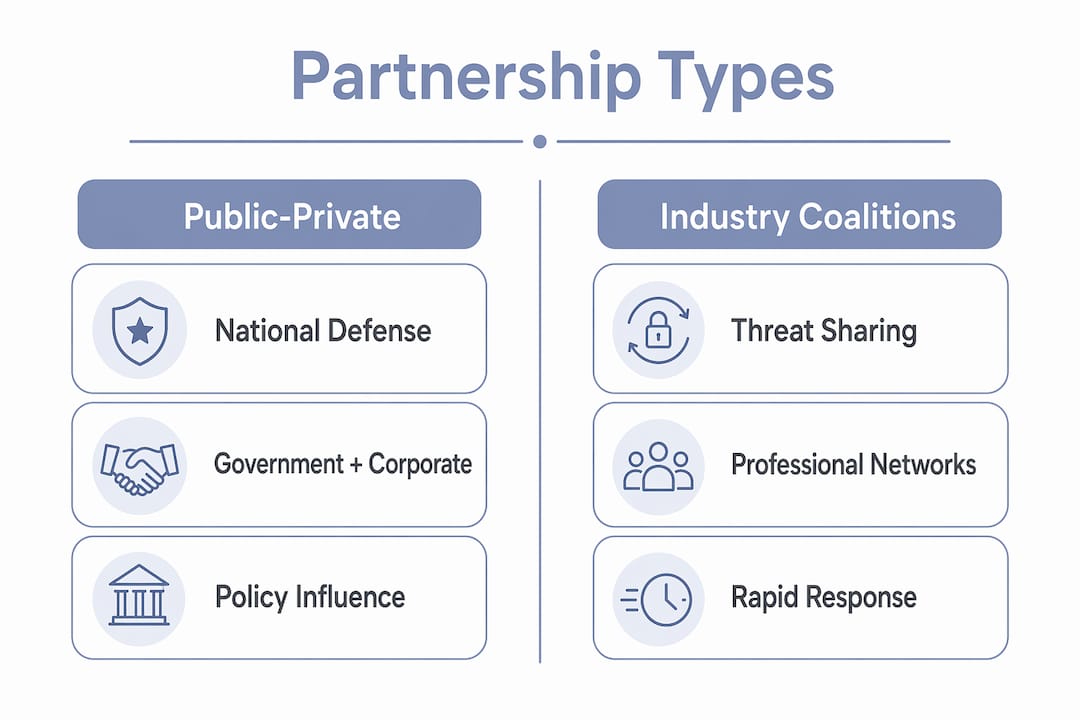
Informal networks, such as Information Sharing and Analysis Centers (ISACs), trade speed for governance. They share threat data quickly but lack the binding agreements that formal partnerships carry. Choosing the right model depends on your organization’s risk profile, regulatory environment, and the depth of collaboration you need.
What are the key benefits cybersecurity partnerships deliver?
The benefits of cybersecurity partnerships extend well beyond shared threat feeds. They reshape how organizations detect, respond, and recover at every level.
-
Faster detection and response. Shared threat intelligence compresses the time between initial compromise and containment. International alliances enable early warning and coordinated responses by pooling technical intelligence across borders. Speed is the most direct operational gain.
-
Joint framework development. Partnerships produce shared security standards that individual organizations rarely build alone. When Microsoft, ESET, and Palo Alto Networks align on threat classification with NATO, the resulting frameworks carry cross-sector authority. That authority accelerates adoption across the supply chain.
-
Improved attribution. Effective partnerships drive collective attribution of cyberattacks, which strengthens diplomatic and legal responses. Attribution without allies is guesswork. Attribution with corroborating intelligence from multiple partners becomes evidence.
-
Force multiplication in national defense. The Ukraine case proved that private sector cyber teams can extend the reach of national defense operations. No government cyber unit has the headcount or tool diversity to match what a coordinated public-private structure provides.
-
Scaling expertise beyond internal limits. Most organizations cannot hire specialists in every threat domain. Partnerships fill those gaps. Project QuiltWorks, for instance, gives member organizations access to AI vulnerability remediation expertise that most security teams do not have in-house.
Pro Tip: Map your internal capability gaps before approaching potential partners. The clearest partnerships form when each party knows exactly what it brings and what it needs. Vague collaboration requests rarely convert into productive alliances.
What challenges must organizations manage in cybersecurity partnerships?
Partnerships fail more often from governance gaps than from technical incompatibility. Understanding where these gaps appear is the first step to avoiding them.
-
KPI and data governance misalignment. Successful partnerships require shifting from transactional vendor ties to data-sharing ecosystems with shared KPIs and data governance policies. Without agreed metrics, partners drift toward measuring different outcomes and eventually stop collaborating.
-
Regulatory and legal compliance. Formal public-private partnerships often require pre-existing compliance with standards like NIST CSF (Cybersecurity Framework) or NERC CIP before delivering operational benefits. Organizations that skip this step find themselves excluded from the most valuable partnership tiers.
-
Trust as a prerequisite, not a byproduct. Trust-based partnerships formed early in national cybersecurity strategy processes increase effectiveness by addressing sector-specific concerns. Trust cannot be retrofitted after a partnership is already operational. It must be built into the design from day one.
-
Political and commercial complexity in international alliances. When partners operate under different legal jurisdictions, data sovereignty rules create friction. NATO’s non-commercial model sidesteps some of this, but bilateral data-sharing agreements still require careful legal review.
-
Informal versus formal governance gaps. Informal networks move fast but lack accountability. When a breach occurs, informal partners have no binding obligation to share forensic data. Formal agreements close that gap but require investment in legal and compliance infrastructure.
Pro Tip: Before signing any partnership agreement, define three things in writing: what data will be shared, who owns the outputs of that sharing, and what happens when a partner is breached. Skipping this conversation creates the exact fragmentation the partnership was meant to prevent.
How can organizations implement cybersecurity partnerships effectively?
Implementation is where most partnership strategies stall. The following steps convert strategic intent into operational reality.
-
Identify your partnership tier. Decide whether you need a formal PPP, an industry coalition membership, or an informal peer network. Your regulatory environment and threat profile determine which tier delivers the most value. Organizations in critical infrastructure sectors typically need formal structures with NIST CSF compliance built in.
-
Build trust before sharing data. Start with low-sensitivity threat indicators and expand sharing as the relationship matures. This mirrors how NATO structured its non-commercial agreements: structured access that scales with demonstrated reliability.
-
Integrate partners into joint security operations. A partner relationship that lives only in a quarterly meeting delivers minimal value. Embed partner threat feeds into your SIEM (Security Information and Event Management) dashboard. Run joint tabletop exercises. Treat partner intelligence as a first-class input to your detection pipeline.
-
Prioritize AI and frontier technology security. Project QuiltWorks and the AI Proving Grounds Consortium both signal that AI-specific partnerships are the fastest-growing segment of inter-organizational cybersecurity strategies. If your organization deploys AI agents, understanding AI security risks is a prerequisite for productive collaboration in this space.
-
Establish feedback loops and measurement. Define partnership KPIs at launch: mean time to detect (MTTD), number of shared indicators of compromise (IOCs), joint incident response activations. Review these quarterly. Partnerships without measurement decay into formalities.
Cryptographic trust mechanisms are becoming a practical tool for formalizing AI-to-human and organization-to-organization trust. Understanding cryptographic trust in AI security gives security leaders a concrete framework for structuring these relationships technically, not just contractually.
What emerging trends are shaping cybersecurity partnerships?
The cybersecurity partnership model is shifting from information exchange to active, adversarial collaboration. This is the most significant structural change in how organizations work together on defense.
The AI Proving Grounds Consortium represents this shift directly. Adversarial validation partnerships simulate AI-driven threats collaboratively, moving beyond passive information sharing toward active defense testing. Partners no longer just share what they have seen. They actively test each other’s defenses against simulated attacks. This is a fundamentally different level of collaboration.
The broader ecosystem is also shifting from vendor-centric to partner-centric models, with partners acting as strategic advisors rather than technology resellers. This means security leaders should evaluate partners on advisory depth, not just product coverage.
Cross-sector and multinational collaborations are expanding. Energy, finance, healthcare, and defense sectors are forming joint working groups that share threat intelligence across industry lines. A ransomware technique targeting a hospital network in 2025 can appear in a financial institution six months later. Cross-sector partnerships compress that detection window.
Securing autonomous AI systems is the next major frontier for partnership strategies. AI agents introduce new attack surfaces, including prompt injection, data exfiltration, and supply chain compromise. No single organization has the visibility to monitor all of these vectors. Partnerships that pool AI-specific threat intelligence will define the next generation of cyber resilience.
Key takeaways
Cybersecurity partnerships are the most scalable defense strategy available, because they multiply expertise, accelerate detection, and produce shared frameworks that no organization can build alone.
| Point | Details |
|---|---|
| Partnership types matter | Choose between PPPs, industry coalitions, and informal networks based on your regulatory profile and threat exposure. |
| Trust must be designed in | Build trust-based agreements early in strategy development, not after a partnership is already operational. |
| Governance prevents failure | Define shared KPIs, data ownership, and breach protocols in writing before any data changes hands. |
| AI partnerships are the frontier | Coalitions like Project QuiltWorks and the AI Proving Grounds Consortium set the model for AI-specific collaboration. |
| Measurement sustains value | Track MTTD, shared IOCs, and joint response activations quarterly to prevent partnerships from becoming formalities. |
Why i think most organizations are still getting partnerships wrong
Most security leaders treat partnerships as a procurement decision. They sign an agreement, exchange threat feeds, and check the box. That is not a partnership. That is a subscription with extra paperwork.
The organizations I have seen build genuinely effective cybersecurity alliances do something different. They embed partners into their security operations before a crisis forces them to. They run joint exercises. They share uncomfortable data, not just sanitized IOC lists. The NATO model with Microsoft and Palo Alto Networks works because it was designed around intelligence access, not vendor relationships.
The hardest part is not technical. It is cultural. Security teams are trained to protect information, not share it. Overcoming that instinct requires leadership commitment and a clear governance structure that makes sharing feel safe. The organizations that crack this problem will have a structural advantage that no single product purchase can replicate.
My advice: treat your first partnership as a pilot. Pick one peer organization or industry coalition. Define narrow sharing parameters. Measure the outcome over 90 days. Then expand. Partnerships built incrementally last. Partnerships announced in press releases rarely do.
— Nicholas
Build your partnership-ready security foundation with Thepitstop
Thepitstop provides the tools that make partnership-driven security strategies operational, not theoretical. The AI Agent Liability Gap white paper maps the governance and liability considerations that every organization needs to address before entering AI-focused cybersecurity alliances. The free AI Agent Security Scan beta gives you a baseline assessment of your AI attack surface, which is the starting point for any credible partnership conversation. The SERA™ Certification program builds human resilience against social engineering, the vector that undermines even the most technically sound partnership frameworks. And the Infinity Protocol™ provides cryptographic trust infrastructure for securing AI agent and human operator relationships across partner boundaries.
FAQ
What is the role of partnerships in cybersecurity?
Cybersecurity partnerships are structured collaborations that pool threat intelligence, technical expertise, and operational resources across organizations to defend against threats no single entity can counter alone. They enable faster detection, joint framework development, and collective attribution of attacks.
How do public-private partnerships improve cybersecurity?
Public-private partnerships integrate corporate technical expertise into national defense frameworks, acting as a force multiplier for government cyber units. The Ukraine conflict demonstrated that this model significantly extends the reach and speed of national cyber resilience operations.
What are the biggest challenges in cybersecurity partnerships?
The most common failure points are misaligned KPIs, insufficient data governance agreements, and lack of regulatory compliance with frameworks like NIST CSF. Trust must be built into the partnership design from the start, not added after the relationship is already operational.
What is project QuiltWorks?
Project QuiltWorks is a CrowdStrike-led industry coalition that mobilizes more than 10,000 certified professionals to identify and remediate AI-discovered code vulnerabilities at scale. It is a leading example of how industry coalitions address AI-specific security threats through coordinated collaboration.
How are AI systems changing cybersecurity partnership strategies?
AI introduces new attack surfaces including prompt injection and supply chain compromise that require cross-organizational visibility to monitor effectively. Initiatives like the AI Proving Grounds Consortium now use adversarial validation to actively simulate AI-driven threats across partner organizations, moving well beyond passive information sharing.