The Role of Machine Learning in Security: 2026 Guide

Machine learning in cybersecurity is defined as the application of statistical models and adaptive algorithms to detect, classify, and respond to threats faster than any human analyst can. The role of machine learning in security has shifted from experimental to foundational. Microsoft’s multi-model agentic system discovered 16 new vulnerabilities missed by traditional methods. Claroty’s CPS-native AI agent Claire delivers evidence-based alerts with confidence scores so analysts stay in control. A systematic review of 53 studies confirmed that supervised ML techniques show high detection accuracy in controlled environments. That accuracy gap between rule-based systems and ML-powered defenses is exactly why security teams are rebuilding their stacks around adaptive models.
How does machine learning improve threat detection and response?
Machine learning improves threat detection by learning normal network behavior and flagging deviations in real time, rather than waiting for a known signature to match. That shift from reactive to proactive is the core technical advantage ML brings to intrusion detection systems (IDS).
The most widely deployed ML techniques in IDS include:
- Decision trees for classifying traffic patterns with interpretable logic
- Support vector machines (SVMs) for separating benign from malicious activity in high-dimensional data
- Deep learning models such as recurrent neural networks (RNNs) for sequential log analysis and detecting lateral movement
- Anomaly detection algorithms that flag statistical outliers without requiring labeled attack samples
Zero-day attacks are the clearest proof of ML’s advantage. Traditional IDS cannot detect what it has never seen. ML models trained on behavioral baselines catch zero-day exploits because the attack behavior deviates from normal, even if the specific exploit is unknown. This is why ML systems outperform static rule-based IDS in zero-day exploit detection and anomaly recognition.
Multi-agent orchestration takes detection further. Microsoft’s system uses over 100 specialized AI agents that debate findings, construct proofs, and cross-validate results before surfacing an alert. That multi-agent debate pipeline reduces false positives because no single model’s output is treated as final. The practical result is fewer analyst hours wasted on noise and faster remediation of real threats.

Pro Tip: When evaluating ML-based IDS tools, ask vendors specifically how they handle false positive rates in production. A model that performs at 99% accuracy in a lab but floods your SOC with alerts is a liability, not an asset.
Speed of response is the third dimension. ML automates the triage layer, sorting thousands of daily alerts by severity, confidence score, and recommended action. Security teams at organizations using AI-assisted triage report significantly shorter mean time to respond (MTTR) compared to fully manual workflows. For more on building these workflows, see Thepitstop’s guide on AI cybersecurity best practices.
What are the challenges of integrating ML into cybersecurity?
The biggest challenge is not technical capability. The gap between academic ML performance and real-world deployment is significant, driven by poor explainability and untested robustness in production environments. Security leaders who deploy ML expecting a turnkey solution consistently run into this wall.
The specific risks that demand attention include:
- Adversarial attacks: Attackers craft inputs specifically designed to fool ML classifiers, causing malicious traffic to be labeled benign
- Model poisoning: Injecting corrupted data into training sets to degrade detection accuracy over time
- Data tampering: Manipulating the telemetry ML models rely on to skew their outputs
- Alert fatigue: Poorly tuned models generate so many alerts that analysts begin ignoring them, defeating the purpose entirely
ML model pipelines are prime targets for adversarial attacks, including training data poisoning and crafted inputs. Standard deployments often skip adversarial robustness testing entirely. That oversight puts detection capabilities at risk from targeted attacks on the models themselves.
Explainability is the second structural problem. When an ML model flags an alert, analysts need to understand why. Black-box models that output a risk score without reasoning create distrust and slow response. Claroty’s Claire solves this by providing evidence, confidence scores, and remediation steps for every alert. That design keeps human analysts in control while the AI handles volume.
Pro Tip: Require explainability as a non-negotiable feature in any ML security tool you evaluate. If a vendor cannot show you why their model flagged a specific event, you cannot defend that decision to your board or a regulator.
Human-in-the-loop orchestration is not optional. Fully autonomous ML systems without human oversight create accountability gaps and miss context that only experienced analysts carry. The most effective deployments treat ML as a force multiplier for human judgment, not a replacement for it.
Traditional security methods vs. ML-enhanced systems
Signature-based IDS and ML-powered anomaly detection represent fundamentally different philosophies. One looks backward at known threats. The other models normal behavior and detects anything that deviates from it.
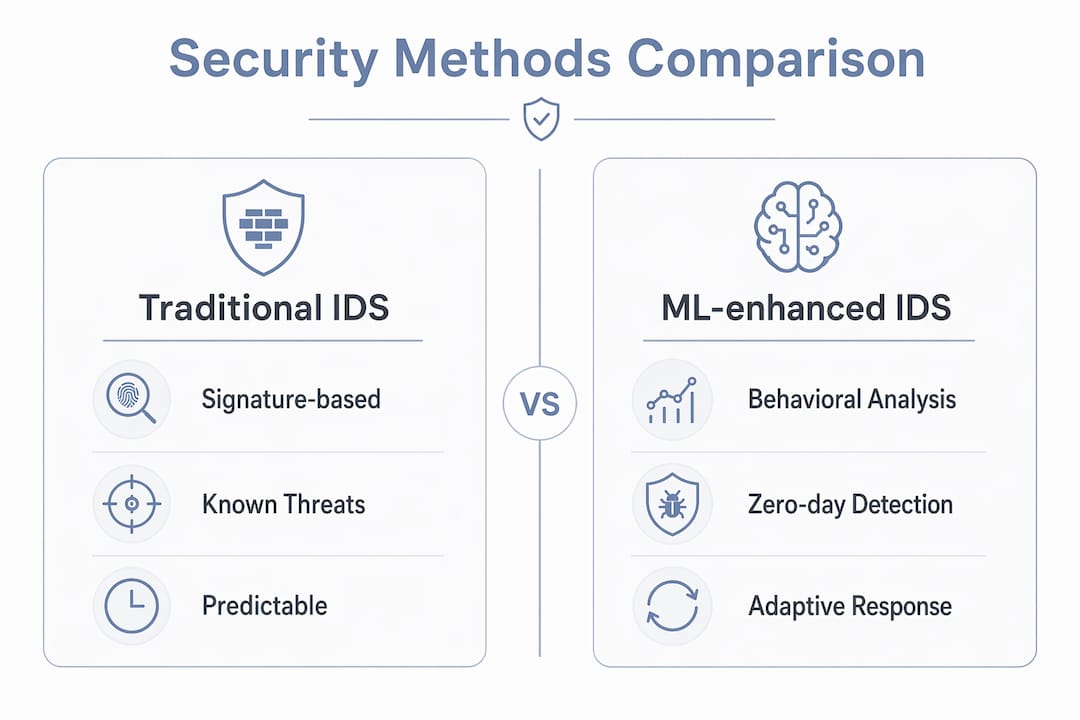
| Capability | Signature-based IDS | ML-enhanced IDS |
|---|---|---|
| Zero-day detection | No. Requires known signatures. | Yes. Detects behavioral anomalies. |
| Adaptability | Static. Requires manual rule updates. | Continuous. Retrains on new data. |
| False positive rate | High for novel traffic patterns. | Lower with well-tuned models. |
| Explainability | High. Rules are human-readable. | Variable. Depends on model type. |
| Scale | Limited by rule complexity. | Scales with data volume. |
| Adversarial robustness | Not applicable. | Requires dedicated testing. |
The table reveals a clear tradeoff. Signature-based systems are transparent and predictable but blind to anything new. ML systems are adaptive and scalable but require investment in explainability and robustness testing to be trustworthy in production.
The hybrid approach outperforms both extremes. Signature rules catch known, high-confidence threats instantly. ML models handle the gray zone of novel and stealthy attacks. Human analysts review the ML output and refine model behavior over time. This three-layer model is what organizations like real-world network anomaly detection teams use to maintain coverage across both known and unknown threat categories.
The rapid expansion of IoT and 5G has increased the attack surface to a scale where signature-based methods simply cannot keep pace. The volume and variety of connected devices generate traffic patterns no static ruleset can fully describe. ML is the only architecture that scales with that complexity.
Practical applications and future trends in ML security
The most consequential AI applications in security today are agentic systems. These are not single models running in isolation. They are orchestrated pipelines where specialized agents handle distinct tasks, from data ingestion to vulnerability validation to remediation recommendation.
Here is how leading organizations are deploying ML-driven security in 2026:
- Agentic vulnerability discovery: Microsoft’s system uses auditor, debater, and prover agent roles to cross-validate findings before surfacing them to analysts. This pipeline design eliminates single-model overconfidence.
- AI-native proxy security: Cloudflare’s reverse proxy layer processes approximately 20% of web traffic to detect prompt injections, PII leakage, and toxic content before it reaches AI models. Existing Web Application Firewall (WAF) rules are combined with AI signals for layered protection.
- CPS and OT security: Claroty’s Claire applies ML specifically to cyber-physical systems, where traditional IT security tools have no visibility. Industrial control systems and operational technology (OT) environments are now within ML’s detection scope.
- Human resilience testing: Thepitstop’s platform tests human operators against phishing and social engineering attempts alongside machine-level security scans, recognizing that the human layer is as exploitable as any software vulnerability.
| Application | ML technique | Primary benefit |
|---|---|---|
| Intrusion detection | SVM, deep learning | Detects zero-day and anomalous traffic |
| Vulnerability discovery | Multi-agent orchestration | Finds complex bugs missed by single models |
| Proxy-level AI defense | Classification + WAF integration | Blocks prompt injections and data leaks |
| Phishing simulation | NLP and behavioral modeling | Tests and trains human operators |
The next wave of ML security applications will center on IoT, cloud-native environments, and 5G infrastructure. Each of these expands the attack surface and generates data volumes that only ML can process at speed. Organizations that build ML into their security architecture now will be positioned to absorb those expansions without rebuilding from scratch. For a deeper look at protecting AI systems from data leaks specifically, Thepitstop’s guide on mitigating data exfiltration is worth reviewing.
Key takeaways
Machine learning in cybersecurity delivers its greatest value when adaptive detection, multi-agent validation, and human oversight operate together as a single integrated system.
| Point | Details |
|---|---|
| ML enables zero-day detection | Behavioral anomaly models catch novel attacks that signature-based IDS cannot identify. |
| Multi-agent pipelines reduce errors | Systems like Microsoft’s use debater and prover agents to validate findings before alerting analysts. |
| Adversarial risks are real | ML pipelines require dedicated robustness testing to defend against poisoning and crafted inputs. |
| Human oversight is non-negotiable | Evidence-based alerts with confidence scores keep analysts in control and prevent alert fatigue. |
| Hybrid architectures outperform | Combining signature rules, ML anomaly detection, and human review delivers the strongest defense posture. |
Why I think most organizations are still getting ML security wrong
I have watched the security industry adopt machine learning the same way it adopted every previous technology: with more enthusiasm than discipline. The pattern is familiar. A vendor demo shows impressive detection rates. A procurement team signs a contract. Six months later, the SOC is drowning in alerts and the ML model has not been retrained since deployment.
The discrepancy between academic ML performance and real-world results is not a research problem. It is a deployment culture problem. Organizations treat ML models as products rather than systems that require ongoing maintenance, adversarial testing, and human calibration.
What actually works is treating ML as the analytical layer of a larger human-machine system. The organizations getting this right are the ones where analysts interact with model outputs daily, flag incorrect classifications, and feed that feedback back into retraining cycles. That is not glamorous. It does not make for a compelling conference talk. But it is what separates a security program that improves over time from one that stagnates.
The other misconception I see constantly is the belief that more automation equals more security. True resilience depends on human-in-the-loop orchestration that balances automation with expert judgment. Fully autonomous ML systems create accountability gaps that attackers will eventually find and exploit. The goal is not to remove humans from security operations. The goal is to free human analysts from low-value triage so they can focus on the decisions that actually require judgment. That distinction matters more than any benchmark score.
— Nicholas
Secure your AI-driven infrastructure with Thepitstop

The shift to ML-powered security creates new attack surfaces that traditional tools were never designed to address. Thepitstop was built specifically for this environment. The platform’s AI Agent Security Scan assesses vulnerabilities across your entire AI-driven attack surface, including prompt injection risks, data exfiltration vectors, and supply chain exposures. For teams that need to understand the liability implications of deploying AI agents, the AI Agent Liability Gap white paper provides a rigorous framework for risk assessment. Security teams can also validate their human operators with the SERA™ Certification program, which tests social engineering resilience alongside machine-level defenses.
FAQ
What is the primary role of machine learning in security?
Machine learning in cybersecurity detects threats by modeling normal behavior and flagging deviations, enabling identification of zero-day attacks and novel exploits that signature-based systems miss entirely.
How does ML reduce false positives in threat detection?
Multi-agent pipelines, like Microsoft’s system using auditor and debater roles, cross-validate findings before surfacing alerts. That validation layer filters out noise and delivers only high-confidence, actionable findings to analysts.
What are the biggest risks of using ML in cybersecurity?
ML pipelines are vulnerable to adversarial attacks, model poisoning, and data tampering. Standard deployments often skip robustness testing, leaving detection capabilities exposed to targeted attacks on the models themselves.
How does ML-enhanced security compare to traditional IDS?
ML systems detect zero-day and behavioral anomalies that static signature-based IDS cannot identify. The tradeoff is that ML requires ongoing retraining, explainability investment, and human oversight to remain trustworthy in production.
Why is human-in-the-loop design critical for ML security systems?
Fully autonomous ML systems create alert fatigue and accountability gaps. Evidence-based alerts with confidence scores, as used by Claroty’s Claire, keep human analysts in control while the AI handles high-volume triage.