The Role of End Users in AI Safety in 2026

Most people assume AI safety is a problem for researchers and developers to solve in a lab. That assumption is wrong, and it’s becoming more costly by the day. The role of end users in AI safety is not a footnote to the developer story. It’s a parallel track that determines whether a safe model becomes a safe deployment. From identifying biased outputs that automated tests miss to shaping governance decisions that affect entire communities, what you do with AI matters as much as how it was built.
Table of Contents
- Key takeaways
- The role of end users in AI safety goes beyond passive consumption
- Why non-expert users are indispensable for AI auditing
- Practical ways users contribute to AI safety every day
- The real challenges of user involvement in AI safety
- My perspective: developers cannot save you from a system users ignore
- How Thepitstop helps you put this into practice
- FAQ
Key takeaways
| Point | Details |
|---|---|
| Users are active safety partners | End users catch social and ethical harms that developer audits routinely miss in real deployments. |
| Feedback loops close safety gaps | User-reported issues feed back into model correction, bias detection, and guardrail improvement cycles. |
| Governance needs your voice | Decentralized models like DAO voting give non-expert users real influence over how AI behaves at scale. |
| Trust calibration protects you | Maintaining critical thinking when using AI prevents skill atrophy and reduces over-reliance risks. |
| Privacy creates accountability tension | Features that protect user privacy can also limit traceability, requiring careful organizational balance. |
The role of end users in AI safety goes beyond passive consumption
For most of AI’s short public history, safety conversation centered on the model: training data, alignment techniques, red-teaming by experts. That framing is outdated. AI safety is now primarily a system and deployment challenge, and the system includes you.
Think about what actually happens when an AI model reaches production. It encounters inputs its developers never anticipated. It gets used in contexts, by populations, and for purposes that no internal test suite fully covered. The gap between the controlled environment where a model was validated and the real world where it operates is exactly where user participation becomes non-negotiable.
There are concrete mechanisms through which users close that gap:
- Contestation mechanisms: Users cross-check AI outputs against other sources and flag inconsistencies. This is not optional diligence. It is a formal component of responsible AI deployment described in peer-reviewed safety research.
- Active documentation: When users record what the AI did wrong, in what context, and what the consequence was, they generate the kind of contextual data that developers cannot produce internally.
- Continuous training participation: Organizations that treat AI safety seriously run regular sessions where users learn to recognize failure modes, not just use features correctly.
Pro Tip: If your organization deploys any AI tool, build a simple shared log where users record unexpected or concerning outputs. That log is your first line of safety intelligence.
AI security failures often stem from complex system issues involving user interfaces and APIs, not model architecture alone. End-user feedback is one of the few signals that can surface those failures before they cause serious harm.
Why non-expert users are indispensable for AI auditing
Here is a finding that surprises most people: the people most likely to catch genuinely harmful AI behavior are often not AI experts. They are the nurses, teachers, case workers, and everyday consumers actually using the systems.

Participatory auditing research confirms that non-expert users contribute contextually rich observations that automated metrics and developer teams frequently miss. A developer testing a healthcare AI for accuracy will not necessarily notice that it consistently gives shorter, less thorough responses to patients who write in non-standard English. A nurse using that system daily will.
This insight is now driving structural changes in how AI governance works. Compare two approaches:
| Governance model | Who audits | What gets caught | Main limitation |
|---|---|---|---|
| Developer-led internal audit | Engineers and data scientists | Technical errors, benchmark failures | Blind to social context and lived experience |
| Participatory user auditing | Diverse end users across roles | Bias, ethical harm, real-world failures | Requires structured support and time investment |
The participatory model consistently surfaces issues the internal model misses. An integrative review confirmed that involving non-AI experts in development and auditing is a fundamental requirement for producing trustworthy AI tools in public administration.
Beyond informal auditing, governance structures are evolving to formalize user involvement. DAO-based voting systems now allow community discussion, compromise, and minority viewpoint protection in AI decision-making. This is a meaningful shift from the survey model, where user opinions are collected and then set aside. Real voting mechanisms give users proportionate influence over how AI behaves in their communities.
“Community-driven AI governance platforms can democratize AI decision-making beyond mere surveys, improving fairness and inclusivity.” — InclusiveAI research, Phys.org, 2026
For this to work, three conditions matter: transparency about what is being decided, early involvement before product decisions are locked in, and support tools that help non-experts understand what they are reviewing. Without those conditions, participatory auditing becomes theater.
Practical ways users contribute to AI safety every day
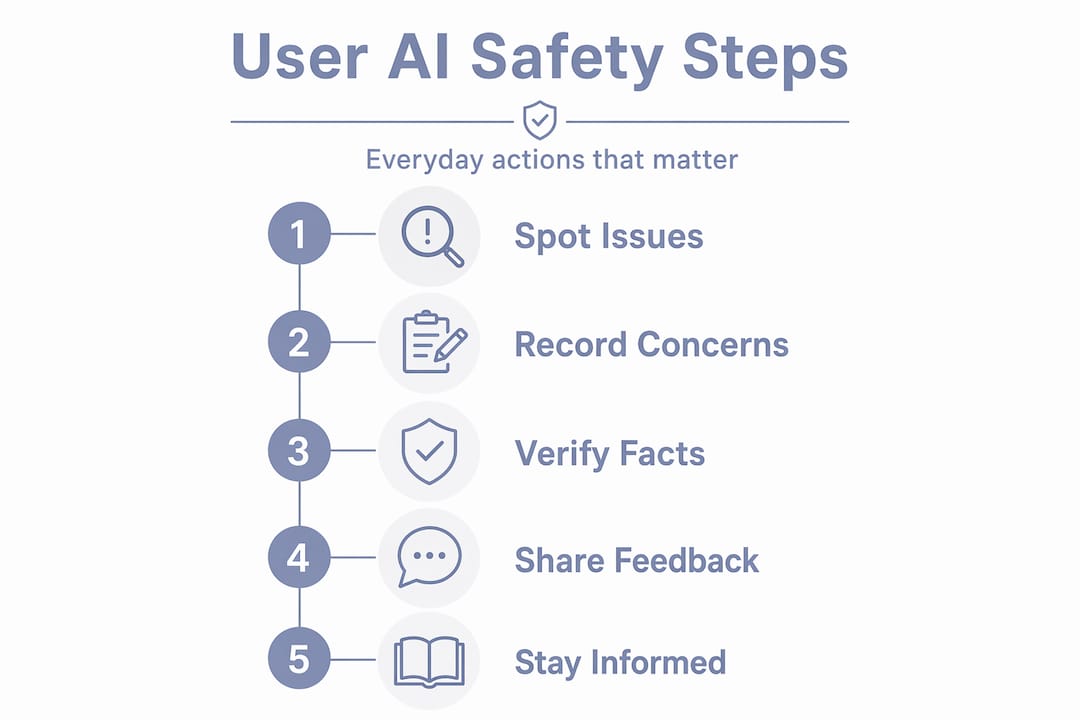
Understanding the theory is useful. Knowing exactly what to do on a Tuesday morning is better. End user contributions to AI safety happen at three distinct levels, and most users are already doing some of this without realizing it.
-
Input-level safety: What you type or submit to an AI system matters. Phrasing requests carefully, avoiding the inclusion of sensitive personal data, and not trying to manipulate the system into bypassing its constraints all reduce risk. Effective logging and filtering frameworks at the user interface level include real-time PII masking and feedback loops for model correction. Your behavior at the input stage directly feeds those systems.
-
Output-level verification: Never treat an AI response as finished work without review. This applies to factual claims, legal interpretations, medical information, and code. OpenAI updated ChatGPT in May 2026 to include safety summaries and distress signal recognition, but the system still depends on users to verify outputs in context.
-
Feedback and reporting: Most AI platforms have mechanisms to flag problematic responses. Using them consistently is one of the highest-value things a user can do. Organizations advocating human-in-the-loop bias evaluations rely on this signal to drive model corrections. One flag by one user may seem insignificant. Patterns across thousands of users force changes.
The trust calibration problem deserves special attention here. Designing AI tools that encourage over-trust leads to skill atrophy, where users gradually lose the capacity to evaluate outputs critically because the tool has made that effort feel unnecessary. Safe AI should actively prompt users to verify, question, and maintain their own judgment. Users who understand this dynamic can resist it deliberately, even when the interface does not support them.
Pro Tip: Set a personal rule that you will always check at least one factual claim per AI-assisted task against an independent source. This one habit keeps your critical thinking sharp and catches errors before they compound.
For organizations, building a social engineering defense workflow that incorporates AI awareness training is a direct extension of this principle. The human in the loop needs to be a trained, skeptical human to be genuinely useful.
The real challenges of user involvement in AI safety
None of this is without friction. Honest engagement with the role of consumers in AI safety requires acknowledging where user involvement gets complicated.
The privacy and accountability tension is real. Features like incognito modes protect users from having their AI interactions logged and stored. That is a legitimate privacy interest. But privacy protections create genuine challenges for auditing AI behavior and maintaining accountability when something goes wrong. You cannot trace a harmful output pattern if the logs that would reveal it do not exist.
Other complications worth knowing about:
- Over-reliance risk: If organizations treat user feedback as a complete substitute for rigorous technical auditing, they introduce new failure modes. User feedback is a layer of safety intelligence, not a replacement for structured evaluation.
- Representation bias in feedback: Users who submit feedback are not a random sample. They tend to be more engaged, more technically comfortable, or more affected by a specific issue. Systems that weight feedback without correcting for this skew can amplify some voices while silencing others.
- Accountability diffusion: When safety responsibility is distributed across users, developers, and operators, it becomes easy for each group to assume someone else is handling it. Clear accountability structures prevent that diffusion.
- Skill atrophy at scale: Across an entire workforce, gradual over-trust in AI outputs can quietly erode the expertise that makes human oversight meaningful.
The frameworks addressing these challenges share a common feature. They do not try to solve the tension by choosing one value over another. Instead, they build structures that hold both privacy and accountability, or both user feedback and technical rigor, at the same time. Cryptographic trust mechanisms represent one technical path toward that balance, creating verifiable accountability without requiring users to surrender privacy entirely.
My perspective: developers cannot save you from a system users ignore
I’ve spent years watching organizations deploy AI tools with real care taken at the model level, only to see the safety work unravel in production because users were treated as an afterthought. The pattern is almost always the same. Developers do the hard work. A compliance team signs off. Users get a 20-minute onboarding video. And then the system starts producing outputs that nobody anticipated, in contexts nobody modeled, with consequences nobody logged.
What I’ve learned is that user responsibility in AI governance is not just a nice addition to the safety stack. It is load-bearing. When organizations skip it, they are not saving resources. They are pushing risk downstream to the moment when a user, unprepared and unsupported, makes a decision the system should never have allowed them to make alone.
The most effective deployments I have seen treated users as contributors from day one. Not as testers, exactly, but as participants in an ongoing process of understanding what the system actually does in the world. That means early involvement, real feedback channels, and organizational cultures where flagging a problem is recognized as a contribution rather than treated as a complaint.
The uncomfortable truth is that most AI safety discussions still center on the model. Shifting that conversation toward deployment, governance, and the people using these systems every day is one of the most practical moves any organization can make in 2026.
— Nicholas
How Thepitstop helps you put this into practice
The gap between understanding user responsibility and operationalizing it is where most organizations get stuck. Thepitstop was built specifically for that gap.
Whether you are an individual trying to understand your own exposure or a security team mapping your organization’s AI attack surface, Thepitstop provides free, automated tools designed to assess both machine-level vulnerabilities and human resilience. The AI Agent Liability Gap white paper is the right starting point for anyone who wants a deeper framework for understanding how end users reshape AI safety beyond the model. For organizations ready to act, the free AI agent security scan surfaces deployment-level risks with human-in-the-loop evaluation built in. And for individuals who want a credential that reflects genuine social engineering resilience, the SERA™ Certification is a direct investment in the kind of user-level safety competence this article describes.
FAQ
What is the role of end users in AI safety?
End users identify real-world failures, submit feedback that drives model corrections, and act as a human safety layer that automated testing cannot replicate. Their participation is a structural requirement for safe AI deployment, not an optional extra.
How do end users affect AI safety in practice?
Users contribute at three levels: careful inputs that reduce data exposure, output verification that catches errors before they cause harm, and feedback reporting that surfaces patterns developers cannot see internally.
Why is user involvement in AI ethics important?
Non-expert users detect nuanced social and ethical harms that developer-led audits miss, including bias patterns affecting marginalized groups in healthcare and education contexts. Their lived experience is a form of audit data.
What challenges complicate user participation in AI safety?
The main tensions involve privacy versus accountability, over-reliance on feedback as a substitute for technical auditing, and the risk that distributing safety responsibility diffuses it to the point where no one owns it clearly.
How can organizations improve user responsibility in AI governance?
Start with structured training, build real feedback channels into every AI deployment, and treat user-reported issues as safety intelligence rather than support tickets. AI accountability frameworks that include user validation processes produce measurably better safety outcomes than those that do not.