The Role of Cyber Hygiene in AI Security in 2026

Most organizations treating AI security as a separate concern from basic cyber hygiene are already behind. The role of cyber hygiene in AI is not a side conversation you can defer until your AI deployment matures. AI systems expand your attack surface, multiply your non-human identities, and introduce entirely new threat vectors like prompt injection and behavioral misalignment. If your foundational hygiene is weak, your AI security will collapse at the first serious probe. This article breaks down what that means in practice, what the new risks actually look like, and what you need to do about it now.
Table of Contents
- Key Takeaways
- The role of cyber hygiene in AI systems
- New risks AI systems bring to your security posture
- Integrating hygiene with AI-specific security frameworks
- Practical cyber hygiene strategies for AI environments
- My perspective on cyber hygiene and AI security
- How Thepitstop helps you maintain cyber hygiene for AI
- FAQ
Key Takeaways
| Point | Details |
|---|---|
| Hygiene still defends most attacks | Full CIS Controls defend against approximately 86% of known cyber attack techniques, even in AI environments. |
| AI expands the attack surface fast | Agentic AI systems introduce privilege escalation, behavioral misalignment, and limited auditability as new risk categories. |
| AI-specific frameworks are necessary | Traditional security frameworks have gaps; MITRE ATLAS addresses AI-specific threats like data poisoning and model extraction. |
| Least privilege applies to AI agents | Treat AI agent identity as a critical IAM problem with scoped, explicit access controls from day one. |
| Human oversight is non-negotiable | Continuous human-in-the-loop controls, like gated tool integration, substantially reduce the risk of persistent agent compromise. |
The role of cyber hygiene in AI systems
Cyber hygiene refers to the consistent, disciplined practices organizations use to maintain the health and security of their digital environments. At its core, that means patch management, access controls, asset inventory, configuration management, and continuous monitoring. These are not glamorous. They are also not optional.
The importance of cyber hygiene has not diminished because AI arrived. It has become more foundational. Full CIS Controls defend approximately 86% of known cyber attack techniques, and even baseline hygiene controls alone cover roughly 77%. That statistic holds just as true for AI-integrated environments as for traditional infrastructure.
What changes with AI is the surface area those hygiene practices must cover. Consider a standard enterprise AI deployment. You now have:
- AI models accessing sensitive data sources
- Automated pipelines making decisions without human review
- Non-human agents authenticating to internal systems
- Third-party model providers in your supply chain
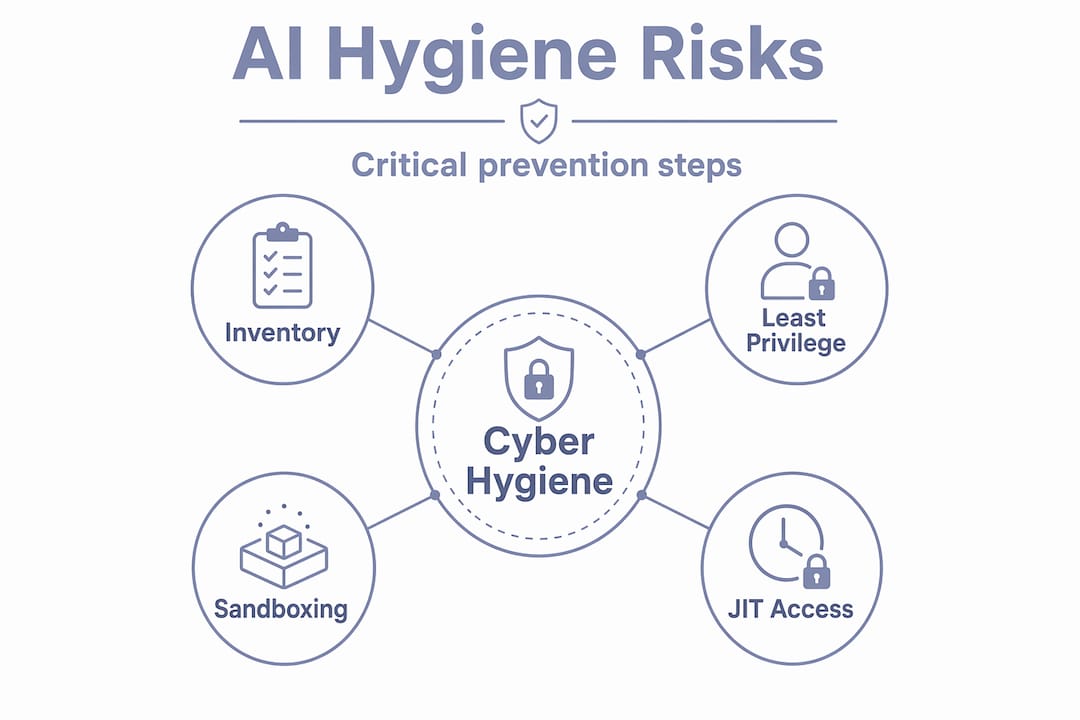
Each of these is a hygiene problem before it is an AI problem. If you have not inventoried what your AI agents can access, or who owns those assets, you cannot secure them. Clear asset ownership and secure configuration are the linchpins of effective cybersecurity hygiene, and that applies directly to AI infrastructure.
Pro Tip: Map every AI agent and model in your environment to a named human owner. If no one is accountable for an agent’s behavior, no one is monitoring it either.
New risks AI systems bring to your security posture
Here is where the conversation shifts from “more of the same” to genuinely new territory. Agentic AI systems introduce risks like expanded attack surfaces, privilege escalation, behavioral misalignment, and severely limited auditability. These are not variations on existing threats. They require you to extend how you think about cyber hygiene.
The autonomy of AI agents is the crux of the problem. An AI agent does not wait for human approval before taking action. It authenticates, retrieves data, calls tools, and writes outputs, often in seconds. That speed and autonomy means a compromised agent can cause far more damage far faster than a compromised human account. Between November 2025 and February 2026, there was a 32% increase in malicious attempts targeting AI agent deployments specifically.
Four risk categories deserve particular attention:
- Privilege escalation and permission creep. AI agents often start with narrow permissions and accumulate broader access over time as capabilities expand. Without active governance, organizations lacking AI agent governance risk serious privilege creep that leads to operational security incidents.
- Prompt injection. System prompts cannot be trusted as security controls. Attackers craft inputs that override an agent’s instructions and redirect its behavior, and the model may comply without any indication something went wrong.
- Data poisoning. As little as 0.1% of training data compromised can enable a successful data poisoning attack, with traditional detection methods often too blunt to catch it.
- Behavioral misalignment. An AI agent can drift from intended behavior due to model updates, retrieval scope changes, or adversarial manipulation, without triggering any traditional security alert.
“AI agents increase the ratio of non-human identities dramatically, requiring novel IAM governance and monitoring approaches.” This is not a future concern. It is the current reality for any organization running agentic systems at scale.
Understanding these risks is also why mapping your real attack surface matters before you add AI agents, not after.
Integrating hygiene with AI-specific security frameworks
Traditional security frameworks like MITRE ATT&CK were designed for human-operated infrastructure. They have coverage gaps when applied to AI systems. MITRE ATLAS covers AI-specific attack tactics including training data poisoning and model extraction, making it a necessary complement to your existing threat modeling.
The practical question is how to integrate AI-specific controls into your existing hygiene programs without creating a separate, siloed AI security function. Siloed security programs tend to lack the operational integration needed to catch real incidents. Organizations should embed AI risk management into existing cybersecurity frameworks rather than building them separately.
Here is how core hygiene controls map to AI-specific controls:
| Traditional control | AI-specific equivalent | Purpose |
|---|---|---|
| Least privilege access | Scoped, JIT access for AI agents | Limits agent blast radius |
| Network segmentation | Agent sandboxing and egress filtering | Contains compromise scope |
| IAM and MFA | Non-human principal authorization | Prevents unauthorized agent actions |
| Patch management | Model version pinning and update validation | Reduces behavioral drift risk |
| Audit logging | Agent action logging and session replay | Supports forensic review |
Agent sandboxing, credential isolation, and egress filtering form the critical patterns that contain the blast radius when an AI system is compromised. Sandboxing limits what an agent can touch. Credential isolation prevents exposed secrets from becoming a pivot point. Egress filtering stops data from leaving.
On the identity side, AI agents should be treated as distinct non-human principals with explicit authorization policies. That means every AI agent has an identity, that identity has defined permissions, and those permissions are scoped to the minimum required for the agent’s function. This is standard IAM discipline applied to a new category of principal.
Pro Tip: Use just-in-time (JIT) access for high-privilege AI agent operations. Grant the permission, execute the task, revoke the permission. It is more operationally complex, but the risk reduction is significant.
Practical cyber hygiene strategies for AI environments
Knowing the frameworks is one thing. Executing daily is another. The following steps represent what strong cyber hygiene looks like when adapted for AI infrastructure. Daily cyber hygiene practices remain the foundation of security, and discipline consistently outperforms expensive tooling without operational rigor.
-
Build and maintain an AI asset inventory. Every model, agent, pipeline, and integration point should be cataloged with an assigned owner. If it processes data or takes autonomous action, it belongs in your inventory.
-
Apply configuration management to AI infrastructure. Treat model configuration, retrieval parameters, and tool permissions as configuration artifacts. Track them in version control. Review changes before they hit production.
-
Run regular audits and verification cycles. Test your AI agents against known attack patterns, including prompt injection attempts. Verify that access controls still match your intended scope. Progressively validate agent privileges before expanding them.
-
Establish human escalation controls. Define which agent actions require human approval before execution. Financial transactions, data exports, and external communications are good starting candidates. Do not leave these to the agent’s judgment.
-
Deploy purpose-built security tooling for AI. General-purpose SIEM and endpoint tools miss AI-specific behaviors. Look for tools that log agent actions, monitor retrieval scopes, and flag behavioral anomalies. Cyber hygiene training for AI teams should also include hands-on exposure to how agents actually behave under adversarial conditions, not just classroom theory.
Investing in reducing attack surfaces in AI operations requires treating these steps as recurring operational practice, not a one-time setup task.
Pro Tip: Establish a “fail-safe default” policy for AI agents: if an agent encounters an ambiguous or unexpected instruction, it should halt and escalate rather than proceed. This one default prevents a significant class of prompt injection damage.

My perspective on cyber hygiene and AI security
I have watched organizations pour significant resources into AI capability while treating security as something they will sort out later. The rationalizations are always the same: “We are still in a pilot phase,” or “Our AI is not doing anything sensitive yet.” Both miss the point entirely.
What I have found is that the assuming-breach mindset, which the endpoint security world adopted over a decade ago, is the exact paradigm shift AI security needs right now. You do not wait for AI agents to be compromised and then respond. You architect every deployment on the assumption that compromise will occur, and you design to contain the damage. That means blast radius thinking is not an advanced topic for large enterprises. It is the baseline design question for any AI deployment.
The uncomfortable truth I have learned about AI cyber hygiene is that the most dangerous gap is not in your tools or your frameworks. It is in the daily discipline of your team. I have seen organizations with excellent AI security policies that were consistently bypassed because no one was checking the asset inventory, no one was reviewing the agent access logs, and no one had defined who actually owned each agent’s behavior. Security without operational rhythm is theater.
What I believe you should take seriously right now is building social engineering resilience into your AI teams. Human operators remain the most targeted entry point, and an AI agent is only as trustworthy as the human who configured it and monitors it.
— Nicholas
How Thepitstop helps you maintain cyber hygiene for AI
Thepitstop was built specifically to address the security gaps that appear when AI agents and human operators work together. The platform offers free, automated tools that assess your security across the full attack surface, covering both machine-level vulnerabilities in AI agents and human susceptibility to social engineering.
If you are starting from an audit of your current AI security posture, the free AI Agent Security Scan gives you an immediate, objective view of where your agents are exposed. For organizations looking to understand the deeper liability and governance questions around AI agents, the AI Agent Liability White Paper provides the frameworks you need to brief leadership and drive internal policy. Thepitstop also offers the Infinity Protocol™, a cryptographic trust mechanism for securing agent-human interactions at the infrastructure level. These tools integrate directly with existing cyber hygiene practices rather than replacing them.
FAQ
What is cyber hygiene and why does it matter for AI?
Cyber hygiene refers to consistent security practices like patch management, access controls, and asset inventory. In AI environments, it matters because weak foundational hygiene directly enables the AI-specific attacks like prompt injection and privilege escalation that cause the most damage.
How does AI change the impact of cyber hygiene on security?
AI expands the attack surface by adding non-human agents, automated pipelines, and third-party model dependencies. The impact of cyber hygiene on AI security is amplified because a single hygiene gap can allow an autonomous agent to cause damage across multiple systems simultaneously.
What are the best cyber hygiene guidelines for AI agent deployments?
The best cyber hygiene guidelines for AI agents include treating each agent as a distinct IAM principal, applying least-privilege and JIT access, sandboxing agent execution environments, logging all agent actions, and establishing human escalation checkpoints for high-risk operations.
What is prompt injection and how does cyber hygiene help prevent it?
Prompt injection is an attack where malicious input overrides an AI agent’s instructions, redirecting its behavior. Cyber hygiene strategies defend against it through application-layer authorization, tight retrieval scope filters, and rigorous input validation rather than relying on system prompts alone.
How should organizations start improving cyber hygiene for AI systems?
Start with an accurate inventory of all AI agents and their access permissions, assign human owners to each, and run an independent security assessment to identify exposure. Building from that baseline is more effective than deploying new tools without knowing your current state.