The Role of Cryptographic Trust in AI Security

Most trust in AI systems today rests on assumptions you cannot verify. A model returns a result, a log entry says it ran correctly, and you either believe it or you don’t. The role of cryptographic trust in AI is to replace that ambiguity with mathematical proof. Instead of assuming an agent behaved as intended, you verify it did. This article walks through the core mechanisms, current frameworks, and practical implementation strategies that let AI researchers and developers build systems where trust is earned through cryptography, not granted through hope.
Table of Contents
- Key takeaways
- The role of cryptographic trust in AI systems
- Frameworks and technologies implementing cryptographic trust
- Technical best practices for implementation
- Why cryptographic trust is now indispensable
- My perspective on where this is heading
- How Thepitstop addresses cryptographic trust for AI teams
- FAQ
Key takeaways
| Point | Details |
|---|---|
| Cryptographic trust is mathematically verifiable | Unlike traditional trust models, cryptographic guarantees are provable, not just assumed. |
| Digital signatures cover three critical properties | Authenticity, integrity, and non-repudiation are all enforced through signing at each pipeline stage. |
| Merkle audit trails prevent log tampering | An append-only Merkle chain means any modification or deletion breaks the chain and is immediately detectable. |
| Determinism enables verifiable execution | Content-addressed artifacts and reproducible runs allow replayable, auditable AI workflows. |
| Regulatory pressure is accelerating adoption | The EU AI Act mandates tamper-evident logging for high-risk AI, making cryptographic trust a compliance requirement. |
The role of cryptographic trust in AI systems
What is cryptographic trust, exactly? At its core, it is a security model where confidence in data, code, or identity comes from mathematical verification rather than from reputation, policy, or access controls alone. A cryptographic guarantee does not say “we think this hasn’t been tampered with.” It says “any tampering would break this proof, and we can verify that independently.”
Traditional AI trust models rely on perimeter security: lock down access to the model, trust the infrastructure it runs on, and assume logs are accurate. The problem is that this breaks down quickly in autonomous systems. When an AI agent calls external tools, retrieves data, or chains outputs to other agents, each step introduces an unverified handoff. A single compromised link can corrupt the entire workflow without triggering any visible alarm.
Cryptographic trust mechanisms solve this differently. They anchor verification to the artifact itself, not to the environment it lives in.
Digital signatures: the foundation
Digital signatures provide three properties that matter deeply in AI security: authenticity (you know who produced the artifact), integrity (you know it hasn’t changed), and non-repudiation (the signer cannot deny producing it). For AI workflows, this means signing model weights, prompts, configuration files, and outputs at every stage.
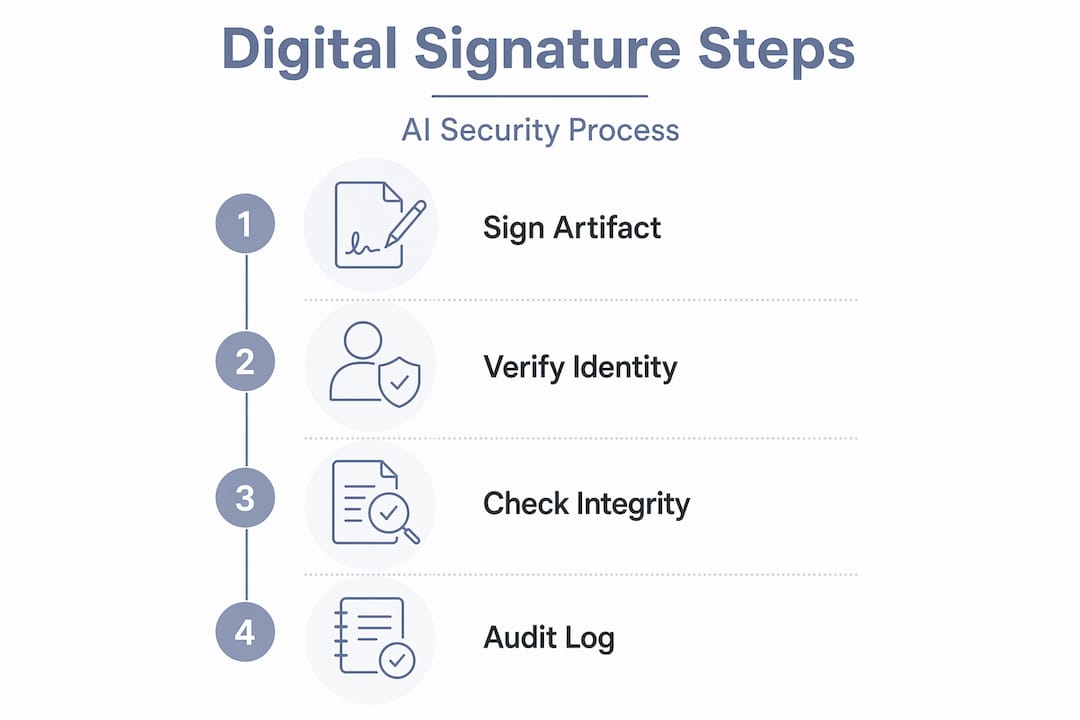
Modern implementations favor ECDSA or Ed25519 over RSA for signature efficiency, particularly at scale. Both are well-suited to the high-frequency signing demands of autonomous agents operating in real time.
Merkle trees and append-only logs
A Merkle tree is a hash tree where each parent node is the hash of its children. This structure means you can verify the inclusion of any single entry without reviewing the entire log. For AI audit trails, this is powerful: Merkle-chain audit logs allow anyone to independently confirm that no entry was modified or deleted after the fact, without trusting the host or the agent that wrote the log.
Content-addressing with CIDs
Content-addressed identifiers (CIDs) derive a unique ID from the content’s hash rather than from its location. This means the same model, prompt, or tool always produces the same CID. If anything changes, the CID changes. Using CIDs for models, prompts, and tools enables replayable, deterministic AI workflows that end the black-box era of unverifiable inference runs.

Key transparency
Key transparency systems verify public key ownership via append-only Merkle logs, letting clients verify consistency proofs independently. For AI agents exchanging signed artifacts, this prevents key substitution attacks where an adversary swaps a legitimate public key for their own. The security model shifts from trusting the key server to verifying it cryptographically.
Pro Tip: Sign artifacts at every stage of your AI pipeline, not just at deployment. A model signed at build time but run without runtime verification leaves the most critical window unprotected.
Frameworks and technologies implementing cryptographic trust
The theoretical foundations above now have real-world implementations you can deploy today. Understanding what each framework addresses helps you choose the right tools for your system’s threat model.
DigiCert AI Trust framework
The DigiCert AI Trust framework organizes AI security into three pillars. AI Agent Trust handles identity and behavior verification for agents. AI Model Trust covers the integrity and provenance of model weights and configurations. Content Trust uses C2PA signing standards to track content provenance across the AI output lifecycle. Together, these pillars provide a structured approach to verifiable AI at scale.
Verifiable execution
Verifiable execution binds data and AI agent code using cryptographic hashes and signed certificates, running models deterministically in isolated sandboxes with content-addressed artifacts. Every input, model version, and output is logged with a cryptographic fingerprint. If the output cannot be reproduced from the logged inputs, the discrepancy is detectable. This architecture makes AI agents auditable in a way that traditional logging never could achieve.
Immutable registries and blockchain-style logs
OCI registries and IPFS provide content-addressed, append-only storage for AI models and tools. Unlike traditional file servers, these systems make silent modification impossible because the content’s address is its hash. Blockchain-style cryptographic transparency logs extend this further by recording every push, update, and access event in a tamper-evident chain.
| Framework component | What it protects | Key technology |
|---|---|---|
| AI Agent Trust | Agent identity and runtime behavior | Signed certificates, behavioral attestation |
| AI Model Trust | Model weight integrity and provenance | Content-addressing (CIDs), signed manifests |
| Content Trust (C2PA) | Output provenance and authenticity | Cryptographic content signing |
| Key transparency logs | Key exchange integrity | Append-only Merkle key logs |
| Immutable registries | Model and tool storage | OCI, IPFS |
Regulatory drivers
The EU AI Act requires traceability and tamper-evident logging for high-risk AI systems. Organizations must demonstrate reproducibility and integrity of AI outputs, meaning cryptographic audit trails are no longer optional for production systems in regulated sectors. This regulatory pressure is compressing the timeline for adoption significantly.
Pro Tip: Even if your current deployment falls outside EU AI Act scope, building cryptographic logging into your architecture now costs far less than retrofitting it after a regulatory mandate arrives.
Technical best practices for implementation
Knowing the frameworks matters, but implementation details determine whether your cryptographic trust architecture actually holds up under adversarial conditions. Several common failure patterns trip up teams that are new to this work.
-
Prioritize determinism or reproducibility. Full determinism in LLMs is achievable in some configurations, and where it isn’t, reproducibility commitments and semantic equivalence comparisons provide practical alternatives. Without some form of reproducibility guarantee, your signed artifacts cannot be meaningfully verified after the fact.
-
Sandbox and isolate tool-calling. AI agents that call external tools represent a large attack surface. Isolation techniques like gVisor, Firecracker microVMs, SELinux, and eBPF/seccomp filters control execution permissions and network access at a granular level. Combine sandboxing with signed tool manifests so each tool call is verified before execution.
-
Implement Merkle audit trails from day one. Appending logs as a Merkle chain lets anyone independently verify no tampering or deletion occurred without trusting the host or the agent. Retroactively adding a Merkle structure to an existing flat log is painful and often incomplete. Design the audit trail first.
-
Plan your re-signing strategy before you need it. A comprehensive re-signing strategy is critical for long-term signature validity as cryptographic algorithms and certificates evolve or expire. Define your certificate rotation schedule, identify which artifacts need re-signing, and automate it. Post-quantum algorithm transitions are coming and your signing infrastructure needs to be ready.
-
Sign at the correct pipeline stage. A surprisingly common mistake is signing a model artifact after it has already been transferred, decompressed, or modified by a build system. Sign the canonical artifact before any downstream transformation.
-
Avoid nonce reuse. In signature schemes that depend on random nonces, reuse can catastrophically leak private keys. Use hardware security modules or dedicated key management services to generate nonces and manage signing keys.
The gap between a cryptographically sound architecture and a real-world secure deployment often comes down to these operational details. Getting the theory right is the starting point, not the finish line.
Why cryptographic trust is now indispensable
The advantages of cryptographic trust mechanisms go beyond security hardening. They reshape what accountability means for AI systems.
-
Mathematical proof replaces assumption. Instead of asserting that a model ran correctly, you prove it. This shifts the security model from “we haven’t been breached as far as we know” to “here is verifiable evidence of every action taken.”
-
Auditability scales independently of trust. Any party with access to the public keys and the audit log can verify the record without requiring access to the original infrastructure. This is crucial for third-party audits, regulatory reviews, and post-incident forensics.
-
Supply chain protection becomes concrete. Signing every component in the AI pipeline means a compromised dependency is detectable before it executes. Without cryptographic signing, you cannot distinguish a legitimate model update from a malicious one.
-
Autonomous agent governance becomes tractable. When AI agents operate with significant autonomy, accountability requires more than activity logs. Cryptographic identity shifts the focus from sharing raw data to proving legitimacy through cryptographic interactions, creating resilient operational models where agent actions can be attributed, verified, and audited.
-
Regulatory compliance becomes demonstrable. Tamper-evident logs backed by cryptographic proofs give you something concrete to show auditors. This is the difference between saying “our system is trustworthy” and proving it with mathematics.
The advantages of cryptographic trust extend to privacy as well. Zero-knowledge proofs allow AI systems to demonstrate properties about their data or behavior without exposing the underlying information, which is increasingly relevant for systems processing sensitive inputs. Exploring AI security risks and resilience helps contextualize where cryptographic controls fit within a broader security posture.
My perspective on where this is heading
I’ve been watching the gap between what AI security teams say they do and what they can actually prove for a while now. The honest answer is that most logging architectures in production AI systems are not tamper-evident. They’re flat files on a server that someone with the right access can quietly modify. That’s not paranoia. That’s just how most infrastructure is built.
What I find genuinely interesting about the current moment is that the tooling to do this properly is finally accessible. You no longer need a dedicated cryptography team to implement signed artifacts and Merkle audit trails. The frameworks exist, the libraries are mature, and the regulatory pressure is creating real deadlines.
The part that I think most teams underestimate is the determinism problem. You can sign a model and its inputs beautifully, but if the same inputs don’t reliably produce the same outputs in a verifiable way, your cryptographic audit trail proves process but not result. Solving that requires rethinking how you store and replay inference workflows, not just adding signatures to what you already have.
My prediction is that teams who build cryptographic trust into their architecture now will find compliance far easier when the next wave of AI regulation arrives. Those who wait will be retrofitting under pressure. The AI agent liability gap is real, and cryptographic proof is the only thing that closes it in court or before a regulator.
I’m also watching the intersection of cryptographic identity and autonomous agent governance closely. When agents act on behalf of humans and organizations, accountability without cryptographic attribution is fiction. That problem is not solved yet, but the building blocks are here.
— Nicholas
How Thepitstop addresses cryptographic trust for AI teams
Thepitstop was built specifically to close the gap between knowing you need cryptographic trust in your AI systems and actually having it in place. The Infinity Protocol™ is Thepitstop’s cryptographic trust mechanism designed to establish verifiable, secure partnerships between AI agents and human operators, covering identity signing, runtime validation, and tamper-evident audit trails in a single framework. For teams assessing where their current AI agent architecture is exposed, the free AI agent security scan provides an automated baseline across your full attack surface. For developers and operators who want a professional credential that demonstrates human-side resilience alongside technical controls, the SERA™ Certification is the only program of its kind targeting social engineering resilience in AI-driven environments.
FAQ
What is cryptographic trust in AI?
Cryptographic trust in AI is a security model where confidence in an AI system’s behavior, outputs, or identity is established through mathematical proof rather than policy or access controls alone. It uses techniques like digital signatures, Merkle audit logs, and content-addressing to make tampering detectable and actions attributable.
What are the main advantages of cryptographic trust mechanisms?
The core advantages of cryptographic trust mechanisms include mathematically verifiable integrity, independent auditability without trusting the infrastructure operator, supply chain attack detection, accountable autonomous agent governance, and demonstrable regulatory compliance.
How do Merkle trees improve AI audit trail integrity?
A Merkle-chain audit trail links each log entry’s hash to the next, meaning any modification or deletion breaks the chain and is immediately detectable by anyone with access to the log. This makes AI audit trails tamper-evident rather than simply tamper-resistant.
Why is determinism important for cryptographic trust in AI?
Determinism allows the same inputs to reproduce the same outputs, which means a signed execution can be independently verified. Where full determinism isn’t achievable, reproducibility commitments and semantic equivalence comparisons provide practical alternatives for auditable AI behavior.
Does the EU AI Act require cryptographic logging?
The EU AI Act requires traceability and tamper-evident logging for high-risk AI systems, which in practice pushes organizations toward cryptographic audit trails. Organizations must demonstrate reproducibility and integrity of AI outputs to satisfy these requirements.