The Role of Certification in Cybersecurity: 2026 Guide

Cybersecurity certification is a credential that demonstrates mastery of the knowledge and skills required for specific security roles, serving as the primary evidence-based signal between talent and organizational trust. The role of certification in cybersecurity extends well beyond resume decoration. Credentials issued by accredited bodies like ISC2, CompTIA, and OffSec validate competency across domains including network security, ethical hacking, and incident response. Frameworks like the NIST NICE Framework and DoD 8140 now define how those credentials map to real job functions, making certification a strategic workforce tool rather than a standalone achievement.
How do certifications map to cybersecurity roles and proficiency frameworks?
Certifications have the greatest value when tied to specific job roles and proficiency levels, not when collected as generic resume badges. The NICE Framework defines cybersecurity work using a proficiency scale modeled after SFIA Levels of Responsibility, measuring capability based on real workplace context rather than classroom hours. That distinction matters because two professionals holding the same credential may perform at entirely different levels depending on their applied experience.
DoD 8140 took this further by replacing older baseline certification requirements with a role-based workforce framework that treats credentials as one dimension among education, experience, and training. A penetration tester and a security operations analyst may both hold CompTIA Security+, but their qualification under DoD 8140 depends on how that credential maps to their specific Cyber Workforce Framework (DCWF) work role. This multi-axis approach prevents the false equivalence that comes from treating any single credential as a universal qualifier.

For compliance officers building workforce qualification documentation, this framework alignment is not optional. It is the architecture that makes certification evidence defensible during audits.
Pro Tip: Use the NICCS Cyber Career Pathways tool to map each team member’s certifications to their specific NICE Framework work role before your next audit cycle. Generic credential lists will not satisfy reviewers who understand the DCWF.
Key elements of role-based certification mapping include:
- Work role alignment: Match credentials to specific NICE Framework work roles, not broad job titles like “security analyst.”
- Proficiency scaling: Identify whether a credential addresses foundational, intermediate, or advanced proficiency for the target role.
- Task, Knowledge, and Skill (TKS) coverage: Verify that the certification’s exam domains correspond to the TKS statements in the relevant work role.
- Multi-axis documentation: Record certification alongside education, training, and experience to satisfy DoD 8140 qualification standards.
What tangible benefits do certifications provide to professionals and organizations?
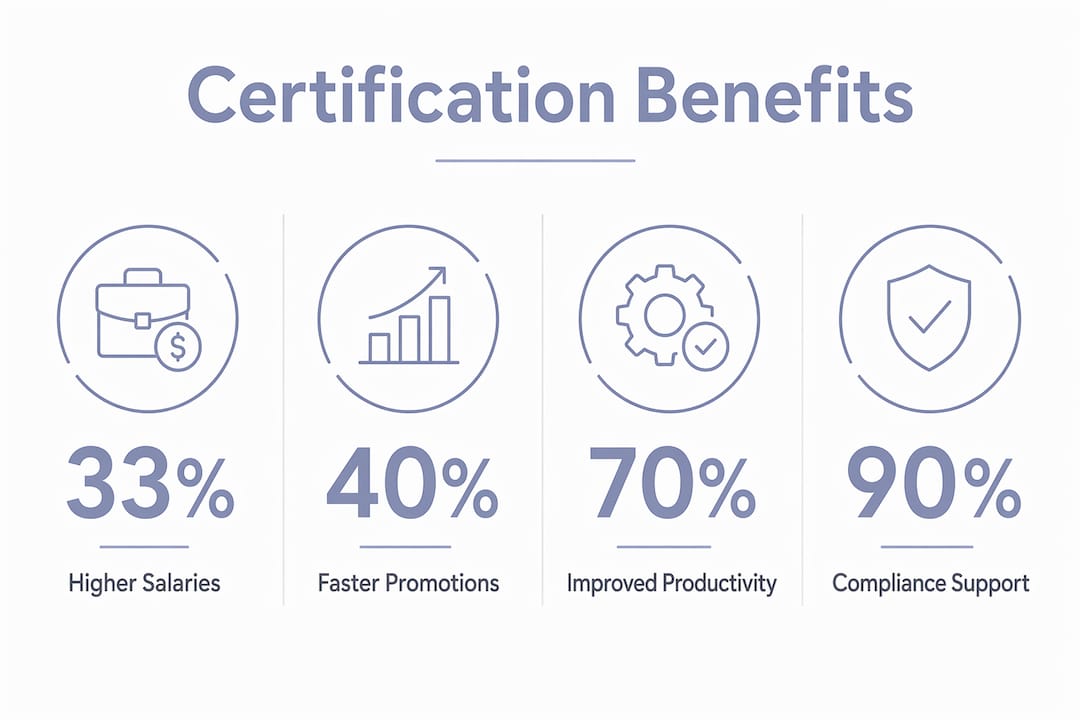
The measurable impact of professional credentials on cybersecurity careers is well documented. Nearly a third of certified professionals report salary increases after earning a certification, with 31% receiving raises exceeding 20%. That figure reflects more than market demand. It reflects the information asymmetry problem that certifications solve: employers cannot directly observe a candidate’s skill level, so credentials function as a verified signal that reduces hiring risk.
The organizational benefits extend beyond compensation. The same data shows that 92% of IT leaders prioritize certified candidates in hiring decisions, and certified employees improve team innovation rates by 76%. Those numbers indicate that certification functions as a workforce quality filter, not just a personal career tool.
For hiring managers and CISOs, the practical benefits break down into four categories:
- Reduced hiring risk: Certifications from bodies like OffSec, which require hands-on lab performance rather than multiple-choice exams, demonstrate real readiness rather than memorization.
- Faster onboarding: Certified professionals share a common technical vocabulary and baseline knowledge, reducing the time needed to integrate them into security operations.
- Career mobility: Credentials like CISSP, CEH, and OSCP are recognized across industries and geographies, giving professionals flexibility and organizations a portable talent pool.
- Team leveling: Structured credentialing programs create a shared competency baseline across security teams, reducing skill gaps that attackers exploit.
The productivity gains tied to certification are not incidental. They reflect the fact that standardized credentialing forces professionals to engage with domains they might otherwise avoid, producing broader and more consistent capability across the workforce.
How do certifications fit into compliance frameworks and governance strategies?
Certification operates as an evidence-backed control in governance frameworks, providing a shared reference point that regulators, clients, and executives can all interpret without technical translation. For a CISO presenting workforce readiness to a board, a credential matrix tied to NICE Framework work roles communicates capability in a language that non-technical stakeholders understand. That accessibility is a governance asset.
Compliance officers face a specific challenge: demonstrating that the workforce is qualified to execute the controls documented in security policies. Certification provides audit-ready evidence for that requirement. When a penetration tester holds OSCP and that credential maps to their assigned DCWF work role, the qualification chain is traceable and defensible. Without that mapping, workforce qualification documentation becomes a list of names and titles that auditors cannot evaluate.
Continuous renewal requirements built into credentials like CISSP (which requires 120 CPE credits every three years) and CompTIA Security+ (which requires renewal every three years) also serve a governance function. They create a documented record of ongoing professional development, which supports the continuous monitoring requirements in frameworks like NIST SP 800-53 and ISO 27001.
Pro Tip: Build certification renewal schedules into your governance calendar alongside policy review cycles. Treating credential maintenance as a compliance event rather than an individual responsibility creates accountability and produces the documentation trail auditors expect.
Combining certification with broader evidence of workforce readiness produces the strongest compliance posture. A multi-axis proficiency matrix that documents credentials alongside formal education, on-the-job experience, and structured training satisfies both DoD 8140 requirements and the workforce assurance expectations of frameworks like FedRAMP and SOC 2.
What criteria should you use to select cybersecurity certifications?
Selecting the right credential from hundreds of available options requires a structured approach. NICCS provides mapping tools that connect certifications to NICE Framework work roles and proficiency levels, removing the guesswork from selection. The goal is not to find the most prestigious certification. The goal is to find the certification that closes the specific skill gap in a specific work role.
A practical selection process follows this sequence:
- Identify the target work role using the NICE Framework’s work role catalog, not a generic job title.
- Review the TKS statements for that work role to understand what knowledge and skills the role requires.
- Use NICCS Cyber Career Pathways to identify certifications that map to those TKS statements at the appropriate proficiency level.
- Assess prerequisites including education background, existing experience, and any prerequisite certifications required for the target credential.
- Verify renewal requirements to confirm the credential can be maintained within your professional development budget and schedule.
One distinction that professionals frequently overlook is the difference between a certification and a certificate. A certificate confirms course completion. A certification requires passing a proctored exam and, in the case of credentials like OSCP or GPEN, demonstrating hands-on performance under controlled conditions. For compliance purposes, only certifications from accredited bodies carry the evidentiary weight that auditors and regulators recognize.
| Credential type | What it proves | Compliance value |
|---|---|---|
| Certificate of completion | Attended or completed a course | Low. No independent assessment of skill. |
| Vendor certification | Proficiency with a specific vendor’s product | Moderate. Useful for tool-specific roles. |
| Accredited certification | Validated knowledge across a domain | High. Recognized by NICE, DoD 8140, and regulators. |
| Performance-based certification | Demonstrated hands-on skill under exam conditions | Highest. Directly maps to operational readiness. |
How should certification strategies evolve to address emerging threats?
Certification programs that do not update alongside the threat environment become liabilities rather than assets. NICE Framework v2.2.0, released in 2026, added new work roles and updated competency areas reflecting emerging domains including supply chain risk management, DevSecOps, and post-quantum cryptography. Organizations whose certification strategies still reference the prior framework version are qualifying their workforce against an outdated map.
The practical risk of stagnation is concrete. A security engineer certified in network defense five years ago may hold a credential that does not address container security, AI-assisted threat detection, or software supply chain integrity. Those gaps are exactly where modern attackers operate. Certification strategies must be reviewed annually against current framework versions to identify where the credential portfolio no longer covers active threat domains.
“Certification strategies that freeze at a point in time create a false sense of workforce readiness. The NICE Framework is a living document, and your credential matrix should be too.”
Staying current requires more than individual renewal. Organizations benefit from participating in NIST’s public comment processes for framework updates, which provides advance visibility into emerging work roles before they become compliance requirements. Security teams that engage with cyber hygiene practices in AI security alongside their certification programs build a more complete picture of workforce readiness in the AI era.
The certifications most likely to retain relevance are those tied to performance-based assessment and regularly updated exam content. Credentials from bodies that publish transparent exam update schedules and align domain coverage to current threat intelligence provide a more durable qualification signal than those with static exam blueprints.
Key takeaways
Certification in cybersecurity functions as a strategic workforce control when mapped to specific job roles, proficiency frameworks, and compliance requirements rather than treated as a standalone credential.
| Point | Details |
|---|---|
| Role-based mapping is mandatory | Align credentials to NICE Framework work roles and DCWF codes, not generic job titles. |
| Multi-axis evidence wins audits | Combine certification with education, experience, and training documentation under DoD 8140 standards. |
| Salary and productivity gains are measurable | 31% of certified professionals received raises over 20%; certified teams improve innovation by 76%. |
| Compliance value requires renewal | Treat credential maintenance as a governance event with scheduled documentation, not an individual task. |
| Framework alignment must be annual | Review certification portfolios against NICE Framework updates, including v2.2.0, to close emerging skill gaps. |
Why credentials alone will never be enough
I have spent years working inside certification programs and compliance audits, and the pattern I see most often is organizations that confuse credential collection with workforce readiness. A team holding CISSP, CEH, and Security+ across every role looks impressive on paper. It tells you almost nothing about whether those people can respond to a live incident, recognize a social engineering attempt, or secure an AI agent pipeline.
The certifications that actually move the needle are the ones tied to demonstrated performance. OffSec’s OSCP requires candidates to compromise real systems under time pressure. That is a fundamentally different signal than passing a multiple-choice exam. When I review workforce qualification documentation for compliance purposes, I weight performance-based credentials significantly higher than knowledge-based ones, and I think most compliance frameworks are moving in that direction.
My practical advice: stop treating certification as the destination and start treating it as one coordinate in a larger map. The map also includes hands-on testing, red team exercises, and structured assessment of human resilience against social engineering. Professionals who test human cyber resilience alongside their credential programs build a qualification profile that holds up under real scrutiny. The credential gets you in the room. What you can actually do determines whether you stay.
— Nicholas
Strengthen your certification strategy with Thepitstop
Certifications validate knowledge. Thepitstop tests whether that knowledge holds under real-world pressure.
Thepitstop’s SERA™ Certification is a professional credential built specifically for social engineering resilience, one of the most under-certified domains in the workforce. Where traditional certifications assess what you know, SERA™ assesses how you perform when an attacker is actively targeting you. For compliance officers building multi-axis workforce qualification evidence, that distinction is significant. Thepitstop also offers a free AI agent security scan that extends workforce readiness assessment to the machine layer, covering the AI agent attack surface that no existing certification program currently addresses.
FAQ
What is the role of certification in cybersecurity?
Certification validates that a professional has demonstrated the knowledge and skills required for a specific cybersecurity role, serving as an evidence-based signal for employers, regulators, and compliance frameworks. Its value is highest when credentials are mapped to NICE Framework work roles and proficiency levels rather than used as generic qualifications.
How do certifications support compliance and audit requirements?
Certifications provide audit-ready documentation of workforce qualification when paired with education, experience, and training records under frameworks like DoD 8140. Compliance officers use credential matrices tied to DCWF work roles to demonstrate that security personnel are qualified to execute the controls documented in security policies.
Which certifications carry the most weight for cybersecurity careers?
Performance-based certifications like OSCP from OffSec and knowledge-domain credentials like CISSP from ISC2 carry the highest weight because they require demonstrated competency rather than course completion. Accredited certifications recognized by NICCS and aligned to NICE Framework work roles produce the strongest career and compliance outcomes.
How often should certification strategies be reviewed?
Certification portfolios should be reviewed at least annually against current framework versions. NICE Framework v2.2.0, released in 2026, added new work roles covering supply chain risk and DevSecOps, meaning strategies built on prior versions may leave active threat domains unaddressed.
What is the difference between a certificate and a certification?
A certificate confirms that a professional completed a course or training program. A certification requires passing an independent, proctored assessment and is issued by an accredited body. For compliance and hiring purposes, only certifications carry the evidentiary weight that auditors and regulators recognize.