The Role of Automation in Cybersecurity: 2026 Guide

Cybersecurity automation is defined as the use of technology to execute security tasks, including threat detection, alert triage, incident response, and compliance reporting, without continuous human intervention. The role of automation in cybersecurity has shifted from a competitive advantage to an operational necessity. Organizations using security AI and automation save an average of $2.22 million annually in breach costs, making it a financial control as much as a technical one. Platforms built around Security Orchestration, Automation and Response (SOAR), Extended Detection and Response (XDR), and agentic AI now form the backbone of modern security operations. This guide explains how these systems work, where they fail, and how to deploy them effectively in 2026.
How does automation improve cybersecurity operations?
Automation improves cybersecurity operations by compressing the time between threat detection and containment while reducing the cognitive burden on security analysts. The industry measures this through two metrics: mean time to detect (MTTD) and mean time to respond (MTTR). Both shrink dramatically when automated workflows replace manual processes.
The operational gains follow four pillars:
- Proactive exposure management: Automated scanners continuously assess attack surfaces, flagging misconfigurations and unpatched vulnerabilities before attackers exploit them.
- Automated detection: AI-driven correlation engines analyze log data, network telemetry, and endpoint signals at machine speed, identifying anomalies that human analysts would miss in high-volume environments.
- Intelligent analysis: Alert enrichment tools pull context from threat intelligence feeds, user behavior analytics, and asset inventories, converting raw alerts into prioritized, actionable cases.
- Orchestrated response: Playbooks execute containment actions, such as isolating a compromised endpoint or blocking a malicious IP, in seconds rather than hours.
Cybersecurity automation reduces analyst workload by 40 to 60%, enabling 24/7 operations that no human team can sustain alone. That workload reduction translates directly into faster response: analysts spend less time on repetitive triage and more time on judgment-intensive decisions like threat hunting and risk prioritization.
Pro Tip: Track MTTD and MTTR as primary KPIs before and after automation deployment. Without baseline measurements, you cannot quantify the operational improvement or justify further investment to leadership.

Research on adaptive GenAI defense shows that detection latency dropped from 5.4 seconds to 1.2 seconds in controlled environments, a reduction that compounds across thousands of daily alerts. At scale, that speed advantage determines whether an attacker achieves lateral movement or gets stopped at the perimeter.
What are the common cybersecurity automation tools and technologies?
Three primary categories of cybersecurity automation tools define the current market. Each serves a distinct function, and the most effective security programs combine all three rather than treating them as alternatives.
| Tool Category | Core Function | Adaptability | Coverage Scope |
|---|---|---|---|
| SOAR Platforms | Orchestrate workflows and execute rule-based playbooks | Low to medium; requires manual playbook updates | Incident response, case management, compliance |
| XDR Platforms | Correlate signals across endpoint, network, cloud, and email | Medium; vendor-defined detection logic | Unified threat detection and investigation |
| Agentic AI Systems | Autonomous reasoning, enrichment, and response across unbounded alert types | High; learns from analyst feedback and adapts over time | Full SOC lifecycle, including novel threat handling |
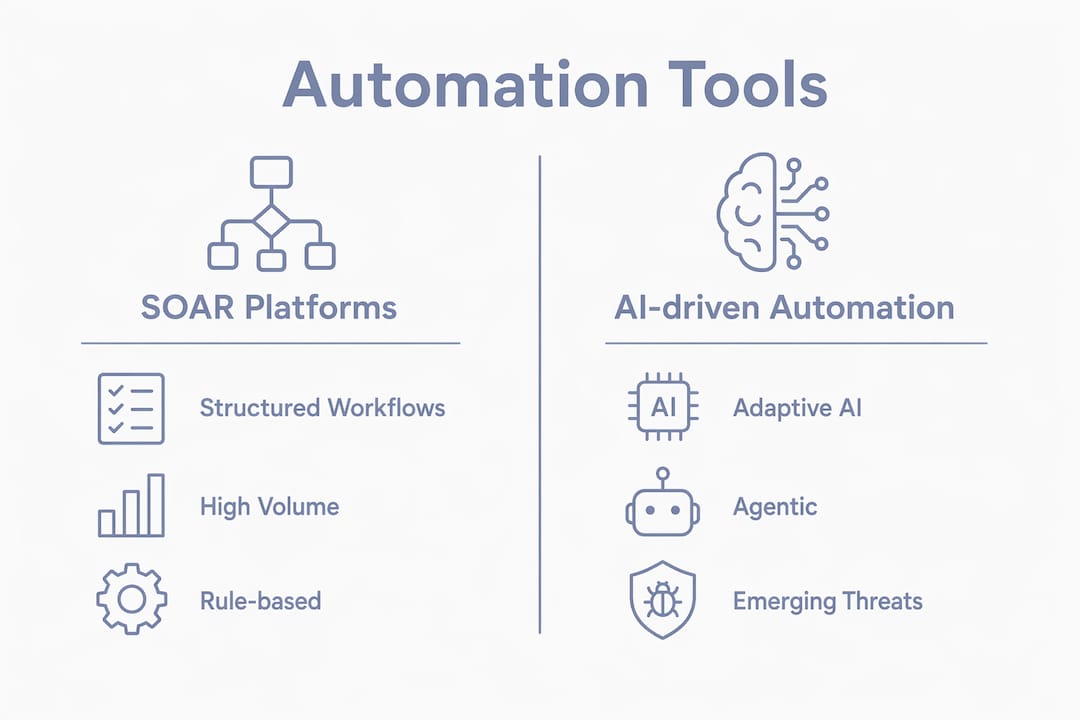
SOAR platforms like Palo Alto Networks Cortex XSOAR and Splunk SOAR excel at structured, repeatable workflows. They are the right tool when you have well-defined processes and need consistent execution. XDR platforms, including Microsoft Defender XDR and CrowdStrike Falcon, consolidate telemetry across the attack surface and reduce the tool sprawl that fragments detection coverage.
The most significant shift in 2026 is the transition from rule-based playbooks to agentic AI. AI-driven security automation uses autonomous agents with context grounding, reasoning, and learning capabilities to handle alert types that no static playbook anticipated. These agents operate under declarative instructions with defined roles, data access boundaries, and decision limits, adapting over time as they learn from analyst corrections. Understanding the foundations of AI security is a prerequisite before deploying agentic systems, since the attack surface expands alongside the autonomy granted to these tools.
Pro Tip: Do not replace SOAR with agentic AI outright. Use SOAR for high-volume, well-understood workflows and reserve agentic AI for complex, ambiguous cases where static playbooks break down. The two systems are complementary, not competing.
What challenges and pitfalls affect automation effectiveness?
Automation fails most often not because the technology is inadequate, but because organizations treat it as a one-time deployment rather than an evolving operational capability. Security automation failures frequently stem from “set-and-forget” attitudes, where playbooks are built once and left unchanged as the network architecture, threat landscape, and risk profile shift around them.
The most common pitfalls security leaders encounter include:
- False positive cascades: Poorly tuned detection rules generate high false positive volumes. When automated response acts on those false positives at scale, the result can be legitimate systems being isolated, users locked out, and operations disrupted. This is not a theoretical risk. It has caused production outages at organizations that skipped tuning cycles.
- Over-automation of high-impact actions: Cascading errors can paralyze networks when automation executes high-impact decisions without human-in-the-loop gates. Best practice is to fully automate only reversible, low-impact tasks and require human approval for actions like account deletion, firewall rule changes, or data quarantine.
- Explainability gaps: Automation that cannot explain its decisions creates compliance and trust problems. Security leaders cannot defend an automated action to auditors or executives if the system cannot produce a clear reasoning trail.
“Supervised autonomy with clear guardrails and escalation paths maximizes the benefits of automated security while mitigating the risks of unchecked autonomous action.” — Cybersecurity Tribe
Explainable AI is critical for maintaining stakeholder trust, and research shows that improved explanation completeness increases trust among non-technical stakeholders by approximately 46%. For security leaders seeking buy-in from boards and compliance teams, that number matters. Reviewing AI security risks and resilience measures before scaling automation helps organizations anticipate governance gaps before they become audit findings.
How can organizations implement cybersecurity automation effectively?
Effective implementation follows a deliberate sequence. Organizations that skip steps, particularly the workflow formalization phase, consistently underperform those that invest time in process design before introducing automation.
- Document and optimize workflows manually first. Before automating anything, map the current process for your highest-volume use cases, such as phishing triage, vulnerability prioritization, or access anomaly investigation. Automating a broken process produces faster broken outcomes. Effective automation requires formalizing workflows before handing them to adaptive AI systems.
- Prioritize high-volume, low-complexity tasks. Alert triage, log correlation, and compliance report generation are the right starting points. Autonomous systems handle 70 to 80% of low-risk tasks effectively, freeing analysts for judgment-intensive work. Start there before moving to complex response automation.
- Build unified detection-to-response workflows. Security teams that unify proactive exposure management, detection, analysis, and response into one operating model improve SOC speed and efficiency measurably. Disconnected tools create handoff gaps that attackers exploit. Connecting your SIEM, SOAR, and endpoint tools through a single orchestration layer eliminates those gaps.
- Train analysts for automation operation and escalation. Automation changes the analyst role, not eliminates it. Staff need to understand how to configure playbooks, interpret automated decisions, recognize when escalation is required, and audit system behavior. Building a social engineering defense workflow for AI-assisted teams is one practical example of training that addresses both human and machine security simultaneously.
- Align automation investments with business risk priorities. Not every security process benefits equally from automation. Map your automation roadmap to the risks that carry the highest business impact, such as ransomware, data exfiltration, and supply chain compromise, and build from there.
Pro Tip: Treat your automation playbooks as software products. Assign ownership, schedule quarterly reviews, and version-control every change. Playbooks that are not maintained degrade in accuracy as the environment evolves around them.
What role does AI-driven automation play against emerging threats in 2026?
AI-driven automation is the primary mechanism through which defenders maintain parity with attackers who already deploy capable AI in their operations. Defenders must assume attackers use capable AI and deploy equivalent defensive AI to maintain advantage. The UK National Cyber Security Centre frames this as a strategic imperative, not an optional upgrade.
The capabilities that frontier AI brings to defense include:
- Signal correlation at machine speed: AI correlates indicators across endpoint, network, identity, and cloud telemetry simultaneously, identifying attack chains that span multiple systems and would take human analysts hours to reconstruct manually.
- Autonomous investigation and remediation: Agentic platforms can investigate an alert, gather supporting evidence, assess severity, and execute a containment action within a single automated workflow, reducing time-to-contain from hours to minutes.
- Adaptive threat modeling: AI systems learn from resolved incidents and update detection logic accordingly, creating a continuous improvement loop that static rule sets cannot replicate.
- Attacker simulation at scale: AI-driven red team tools test defenses continuously, identifying gaps before real attackers find them.
The counterpoint is that AI does not replace the need for strong baseline security hygiene. Patching cadence, access control discipline, and network segmentation remain the foundation. AI-driven automation amplifies a solid security program. It cannot compensate for a weak one. Strategies for protecting against AI-powered threats require both the technical controls and the organizational discipline to operate them correctly. Applying secure AI networking practices is equally important when deploying AI agents that communicate across distributed infrastructure.
Key takeaways
Automation in cybersecurity delivers measurable operational advantage only when organizations combine the right tools, well-designed workflows, human oversight, and continuous tuning into a single integrated program.
| Point | Details |
|---|---|
| Financial and operational impact | Organizations save an average of $2.22 million annually in breach costs by deploying security AI and automation. |
| Tool selection matters | SOAR, XDR, and agentic AI serve complementary roles; no single category covers the full SOC lifecycle. |
| Human oversight is non-negotiable | Automate reversible, low-impact tasks fully; require human approval for high-impact decisions to prevent cascading errors. |
| Workflow formalization comes first | Document and optimize security processes manually before introducing automation to avoid amplifying broken workflows. |
| AI parity is a strategic requirement | Defenders must deploy frontier AI capabilities to match attackers who already use AI-driven tools at scale. |
Why I think most organizations are automating in the wrong order
Most security teams I speak with are deploying automation tools before they have defined what they want those tools to do. They buy a SOAR platform, connect it to their SIEM, and then spend months trying to figure out which playbooks to build. That sequence is backwards, and it explains why so many automation programs stall after the first few use cases.
The discipline that actually produces results is process-first thinking. Before any tool enters the picture, the team should be able to describe the exact decision logic for a given scenario: what data is needed, what conditions trigger a response, what actions are reversible, and who gets notified. If you cannot write that down clearly, you are not ready to automate it. The tool will not add clarity. It will add speed to confusion.
The second issue I see consistently is the absence of explainability requirements in procurement. Security leaders evaluate automation platforms on detection rates and integration depth, which are the right criteria, but they rarely ask how the system explains its decisions. When an automated action causes a false positive that disrupts operations, the first question from leadership is “why did it do that?” If the platform cannot answer that question in plain language, you have a trust problem that no detection rate can fix. The AI Agent Liability Gap white paper addresses exactly this accountability challenge and is worth reading before any agentic deployment.
My advice to security leaders: slow down the tool selection process and invest that time in workflow documentation. The organizations that do this consistently outperform those that chase the latest platform release.
— Nicholas
How Thepitstop supports your automation program
Thepitstop is built specifically for the security challenges that emerge when AI agents and human operators work together in automated environments. The platform’s Agent Security Scan assesses AI agent attack surfaces, including prompt injection risks, data exfiltration paths, and supply chain vulnerabilities, giving security teams the visibility they need before deploying autonomous systems at scale. The Human Resilience Assessment tests operators against phishing and social engineering scenarios, closing the human gap that automation cannot address alone. For teams building governance frameworks around agentic AI, the AI Agent Liability Gap white paper provides a structured analysis of accountability gaps and mitigation strategies. Run a free AI agent security scan to establish your baseline today.
FAQ
What is the role of automation in cybersecurity?
Automation in cybersecurity executes threat detection, alert triage, incident response, and compliance tasks without continuous human intervention, reducing analyst workload by 40 to 60% and enabling 24/7 security operations.
What are the main cybersecurity automation tools in 2026?
The three primary categories are SOAR platforms for orchestrated playbook execution, XDR platforms for unified cross-domain detection, and agentic AI systems for autonomous reasoning and response across unbounded alert types.
How does automation reduce breach costs?
Organizations using security AI and automation save an average of $2.22 million annually in breach costs by accelerating detection and containment, reducing the window attackers have to cause damage.
What is the biggest risk of cybersecurity automation?
The biggest risk is over-automation of high-impact decisions without human-in-the-loop controls. Cascading errors from poorly tuned automation can isolate legitimate systems and disrupt operations at scale.
How should organizations start with security automation?
Start by documenting and optimizing your highest-volume security workflows manually, then automate the repetitive, low-risk tasks first. Assign playbook ownership and schedule regular reviews to keep automation aligned with your evolving environment.