Social engineering: Defining the threat and building resilience

Most cybersecurity budgets go toward firewalls, endpoint protection, and network monitoring. Yet the majority of successful breaches never touch those systems. They go around them, straight to the person sitting at the keyboard. Social engineering exploits trust, urgency, and human habit far more reliably than any software exploit. This article breaks down exactly what social engineering means in a cybersecurity context, which techniques attackers favor, why the manipulation works on both people and AI systems, and what a real defensive posture looks like in 2026.
Table of Contents
- Defining social engineering in cybersecurity
- Core social engineering techniques and how they work
- Why social engineering succeeds: Psychology, context, and AI
- Defensive strategies: Fortifying human and AI systems
- A new era of social engineering: Beyond human weaknesses
- Assess and strengthen your resilience against social engineering
- Frequently asked questions
Key Takeaways
| Point | Details |
|---|---|
| Human-focused attacks | Social engineering exploits trust and context, bypassing technical barriers. |
| Phishing leads | Phishing and pretexting are the most prevalent methods targeting organizations. |
| AI systems at risk | AI agents can be manipulated if organizations neglect workflow vulnerabilities. |
| Layered defense needed | Comprehensive security strategies must include both human and technical protections. |
Defining social engineering in cybersecurity
Social engineering is not a single attack. It is a category of manipulation that uses psychological influence rather than code to compromise security. The attacker’s goal is to change what someone believes, and therefore what they do.
“Social engineering is the psychological compromise of a person that alters their behavior into taking an action or breaching confidentiality.”
That definition matters because it centers the human, not the system. A firewall cannot stop an employee who genuinely believes they are helping their CEO transfer funds. A spam filter does not catch a phone call. Two-factor authentication gets bypassed when the user approves a fraudulent push notification. The attack surface is the human mind, and it is always online.
What separates social engineering from a typical technical exploit is the attack mechanism:
- Preying on cognition. Attackers exploit how people process information under pressure, time constraints, or authority signals.
- Manipulating context. They craft realistic scenarios so the request appears legitimate within the target’s normal workflow.
- Bypassing technical controls entirely. When a person willingly hands over credentials or transfers funds, the security tool never fires an alert.
This is why even organizations with mature security stacks remain vulnerable. The defense workflow for social engineering has to account for human behavior as a first-class risk factor, not an afterthought.
Core social engineering techniques and how they work
Understanding specific techniques is not just academic. Each method maps to a different vulnerability in your organization’s people and processes.
The technique landscape at a glance
| Technique | Primary channel | Core manipulation | Sophistication level |
|---|---|---|---|
| Phishing | Urgency, impersonation | Low to high | |
| Spear phishing | Targeted research | High | |
| Vishing | Voice call | Authority, pressure | Medium to high |
| Smishing | SMS | Urgency, brevity | Medium |
| Pretexting | Any | Fabricated identity | High |
| MFA prompt bombing | Push notifications | Fatigue, confusion | Medium |
Common social engineering methods include phishing, pretexting, and impersonation-based channels such as vishing and smishing, with prompt bombing emerging as a rapidly growing technique. Volume alone tells the story for phishing: it remains the single most reported attack type in enterprise environments year after year. But volume should not distract from how sophisticated the others have become.
Pretexting, for example, involves building a detailed false identity before making contact. An attacker may spend days researching a target on LinkedIn, studying internal org charts, and learning the company’s vendor relationships before impersonating an IT contractor. By the time they call, they know the manager’s name, the ticketing system in use, and the language employees actually use internally. The request sounds completely routine.
A typical attack chain, step by step
- Reconnaissance. The attacker gathers names, roles, email formats, and recent company news from public sources.
- Pretext creation. They build a believable identity or scenario tied to something the target would recognize as normal.
- Initial contact. A phishing email, call, or SMS is sent with a low-risk request or a link that appears safe.
- Establishing trust. The attacker validates their identity by referencing real people, projects, or systems.
- Escalation. Once trust is established, they request sensitive action: credentials, wire transfers, document access.
- Exploitation and exit. The target complies. The attacker achieves their objective and disappears.
Pro Tip: MFA prompt bombing is worth dedicated attention right now. Attackers trigger dozens of authentication requests in rapid succession, betting that a fatigued or confused user will eventually tap “approve” just to stop the alerts. Train your teams to treat any unexpected MFA push as a red flag and verify through a separate channel before approving.
For practical phishing defense strategies, the focus has to move beyond link-scanning tools and include behavioral recognition at the user level.
Why social engineering succeeds: Psychology, context, and AI
Knowing the techniques is only half the equation. Defenders who understand why the manipulation works are far better positioned to interrupt the attack before it succeeds.

The cognitive shortcuts attackers exploit
Human decision-making relies on mental shortcuts, often called heuristics or cognitive biases. These shortcuts are efficient under normal conditions. Attackers turn them into liabilities.
- Authority bias. People comply more readily with requests from perceived authority figures, whether that is a CEO, an IT admin, or a government agency.
- Urgency and scarcity. When someone believes they must act immediately or lose something valuable, analytical thinking shuts down.
- Social proof. If the request appears consistent with what colleagues or peers do, it feels safe.
- Reciprocity. A small favor or piece of information offered upfront creates psychological pressure to return the gesture.
- Familiarity. Repeated exposure to a name, logo, or communication style builds false trust over time.
These are not weaknesses unique to naive or undertrained users. Experienced professionals fall for well-crafted pretexts because the manipulation is designed to work on anyone operating under normal workplace assumptions.
What research actually tells us about real-world attacks
Empirical research on social engineering shows that lab studies only partially reproduce real attacks because target context and cognition are often ignored. This is a critical gap. When a phishing simulation is run in a controlled setting, participants know (at some level) they are being tested. Real attacks carry no such warning, and the stakes feel genuine.
What this means practically:
| Research setting | Real-world attack |
|---|---|
| Low personal stakes | High personal or professional stakes |
| Known testing environment | Unknown, trusted context |
| Single channel attack | Multi-channel, coordinated manipulation |
| Short duration | Slow, relationship-building approach |
The complexity gap explains why click rates in simulations often underestimate actual susceptibility. Organizations that benchmark success on simulation click rates may be significantly underestimating their real exposure.
AI agents as a new attack surface
The rise of AI-powered automation creates a parallel vulnerability that most frameworks have not caught up to yet. AI agents that process emails, manage workflows, or execute transactions based on language instructions can be manipulated using the same psychological levers that work on people. Prompt injection attacks, for example, embed malicious instructions in documents or messages that the AI agent processes as legitimate commands.
If an AI agent is authorized to send emails, schedule meetings, or query databases, an attacker who can manipulate its inputs can do all of those things without ever interacting with a human. Understanding AI security risks in this context means treating AI agents as trust principals that require the same scrutiny as human operators.
Defensive strategies: Fortifying human and AI systems
“Social engineering attacks bypass technology by targeting human and workflow weaknesses, demanding organization-wide defensive frameworks.”
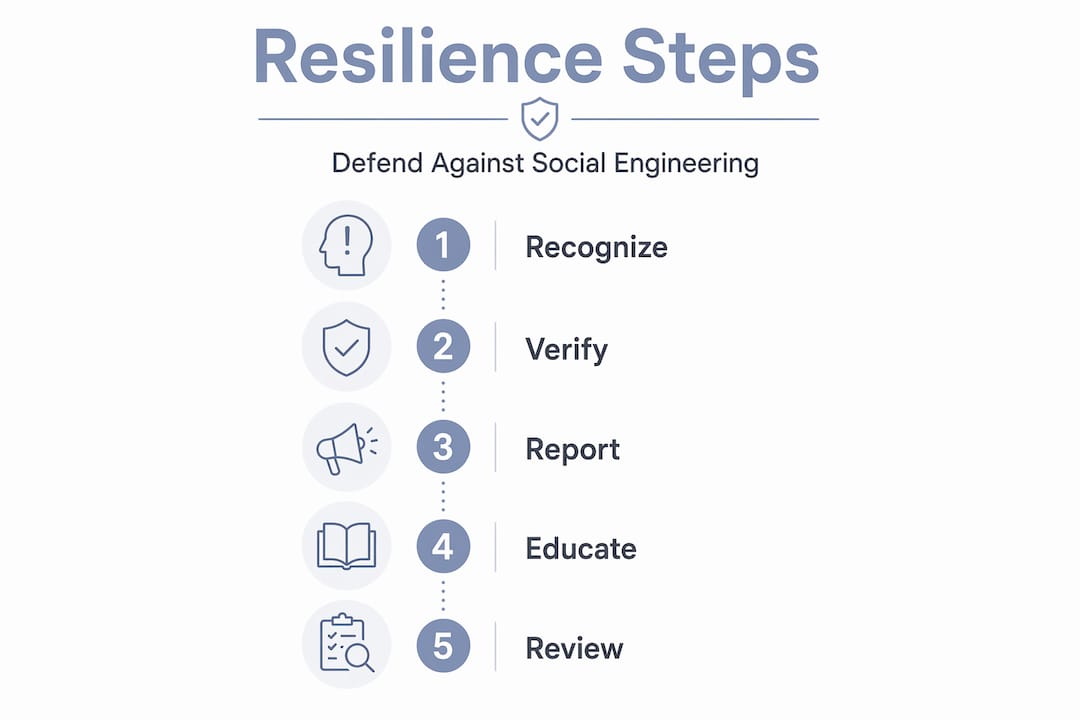
That framing demands a response that is equally broad. A single awareness training session per year does not constitute a defensive framework. Here is what one actually looks like.
The layered defense model
Technical controls:
- Enforce email authentication best practices including DMARC, DKIM, and SPF to reduce spoofed sender attacks.
- Require number-matching or context-aware MFA to defeat prompt bombing.
- Deploy browser isolation and link rewriting tools that add friction before a user reaches a malicious page.
- Monitor for anomalous behavior patterns: unexpected file access, unusual login times, bulk email sends.
Procedural controls:
- Establish out-of-band verification for any financial transaction or credential reset request. A second confirmation through a known phone number is not optional.
- Create clear escalation paths so employees feel empowered to question suspicious requests without fear of appearing unhelpful.
- Implement a “two-person rule” for high-value actions: no single employee should be able to approve and execute a sensitive transaction alone.
Cultural controls:
- Normalize skepticism. The best defenders are those who ask “does this feel right?” as a reflex, not an exception.
- Run realistic phishing simulation workflows that mirror the complexity and emotional pressure of real attacks, not sanitized test scenarios.
- Debrief every simulation incident, successful or not. What made the lure convincing? What signal was missed?
AI system controls:
- Treat AI agents as privileged accounts. Apply least-privilege principles to what data and systems they can access.
- Audit AI agent inputs and outputs for signs of injection or manipulation.
- Build verification checkpoints into any AI-driven workflow that touches sensitive data or financial transactions.
Pro Tip: The defense workflow for AI teams approach works best when security teams map every point where human judgment and AI automation intersect. Each handoff is a potential attack surface.
Practical action items you can start this week
- Pull your last phishing simulation report and identify which departments had the highest click rates. Schedule targeted training, not generic awareness content.
- Audit which AI tools in your stack have access to email, calendar, or financial systems. Review their permission scope against the actual tasks they perform.
- Test your out-of-band verification process with a real drill: ask your finance team to verify a mock wire request via phone. See if the process actually holds.
- Review your MFA configuration to confirm that push notifications require number-matching rather than simple approval.
A new era of social engineering: Beyond human weaknesses
Most published frameworks treat social engineering as a human problem to be solved through user training. That framing made sense in 2015. In 2026, it is dangerously incomplete.
Training helps. Simulations help. Security awareness programs absolutely move the needle on click rates and report rates. But the organizations we see building genuine resilience have shifted their thinking in a significant way: they treat social engineering as a system vulnerability, not a user failure.
What does that mean in practice? It means that when an employee falls for a phishing attack, the post-incident analysis does not end at “user clicked the link.” It asks: Why was this email able to reach the inbox? Why did the process allow a single person to approve a funds transfer? Why did the AI agent execute the instruction without a verification checkpoint? The human failure is the symptom. The system weakness is the cause.
This reframe has direct implications for how you allocate your security budget and your team’s attention. Investing exclusively in awareness training while leaving AI agents unsecured, verification processes weak, and MFA configurations vulnerable is like training athletes in a stadium with no roof. The preparation is real, but the exposure remains.
There is also a liability dimension that leaders need to take seriously in 2026. As AI agents are given more autonomy to act on behalf of organizations, the question of who is responsible when one of those agents is manipulated into a harmful action is not yet settled. Regulatory and legal frameworks are still catching up. Organizations that build verification and audit trails now are not just more secure; they are better positioned when those frameworks arrive.
The defense frameworks for AI conversation needs to happen at the leadership level, not just in the security operations center. Executives who understand that an AI agent is a trust principal with its own attack surface will make better decisions about deployment scope, monitoring investment, and incident response planning.
Assess and strengthen your resilience against social engineering
The gap between knowing what social engineering is and being confident your organization can withstand it is exactly where most teams get stuck.
Thepitstop.ai was built to close that gap. The free social engineering assessment gives you a clear, evidence-based picture of your team’s current exposure to manipulation-based attacks, including readiness for phishing, pretexting, and emerging techniques like prompt bombing. For organizations deploying AI-driven tools, the AI Agent Security Scan evaluates your agents for prompt injection vulnerabilities, over-permissioned workflows, and trust chain weaknesses. Both tools are designed for security leaders who need fast, actionable results without a lengthy implementation cycle.
Frequently asked questions
What makes social engineering different from other cyber attacks?
Social engineering targets people’s trust and decision-making rather than vulnerabilities in software or hardware. The psychological compromise involved means that even technically hardened environments remain exposed.
Which social engineering attack is most common in organizations?
Phishing is the most prevalent. Common methods also include pretexting, vishing, and smishing, but phishing continues to generate the highest volume of successful breaches across industries.
Are AI systems vulnerable to social engineering tactics?
Yes. AI systems can be manipulated through their inputs just as humans are manipulated through communication. The attack surface for social engineering extends to any system that processes language or behaves based on contextual instruction.
What is prompt bombing in social engineering?
Prompt bombing floods a user with MFA push notifications until they approve one out of fatigue or confusion. It is a rising technique that bypasses multi-factor authentication without any technical exploit.
How can organizations defend against social engineering?
Effective defense requires realistic simulations, layered technical controls, and strong verification procedures. Organization-wide frameworks that treat human behavior and AI workflows as equally important attack surfaces produce the most durable results.