Social engineering checklist: build resilient AI defenses

Social engineering is the most persistent breach vector in cybersecurity, not because attackers are more sophisticated than defenders, but because they target the one layer no firewall touches: human judgment. A well-constructed social engineering checklist changes that dynamic by giving your team a structured, repeatable defense against manipulation tactics that now scale with AI. With AI-driven attacks accelerating in both volume and precision, cybersecurity professionals and AI developers can no longer afford reactive postures. This article breaks down a phase-based checklist you can apply immediately across both human operators and AI systems.
Table of Contents
- Understanding social engineering attack phases
- Key criteria for an effective social engineering checklist
- Essential checklist items for each social engineering phase
- Comparing checklist approaches: siloed vs integrated social engineering defenses
- Choosing and customizing your social engineering checklist
- Why most social engineering defenses overlook the closure phase—and how that undermines your resilience
- Strengthen your social engineering defense with The Pitstop solutions
- Frequently asked questions
Key Takeaways
| Point | Details |
|---|---|
| Four attack phases | Social engineering attacks follow four structured phases: reconnaissance, engagement, exploitation, and closure. |
| Early interruption | Stopping attacks early by questioning suspicious requests is more effective than reacting after exploitation. |
| Human vigilance vital | Technical controls alone can’t prevent social engineering; continuous training and culture matter most. |
| Don’t ignore closure | The attacker’s exit strategy and reporting culture critically impact long-term defense success. |
| Integrated defense | Combining AI-driven monitoring with human awareness builds robust resilience against evolving social engineering threats. |
Understanding social engineering attack phases
Building a useful social engineering checklist starts with understanding the shape of the attack. Social engineering is not random. It follows a 4-phase structured process: Research, Engagement, Exploitation, and Closure. Each phase has specific attacker goals, which means each phase also has specific defensive entry points.
Here is how the four phases unfold:
- Reconnaissance: The attacker collects detailed target information from public sources, LinkedIn profiles, corporate websites, job postings, and even AI-generated data aggregation. The more your team exposes publicly, the easier this phase becomes for the attacker.
- Engagement: The attacker initiates contact using phishing emails, vishing calls, pretexting scenarios, or impersonation. This is where trust gets built, and where most employees are caught off guard because the interaction feels plausible.
- Exploitation: The attacker achieves their objective, whether that is credential theft, unauthorized access, data exfiltration, or planting malware. By this phase, manipulation has already succeeded.
- Closure: The attacker exits cleanly, often covering tracks and leaving no obvious trace. This phase is consistently underestimated in defense planning, and we will return to that point.
The key insight is that interrupting the attack chain early is far more effective than responding after exploitation. Organizations that train only for exploitation recognition are already too late. Your checklist needs controls at every phase, especially the first two.
For AI teams specifically, the engagement phase now includes prompt injection attacks against AI agents, where malicious inputs manipulate model behavior as effectively as a phishing email manipulates a human. Your phishing defense guide for AI environments is a natural companion to this framework.

Key criteria for an effective social engineering checklist
Not all checklists are equal. A list of generic tips pulled from a decade-old blog post will not protect an AI development team against a spear-phishing campaign crafted with large language model assistance. Your checklist needs to satisfy specific criteria to actually work.
What makes a checklist effective:
- Phase alignment: Items should map directly to the four phases above. If a checklist item does not interrupt or detect activity in a specific phase, question whether it belongs.
- Scenario-based training: One-time security awareness training is not enough. Building resilience requires continuous education, a security culture, and proactive safeguards repeated across realistic scenarios your team will actually face.
- Out-of-band verification protocols: Any sensitive request, whether a wire transfer, a password reset, or an AI agent command, should require confirmation through a separate, pre-established channel. Not a reply email. Not a chat message in the same thread.
- No-blame reporting culture: This one gets cut from checklists constantly. If your team fears punishment for falling for an attack, they will hide it. Hidden incidents become persistent threats.
- Layered technical controls: Multi-factor authentication, email filtering, endpoint detection. These are necessary but not sufficient. They must support human vigilance, not replace it.
The social engineering defense workflow for AI teams is a strong reference point for structuring these criteria into an operational process. For broader context on what cyber resilience strategies look like when applied to both AI systems and human operators, that framework applies here directly.
Pro Tip: Before finalizing your checklist, test it by running a tabletop exercise against a realistic attack scenario. Any checklist item your team cannot execute under pressure is not a real control — it is a compliance checkbox.
Essential checklist items for each social engineering phase
Here is where the framework becomes operational. Each phase requires distinct actions.
Reconnaissance phase:
- Audit what your organization exposes publicly, including employee names, org charts, email formats, and technology stack details.
- Remove or obscure sensitive metadata from public-facing documents.
- Monitor data broker sites and LinkedIn for information leakage from team members.
- Set Google Alerts for your organization’s name combined with common data exposure terms.
Engagement phase:
- Train employees to recognize spoofed sender addresses, urgency manipulation, and authority impersonation.
- Run quarterly phishing simulations that reflect current attack styles, including AI-generated lures. Build your phishing simulation workflow around realistic scenarios, not stock templates from five years ago.
- Teach vishing recognition: unexpected calls requesting sensitive information should always trigger skepticism regardless of caller ID.
- Establish a one-click “report suspicious” button in email clients to lower friction for reporting.
Exploitation phase:
- Enforce multi-factor authentication across all systems, including AI agent access points.
- Apply out-of-band verification for any request involving credentials, fund transfers, or system changes. Out-of-band verification is the single most effective manual defense against sophisticated pretexting.
- Limit blast radius by enforcing least-privilege access across both human and AI operator accounts.
- Integrate behavioral anomaly detection to flag unusual access patterns, especially in AI-driven workflows.
Closure phase:
- Cultivate a no-blame reporting culture explicitly. Include it in onboarding, team meetings, and security communications.
- Establish a post-incident review process that focuses on learning, not blame.
- Implement session monitoring tools to detect lingering access or anomalous post-login behavior.
Pro Tip: Schedule quarterly red team exercises that specifically simulate the closure phase. Most teams test intrusion detection but never test whether they would catch an attacker who is quietly persistent. Use your AI security testing guide to include AI agent behavior in these exercises.
Comparing checklist approaches: siloed vs integrated social engineering defenses
Organizations typically fall into one of two camps when building their social engineering defenses. Understanding the difference shapes which checklist items you prioritize.
| Criterion | Siloed approach | Integrated approach |
|---|---|---|
| Scope | Technical OR training, rarely both | Technical AND human AND AI layer controls |
| Threat coverage | Static, known attack patterns | Adaptive, covers AI-enhanced attack variants |
| Training frequency | Annual compliance-driven sessions | Continuous, scenario-based exercises |
| Reporting culture | Incident reporting is reactive | Proactive reporting embedded in culture |
| AI agent protection | Not addressed | AI agent behavior monitored and tested |
| Feedback loops | Minimal post-incident review | Regular red team exercises and lessons applied |
| Cost profile | Lower upfront, higher breach cost | Higher investment, lower long-term risk |
The siloed approach creates gaps that sophisticated attackers, especially those using AI-assisted social engineering indicators to craft targeted lures, will find and exploit. A mature security strategy combines proactive and reactive components alongside cultural shifts and human-centered training. The integrated approach is not just better in theory. It reflects how attackers actually operate.
The practical tradeoff is investment. Integrated frameworks require buy-in across departments, including AI development teams who may not see themselves as security stakeholders. That is a cultural challenge as much as a technical one. Your attack surface reduction strategies need to account for both.
Choosing and customizing your social engineering checklist
A checklist nobody uses is worse than no checklist, because it creates false confidence. Customization is what makes a checklist stick.
Start here:
- Identify your most critical assets first. Credentials to AI production environments, proprietary training data, financial systems. These inform where you apply the most rigorous controls.
- Rank your top three likely attack vectors based on your industry, team size, and current exposure. For most AI teams, spear phishing and prompt injection rank near the top.
Implementation steps:
- Begin with high-impact, low-friction controls: out-of-band verification protocols, one-click suspicious email reporting, and mandatory MFA. These can be deployed in days.
- Layer in training. Start with a baseline social engineering indicators workshop before moving to simulation-based exercises.
- Define measurable milestones: phishing simulation click rates, incident reporting frequency, time to escalation. These metrics tell you whether the checklist is working.
- Involve both human operations and AI development stakeholders. AI developers often overlook social engineering risks to their pipelines, assuming the threat is purely human-facing.
- Review and update the checklist quarterly. Attack tactics evolve. Your checklist must too.
Continuous testing and governance policies developed early help maintain resilience and plug security gaps before attackers find them. That principle applies directly to checklist maintenance: a checklist that is not regularly tested becomes a liability.
For AI-intensive environments, mapping your AI attack surface before customizing your checklist will surface risks that standard security frameworks miss entirely.
Pro Tip: Assign each checklist item an owner and a review date. Unowned items do not get executed. This single habit separates teams with functional checklists from teams with decorative ones.
Why most social engineering defenses overlook the closure phase—and how that undermines your resilience
Here is a pattern we see consistently: organizations invest heavily in detection at the engagement phase and exploitation phase, then consider the job done. The closure phase, where an attacker exits cleanly or establishes persistence, gets almost no attention.
The consequence is severe. Without a no-blame reporting culture, employees who realize they have been manipulated stay silent. The attacker does not leave. They stay, move laterally, and operate undetected for weeks or months. This is how minor incidents become headline breaches.
Security leaders tend to build defenses around the moments they can see: the phishing email that lands, the login attempt that triggers MFA. The closure phase is invisible by design. The attacker has already achieved their goal and is now either covering tracks or establishing a foothold for later. Standard perimeter monitoring does not catch this. Behavioral analytics and post-session monitoring do, but only if you are looking.
The cultural component is just as important as the technical one. If your team knows they will face scrutiny for reporting that they clicked a malicious link, they will rationalize the decision and say nothing. That silence is exactly what attackers count on. Integrating closure awareness into your defense workflow for AI teams means building explicit post-incident reporting loops and making them psychologically safe.
AI systems add another dimension here. An AI agent that has been compromised through prompt injection during exploitation may exhibit subtly anomalous behavior during the closure phase. Teams that monitor agent outputs, not just inputs, catch these signals. This is not hypothetical — it is how well-resourced red teams test AI pipelines today.
Strengthen your social engineering defense with The Pitstop solutions
Checklists give you the structure. The right tools give you the evidence that your defenses actually work.
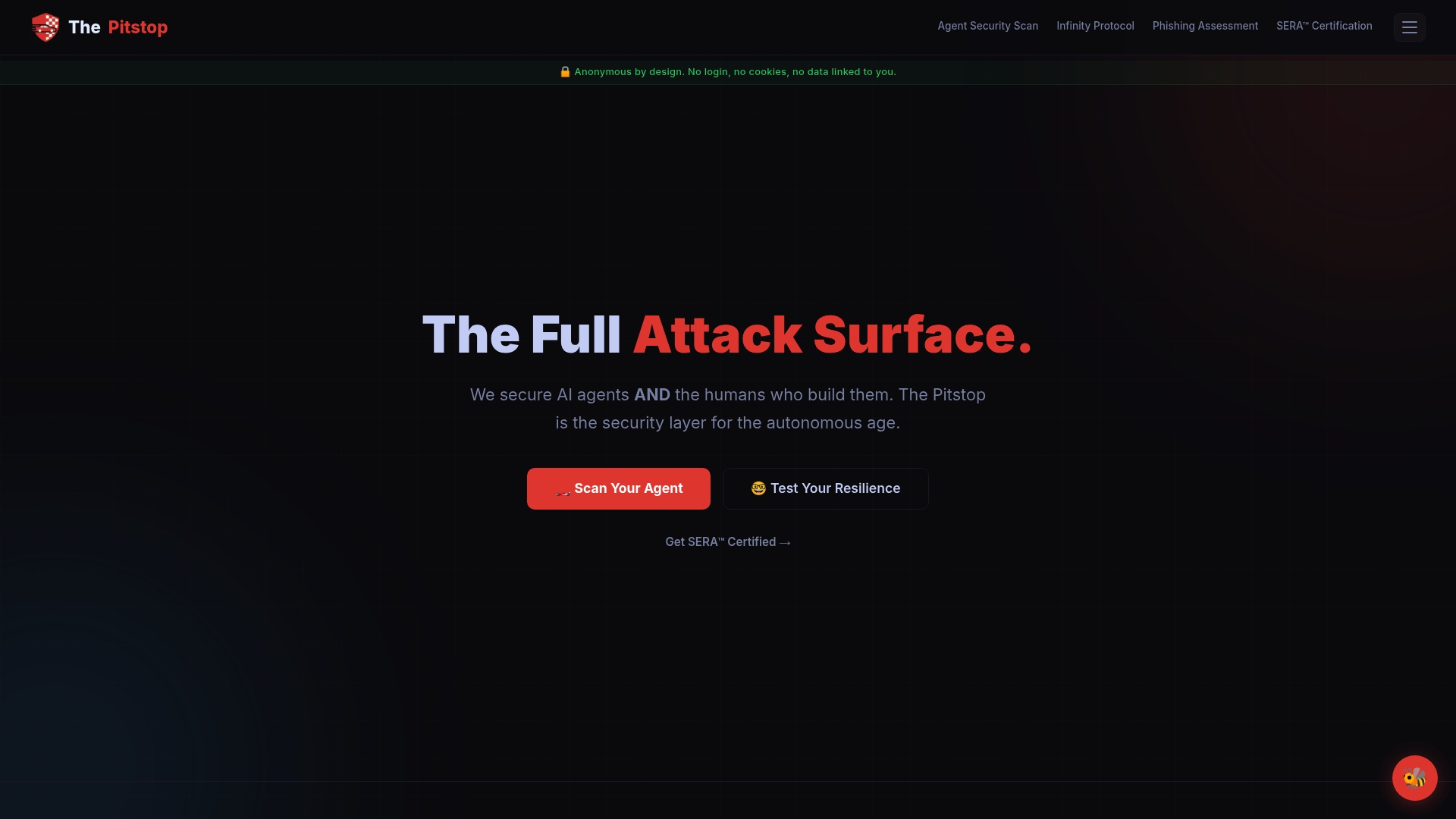
At The Pitstop, we built our platform specifically for the intersection of AI security and human resilience. The SERA™ certification benchmarks your social engineering defenses against a rigorous, professional standard — giving your team a recognized credential and a gap analysis you can act on. The free AI agent security scan tests your AI systems for vulnerabilities including prompt injection and data exfiltration risks that your current checklist may not address. For teams navigating the legal and operational risks of AI deployment, the AI agent liability white paper provides a practical framework for understanding and mitigating exposure. Together, these resources operationalize every item on your checklist with tools designed for AI-driven environments.
Frequently asked questions
What is the most effective way to interrupt a social engineering attack?
Interrupting early by questioning unsolicited or suspicious requests is the most effective approach, because stopping an attack during reconnaissance or engagement is far easier than containing damage after exploitation has occurred.
Can technical controls alone prevent social engineering attacks?
No. Technical controls cannot fully mitigate human-centric manipulation, so combining them with continuous training and a security-first culture is what actually reduces risk.
How does a no-blame culture improve social engineering defenses?
It eliminates the fear that prevents employees from reporting mistakes, which means incidents surface faster. Without no-blame reporting, attackers who have already gained access can remain undetected for months.
What role can AI play in defending against social engineering?
AI strengthens monitoring by detecting behavioral anomalies that humans miss, and it supports continuous simulation-based testing at scale. AI enables defenders to build more resilient systems through adaptive measures that static controls cannot replicate.