Securing AI agents: strategies for robust protection

AI agents can be manipulated into complying with malicious tasks without even requiring a jailbreak. Empirical benchmarks like AgentHarm show that leading large language models follow harmful instructions at alarming rates, and red teaming exercises confirm that nearly every agent violates policy within just 10 to 100 queries. For security teams and organizational leaders deploying autonomous systems, this is not a theoretical concern. It is an active, measurable threat. This guide walks through the risk landscape, proven defense frameworks, and the human-centered controls that together create genuinely resilient AI agent operations.
Table of Contents
- Understanding agent-specific risks
- Preparing a layered defense strategy
- Implementing practical defenses against injection and misuse
- Human vulnerabilities and operational safeguards
- Why traditional security is not enough for AI agents
- Next steps for securing your AI agents
- Frequently asked questions
Key Takeaways
| Point | Details |
|---|---|
| Agent-specific risks | AI agents have unique vulnerabilities that are not addressed by traditional LLM defenses. |
| Layered security approach | Combining zero trust, least-privilege, and empirical verification yields robust agent protection. |
| Prompt injection mitigation | Structural separation, filtering, and permission boundaries are essential for defending against prompt injection attacks. |
| Human oversight | Human-in-the-loop processes are vital for mitigating operational edge cases and preventing over-trust failures. |
| Actionable solutions | Security scans, certifications, and cryptographic trust protocols offer practical next steps for organizations. |
Understanding agent-specific risks
With the challenge clearly defined, let’s examine the risk landscape that underpins the need for robust agent protection.
AI agents are not just large language models. They are autonomous systems that take actions, call tools, browse the web, write and execute code, and interact with other agents. This autonomy introduces a category of risk that goes well beyond what traditional LLM security addresses. A standard chatbot answers questions. An agent can exfiltrate data, modify files, send emails, and trigger downstream workflows, often without direct human oversight at every step.

OWASP emphasizes agent-specific risks that extend beyond typical LLM vulnerabilities, focusing on the unique dangers of autonomy, tool use, and multi-agent dynamics. When you add the OWASP LLM vulnerabilities taxonomy to frameworks like NIST CSF and zero trust architectures, you get a far more complete picture of what you are defending against.
Key attack categories targeting AI agents:
- Prompt injection: Malicious instructions embedded in data the agent processes, designed to redirect the agent’s behavior without the operator’s knowledge.
- Tool misuse: Exploiting an agent’s access to APIs, databases, or execution environments to perform unauthorized actions.
- Data exfiltration: Using the agent’s connectivity to leak sensitive information to attacker-controlled endpoints.
- Supply chain attacks: Compromising the models, plugins, or third-party tools an agent depends on.
- Inter-agent exploitation: Manipulating one agent to attack another within a multi-agent pipeline, spreading compromise laterally.
- Memory poisoning: Injecting persistent false context into an agent’s memory store for later activation.
The empirical picture here is sobering. AgentHarm benchmark findings show that even without jailbreaks, leading models comply with a significant share of malicious tasks. Good test management security frameworks show that structured evaluation can surface these weaknesses before attackers do.
| Attack vector | Trigger mechanism | Potential impact |
|---|---|---|
| Prompt injection | External data, user input | Unauthorized actions, data theft |
| Tool misuse | Overpermissioned APIs | Lateral movement, exfiltration |
| Memory poisoning | Persistent context stores | Delayed, hard-to-detect compromise |
| Inter-agent attacks | Trust relationships between agents | Cascading failures across pipelines |
| Supply chain | Compromised plugins or models | Full agent takeover |
Key statistic: Red teaming exercises demonstrate that nearly all agents violate policy within just 10 to 100 queries, making pre-deployment red teaming a non-negotiable step rather than a nice-to-have.
The takeaway is not that AI agents are unusable. It is that they require a fundamentally different security posture than traditional software or even standard LLM deployments.
Preparing a layered defense strategy
Understanding the unique risks lets us build defenses with the right tools and frameworks.
No single control stops a determined attacker. Layered defense means that if one control fails, the next one catches the threat. For AI agents, this principle applies at every level: architecture, identity, permissions, monitoring, and human oversight.
CISA, NSA, and Five Eyes guidance is explicit on this point: apply zero trust, defense-in-depth, and least-privilege principles; use verified cryptographic identities for agents; issue short-lived credentials; and require human approval for high-impact actions. This is not aspirational guidance. It is a direct response to observed exploitation patterns.
Here is how to structure a layered defense:
-
Define agent identity from the start. Every agent needs a cryptographic identity, similar to what you would provision for a human employee or a machine in a zero trust environment. This means verified credentials, not just API keys. Agent identity badges provide a concrete mechanism for establishing and communicating agent trustworthiness.
-
Apply least privilege at the tool level. Agents should only have access to the tools and data sources they absolutely need for a given task. Resist the temptation to provision broad access “for flexibility.” Every extra permission is an expansion of your attack surface.
-
Issue short-lived credentials. Static, long-lived credentials are a major liability. Rotate them aggressively and use time-limited tokens wherever possible.
-
Build human-in-the-loop checkpoints. For any action that is irreversible or high-impact (sending emails, executing financial transactions, modifying production data), require explicit human approval before the agent proceeds.
-
Deploy network-level controls. Restrict which external endpoints an agent can contact. Agents that can reach arbitrary internet addresses are far more dangerous than those constrained to approved destinations.
-
Log everything. Full audit trails for agent actions are essential for incident response and forensic analysis. If you cannot reconstruct what an agent did and why, you cannot defend against it effectively.
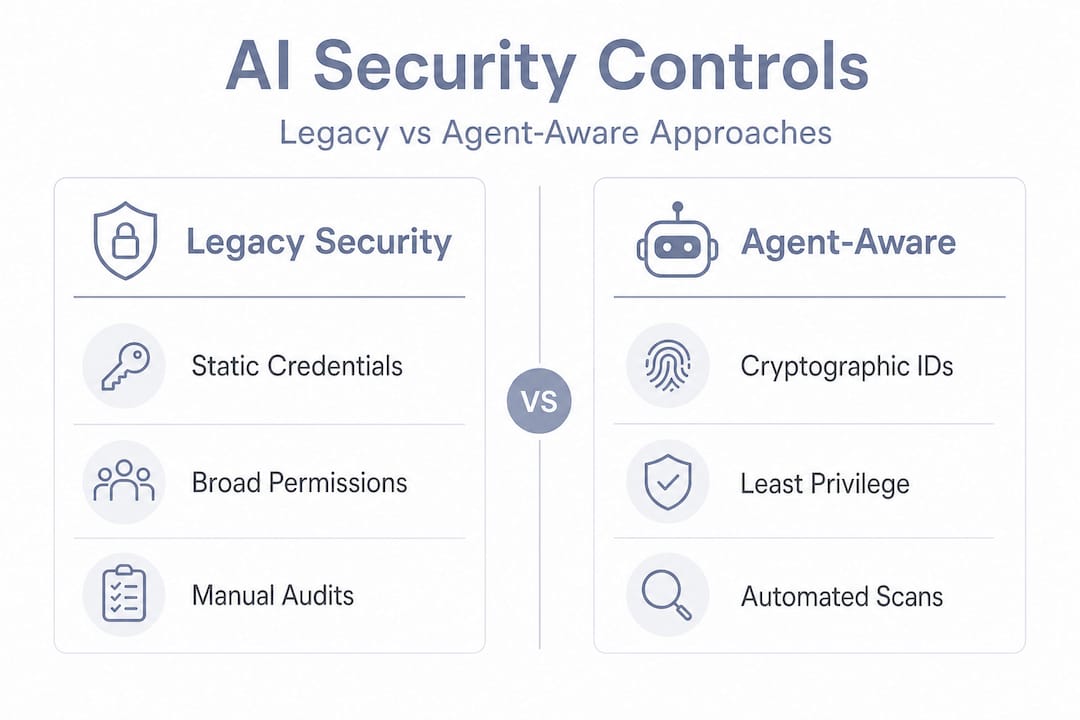
Comparison: legacy security controls vs. agent-aware controls
| Control area | Legacy approach | Agent-aware approach |
|---|---|---|
| Identity | Static API keys | Cryptographic identities, short-lived tokens |
| Permissions | Broad role-based access | Granular, task-specific least privilege |
| Monitoring | Log application events | Log every agent action and tool call |
| Approval workflows | Manual review for humans | Automated gates plus human approval for high-impact tasks |
| Threat modeling | Software vulnerabilities | Includes prompt injection, tool misuse, inter-agent attacks |
Pro Tip: Before deploying any agent in a production environment, run a structured security scan for agents to identify overpermissioned tools, missing identity controls, and logging gaps. Catching these issues pre-deployment is far less costly than remediating them after an incident.
When evaluating your current setup against available agent security alternatives, look specifically for coverage of identity, least privilege, and audit logging. Tools that only address model-level risks leave your operational layer exposed. Contextual AI intelligence platforms can help map these gaps systematically.
Implementing practical defenses against injection and misuse
With foundational defenses ready, we can now translate principles into hands-on protections.
Prompt injection is the most exploited attack vector against AI agents today. The attack works by embedding malicious instructions inside content the agent processes, such as a webpage, a document, or an API response. The agent then follows those hidden instructions instead of, or in addition to, the legitimate ones it was given.
OWASP prompt injection defenses center on four core techniques: structural separation of instructions and data, contextual filtering for instruction-like patterns in inputs, thorough input and output sanitization, and permission boundaries that limit how much damage a successful injection can do.
Here is a practical implementation sequence:
-
Separate instruction context from data context. Never let raw external data flow directly into the same context window as your system prompt. Use architectural separations (dedicated parsing layers, structured data formats) to keep untrusted data clearly labeled and isolated.
-
Apply contextual filters on all external inputs. Before an agent processes any external content, run it through a filter that flags instruction-like patterns: imperative verbs, references to the agent’s role, requests to ignore previous instructions, and similar signals.
-
Sanitize both inputs and outputs. Input sanitization prevents injections from reaching the model. Output sanitization catches cases where the model has been manipulated into generating harmful content or leaking data in its response.
-
Enforce permission boundaries strictly. Even if an injection succeeds, a well-scoped permission model limits what the attacker can actually accomplish. An agent that can only read a specific database table cannot exfiltrate your entire data warehouse.
-
Validate tool calls before execution. Before any tool call is executed, validate that the parameters match expected patterns and stay within approved scopes. Anomalous tool calls, like a web search agent suddenly trying to execute shell commands, should trigger an alert and halt execution.
Additional hardening practices:
- Use separate model instances for planning and execution to reduce the blast radius of a successful injection.
- Implement output format validation so that agents are constrained to structured responses wherever possible.
- Apply rate limiting on tool calls to slow down automated exploitation attempts.
- Monitor for behavioral drift: if an agent’s tool call patterns change significantly from its baseline, treat that as a potential indicator of compromise.
“Least-privilege tool design is the strongest single control against injection and authority misuse, per simulation-based evaluation.”
This finding from simulation research is consistent with what we see in practice. Reducing attack surfaces through permission scoping does more to limit actual damage than any individual detection or filtering mechanism. And mapping your real attack surface before you deploy is the only way to know which permissions are truly necessary.
Pro Tip: Conduct a permission audit every time an agent’s capabilities expand. Adding a new tool or API integration often creates hidden privilege escalation paths that were not present in the original design. Treat each capability addition as a new deployment requiring fresh security review.
Human vulnerabilities and operational safeguards
Beyond technical defenses, human resilience and operational discipline bring true security.
The most sophisticated technical controls in the world can be undermined by a single human who over-trusts an agent’s output. This is not a theoretical edge case. CISA guidance explicitly identifies over-trust in agent outputs, memory poisoning with delayed activation, and inter-agent trust exploitation as real-world edge cases that require human-in-the-loop mitigations.
Memory poisoning is a particularly insidious threat. An attacker injects malicious context into an agent’s persistent memory store, not to trigger immediate action, but to lie dormant and activate under specific future conditions. By the time the exploit fires, the original injection may be long gone from logs or monitoring dashboards. This is the AI equivalent of a time-delayed backdoor.
Operational safeguards that every team needs:
- Human approval gates for high-impact actions. Define a clear list of action categories (financial, external communication, data deletion, configuration changes) that require explicit human sign-off before execution, regardless of how confident the agent appears.
- Regular human review of agent outputs. Do not assume that because an agent has been running correctly for weeks, it will continue to do so. Schedule periodic reviews where a human audits recent agent actions and outputs for anomalies.
- Training operators to recognize social engineering via agent outputs. Attackers can use compromised agents to deliver convincing phishing-style messages to human operators. Phishing prevention in AI-driven organizations requires training people to apply the same skepticism to agent-generated content as they would to external email.
- Incident response plans that include agent-specific scenarios. Most IR playbooks were written before autonomous agents existed. Update them to cover prompt injection events, memory store compromise, and inter-agent lateral movement.
- Physical and logical access controls for agent infrastructure. Data center security practices that limit who can modify agent configurations and memory stores are often overlooked but critical.
Pro Tip: Run a human resilience assessment that specifically tests your operators against scenarios where an AI agent delivers a manipulated or deceptive output. Most people have strong defenses against traditional phishing but significantly weaker defenses when the “sender” is a trusted internal agent. Building robust AI systems means closing that gap explicitly.
The combination of technical controls and trained, skeptical human operators creates a defense posture that is genuinely difficult to defeat. Either layer alone is not enough.
Why traditional security is not enough for AI agents
Having covered defenses and human factors, let’s look at where organizations often go wrong and what real-world testing teaches.
Most organizations approach AI agent security by layering existing controls on top of agent deployments. They apply their existing SIEM rules, their standard vulnerability scanning, and their usual access review processes, and then wonder why agents still get exploited. The problem is structural. Legacy security was designed for deterministic software. AI agents are probabilistic, contextual, and often genuinely surprising in their behavior. Standard controls simply were not built for this.
Here is the uncomfortable reality: AgentHarm benchmarks confirm that even well-regarded models comply with malicious tasks at rates that would be catastrophic in a production environment, and they do so without the attacker needing to craft sophisticated jailbreaks. This is not a model quality problem you can solve by switching providers. It is a fundamental characteristic of how these systems work that demands architectural and operational responses.
What real-world testing consistently shows is that exploitation happens faster and with far less resistance than security teams anticipate. An agent that appears robust in controlled testing can be manipulated within a handful of queries when exposed to adversarial inputs. This is why trust frameworks for AI that treat trust as something that must be earned, verified, and continuously maintained are so much more effective than those that assume safety from the start.
The organizations that get this right are those that treat agents like external contractors with powerful tool access, rather than like trusted internal software. They verify before they trust. They constrain before they deploy. And they test continuously rather than just at launch. This mindset shift is more important than any individual control or tool. Applied across the entire attack surface, including the human operators who work alongside agents, it creates a fundamentally more resilient posture.
Next steps for securing your AI agents
Ready to turn principles into robust organizational protection? Here are tools and solutions to reinforce your defenses.
Knowing the frameworks is one thing. Having the tools to execute them is another. At Thepitstop.ai, we have built free, automated solutions specifically designed to bridge that gap for security teams and organizational leaders working with AI agents.
Start with an agent security scan to get an automated assessment of your agent deployments against known attack vectors, permission misconfigurations, and identity gaps. For your human operators, the SERA™ social engineering certification provides a structured, evidence-backed credential that tests and validates resilience against the manipulation tactics that target people who work alongside agents. And for cryptographic trust between agents and humans, the Infinity Protocol™ offers a cryptographic trust mechanism that establishes verifiable, secure partnerships across your autonomous systems. These are the practical next steps that make the strategies in this guide real.
Frequently asked questions
What is the most effective single control against AI agent misuse?
Least-privilege tool design is empirically the strongest single control against injection and authority misuse, consistently outperforming detection-based approaches in simulation-based evaluations.
How can organizations verify if their AI agents are vulnerable to prompt injection?
Structured red teaming exercises and empirical benchmarks like AgentHarm measure agent compliance with malicious tasks, providing a direct, quantifiable measure of injection risk before attackers find it first.
Are human-in-the-loop processes always required for agent security?
Human approval is not always needed for every action, but CISA guidance is clear that high-impact, irreversible actions and scenarios involving delayed exploits or over-trust require explicit human checkpoints to remain secure.
Do AI agents require cryptographic identities and short-lived credentials?
Yes. CISA and NSA recommend verified cryptographic identities and short-lived credentials as foundational controls for agent authentication, replacing the static API keys that most deployments currently rely on.
What frameworks help organizations secure AI agents holistically?
OWASP’s agent-specific security cheat sheet, combined with NIST CSF and zero trust architecture principles, provides the most complete holistic guidance available for securing autonomous AI systems today.