Secure AI Partnerships Explained for Business Executives

Secure AI partnerships are defined as structured collaborations between organizations and AI vendors that balance innovation with explicit security controls, governance frameworks, and contractual ownership rights. Unlike generic vendor agreements, these alliances require data-flow management, regulatory compliance, and knowledge transfer built into the contract from day one. Standards like SOC 2 Type II and the EU AI Act now set the baseline for what “secure” actually means in practice. Pilots for mid-sized enterprise AI engagements typically run $12K–$40K, with production builds reaching $50K–$100K over 30 to 90 days. That budget range signals the real organizational commitment these partnerships demand.
What frameworks guide building secure AI partnerships?
The most reliable decision model for secure AI partnerships explained in practical terms is the 3-lever framework built around Capability, Criticality, and Complexity. When your internal team lacks the capability, the use case is mission-critical, and the technical complexity is high, partnering is the correct default. Building in-house is only viable when you have the talent and time. Buying off-the-shelf works for low-criticality, low-complexity needs.
The framework produces three clear sourcing paths:
- Build when you have the internal capability and the use case is core to your competitive differentiation.
- Buy when the function is commodity-level and vendor lock-in risk is low.
- Partner when the use case is high-stakes, technically complex, and your team lacks the depth to execute alone.
The most effective AI partnership strategies go one step further with what practitioners call the partner-to-build-then-own model. The vendor builds the system on your infrastructure, not theirs, and documentation plus operator training are written into the contract as deliverables. Ownership transfers to you at project close. This model eliminates the most common failure mode in AI partnerships: permanent dependency on a vendor who holds all the institutional knowledge.
Pro Tip: Insist that your vendor builds within your cloud environment and that all operational runbooks, model configurations, and training pipelines are delivered as contractual milestones, not afterthoughts.

How do regulatory and compliance requirements impact secure AI partnerships?
Compliance is not a checkbox activity in AI partnerships. It is an ongoing operational requirement that reshapes how you structure contracts, manage data, and select vendors.
Key regulatory obligations executives must address include:
- Data-flow registers. Organizations must maintain a detailed register mapping every data point’s lifecycle, including encryption standards and deletion mechanisms, to comply with the EU AI Act and similar frameworks. This register must be updated continuously, not just at contract signing.
- Audit rights. Contracts must grant you the right to commission independent bias audits and review vendor security certifications. SOC 2 Type II certification and verified bias audit results are the only credible assurances. Marketing claims about “responsible AI” carry no legal or operational weight.
- Vendor acquisition clauses. Standard master services agreements frequently exclude rights to model weights and training pipelines. You must negotiate explicit data export and portability clauses that survive a vendor acquisition. If your vendor is acquired, your data and derived assets should not become someone else’s property by default.
- Sovereignty requirements. Depending on your industry and geography, data residency rules may restrict where AI processing can occur. These constraints must be written into the service agreement before any data flows to a vendor environment.
The table below maps common regulatory requirements to the contractual controls that address them:
| Regulatory requirement | Contractual control |
|---|---|
| EU AI Act data-flow compliance | Mandatory data-flow register with lifecycle documentation |
| Bias and fairness obligations | Independent bias audit rights written into SLA |
| Vendor acquisition risk | Explicit data export and model portability clauses |
| Data sovereignty | Geographic processing restrictions in service agreement |
| Security certification | SOC 2 Type II verification as contract prerequisite |
Pro Tip: Assign regulatory responsibility explicitly in the contract. Ambiguity about who owns compliance obligations is the fastest path to a regulatory fine and a broken partnership.
Controlling data flows in AI collaborations is one of the most technically demanding aspects of building secure AI alliances. Thepitstop’s guide on mitigating data exfiltration in AI systems provides a practical framework for documenting and enforcing those controls at the infrastructure level.
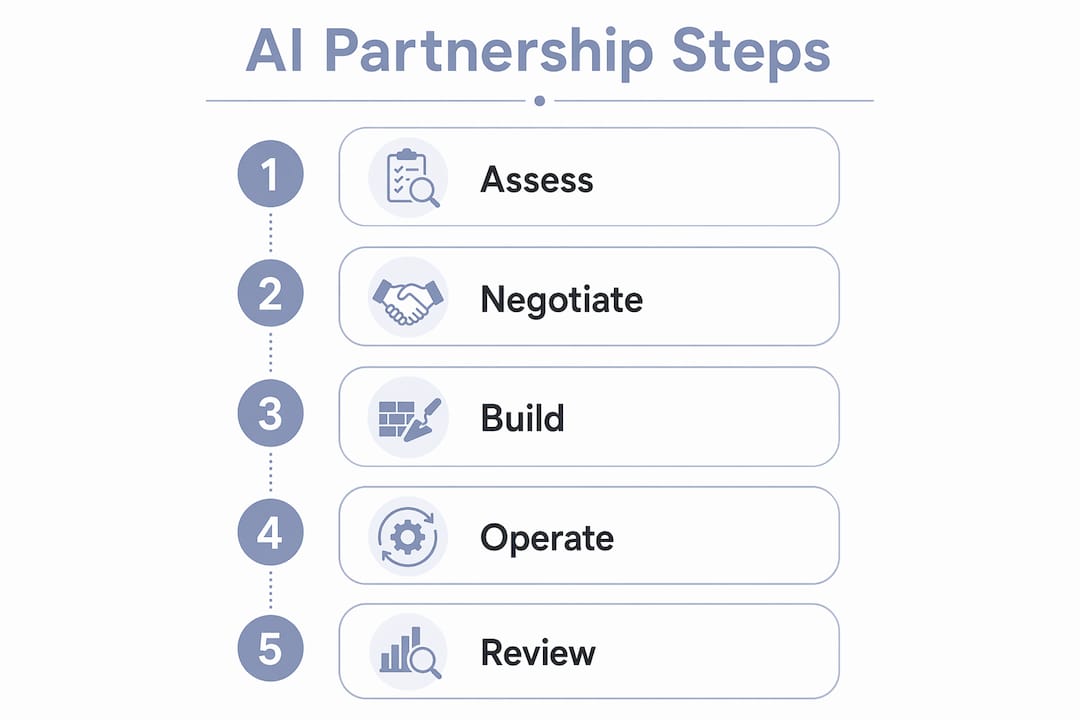
What operational practices ensure long-term security and control?
Signing a contract is the beginning of a secure AI partnership, not the end. Executives must shift from static deployment mindsets to continuous, active governance to sustain security over time. The organizations that treat AI deployment as a one-time project consistently experience model drift, compliance gaps, and vendor dependency within 18 months.
Operational practices that sustain secure AI collaborations include:
- Trust architect roles. Assign dedicated personnel to monitor model drift, bias, and performance within secure perimeters. This role sits between your AI vendor and your internal teams, translating technical signals into business decisions.
- Internal evaluation harnesses. Build a private benchmarking system that runs production-like traffic through your AI systems independently of vendor metrics. An internal evaluation harness benchmarking hallucination rates, safety scores, and latency on redacted real data gives you ground truth that no vendor dashboard can provide.
- Orchestration layer architecture. Architecting for portability via an orchestration layer means you can switch AI providers with minimal code changes. This is the technical equivalent of a prenuptial agreement. You hope you never need it, but the cost of not having it is catastrophic.
- Fallback and error-handling workflows. Every AI system fails at some point. Define fallback behaviors, escalation paths, and human-in-the-loop checkpoints before deployment, not after an incident.
The role of cryptographic trust in AI security is increasingly central to how organizations operationalize these governance models, particularly when AI agents interact autonomously with external systems.
What are the most common pitfalls in AI partnerships?
Most AI partnership failures are predictable. They follow a consistent pattern: a vendor delivers a working prototype, the executive team declares success, and 12 months later the organization cannot modify, audit, or exit the system without the vendor’s involvement.
The table below contrasts the most common failure modes with the practices that prevent them:
| Common pitfall | Risk-mitigation practice |
|---|---|
| One-drop delivery with no knowledge transfer | Require documentation and operator training as contractual deliverables |
| Vendor defines success metrics | Insist on internal benchmarking and SLAs with payment holdbacks tied to verified outcomes |
| No exit strategy in contract | Design portable architecture and include termination-for-convenience clauses |
| Vendor acquisition strips data rights | Negotiate explicit clauses covering derived assets and model weights |
| Vague security assurances | Require SOC 2 Type II and independent bias audit results before go-live |
The “one-drop” failure mode deserves specific attention. This is the practice where a vendor delivers a finished system with no documentation, no training, and no transfer of operational knowledge. Your team can use the system but cannot maintain, modify, or audit it. Avoiding this requires insisting that partners build within your owned infrastructure from the start, with every configuration decision documented in real time.
Letting vendors define success is equally dangerous. Vendors naturally select metrics that favor their product. Internal benchmarking on your own data, with your own evaluation criteria, is the only way to verify that an AI system is performing as promised. Pair that with SLAs that include payment holdbacks tied to independently verified outcomes, and you create a financial incentive for the vendor to prioritize your results over their convenience.
Enterprise AI API integration examples from 2026 show that organizations with portable, well-documented architectures recover from vendor failures in days rather than months. Architectural flexibility is not a technical luxury. It is a business continuity requirement.
Key takeaways
Secure AI partnerships succeed when governance, ownership, and compliance controls are built into the structure of the collaboration from the first contract negotiation, not retrofitted after deployment.
| Point | Details |
|---|---|
| Use the 3-lever framework | Evaluate Capability, Criticality, and Complexity before deciding to build, buy, or partner. |
| Demand the partner-to-build-then-own model | Require vendors to build on your infrastructure with documentation as a contractual deliverable. |
| Embed compliance from day one | Maintain a data-flow register, secure audit rights, and negotiate data export clauses before signing. |
| Assign trust architects | Dedicate personnel to monitor model drift, bias, and performance continuously post-deployment. |
| Design for portability | Use an orchestration layer so you can switch providers without rebuilding your entire stack. |
Why most executives underestimate the governance burden
I have seen the same mistake repeated across organizations of every size. The executive team treats the AI partnership as a procurement event. They evaluate vendors, negotiate price, sign a contract, and hand the project to a technical team. Six months later, the system is live. Twelve months later, nobody inside the organization fully understands how it works, and the vendor has become a permanent fixture in the budget.
The uncomfortable truth is that secure AI partnerships are not procurement events. They are ongoing operational relationships that require the same governance discipline as any critical business function. Ownership and transparency are not nice-to-haves. They are the structural conditions that make trust possible.
What I have found actually works is embedding evaluation into the operating rhythm of the organization. That means a trust architect reviewing model performance monthly, an internal benchmarking harness running weekly, and a contract review cycle that checks compliance obligations quarterly. It also means designing your architecture for the day the partnership ends, because every partnership eventually does.
The executives who build the most durable AI alliances are the ones who plan the exit before they sign the entry. That is not pessimism. It is the kind of structural thinking that protects the organization regardless of what the vendor does next.
— Nicholas
How Thepitstop helps you build secure AI partnerships
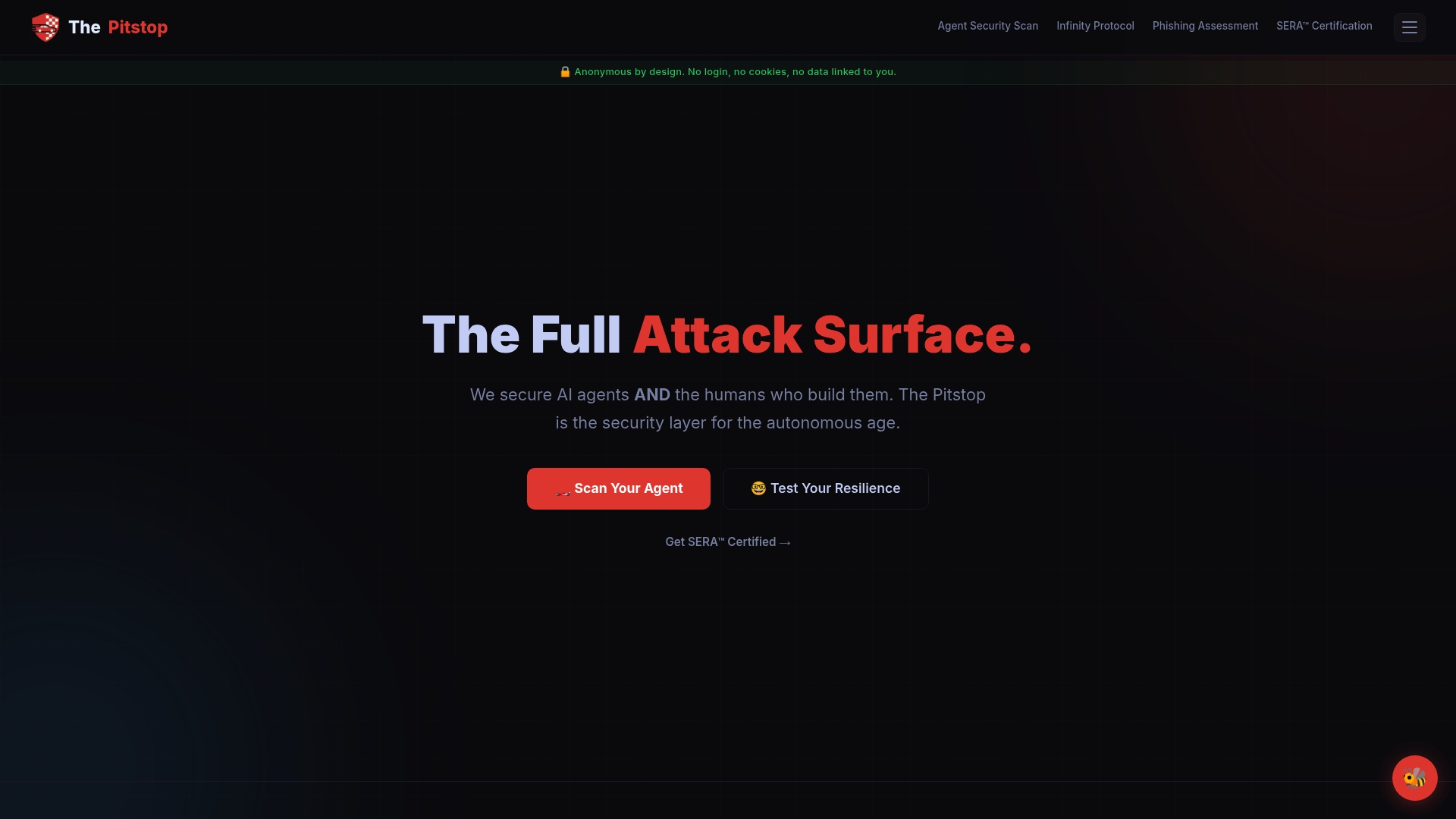
Thepitstop is built specifically for the governance challenges that secure AI partnerships create. The platform’s AI Agent Liability Gap white paper addresses the regulatory and contractual blind spots that most enterprise procurement teams miss, including liability allocation, data export rights, and audit obligations under the EU AI Act. For organizations that need to verify the security posture of their AI systems and human operators before or during a partnership, Thepitstop’s free AI agent security scan provides an automated assessment of the full attack surface. The Infinity Protocol™ adds a cryptographic trust layer that establishes verifiable, tamper-resistant trust between AI agents and human operators, exactly the kind of independent assurance that replaces vendor marketing claims with verifiable evidence.
FAQ
What does “secure AI partnership” mean in practice?
A secure AI partnership is a vendor collaboration that includes explicit contractual controls over data flows, audit rights, knowledge transfer, and exit architecture. Security is defined by verifiable standards like SOC 2 Type II, not vendor assurances.
How do I avoid vendor lock-in in an AI partnership?
Require vendors to build on your infrastructure, negotiate data export and model portability clauses, and architect your system with an orchestration layer that allows provider switching with minimal code changes.
What is the partner-to-build-then-own model?
It is an engagement structure where the vendor builds the AI system on the customer’s infrastructure, with documentation and operator training delivered as contractual milestones, transferring full operational ownership to the customer at project close.
Which regulations apply to AI partnerships in 2026?
The EU AI Act requires organizations to maintain a data-flow register and document encryption and deletion mechanisms. SOC 2 Type II and independent bias audits are the standard verification mechanisms for vendor security claims across most industries.
How should I measure AI partner performance independently?
Build an internal evaluation harness that benchmarks hallucination rates, safety scores, and latency using redacted production data. Tie vendor SLA payments to the outcomes this harness verifies, not to metrics the vendor reports themselves.