Phishing in 2026: A complete defense guide for AI teams

Phishing is not a solved problem. Despite advances in email filtering, zero-trust architecture, and AI-powered threat detection, phishing attacks remain the leading entry point for data breaches worldwide. The assumption that modern tooling automatically neutralizes these threats has created a false sense of security, especially among teams deploying AI agents and autonomous systems. Both human operators and machine systems carry exploitable blind spots that attackers are actively mapping. This guide breaks down exactly how phishing works in 2026, why it keeps succeeding against even sophisticated defenses, and what you can do right now to close the gaps.
Table of Contents
- How phishing attacks work: Mechanisms and modern phases
- Why phishing succeeds: Human, technical, and AI factors
- Detection and defense: What really works against modern phishing
- Future of phishing: Evolving threats and proactive defenses
- Phishing defense in practice: What most experts overlook
- Get help with AI-driven phishing defense
- Frequently asked questions
Key Takeaways
| Point | Details |
|---|---|
| Phishing remains sophisticated | Modern phishing leverages both human psychology and AI weaknesses to bypass defenses. |
| AI-targeted attacks rising | Phishing campaigns increasingly exploit AI systems and connectors, not just humans. |
| Layered mitigation is essential | Combining technical controls, training, and AI-specific protections provides the strongest defense. |
| Continuous adaptation required | Ongoing updates and simulated attacks are critical to counter rapidly evolving phishing threats. |
How phishing attacks work: Mechanisms and modern phases
Understanding why phishing is so persistent starts with understanding its structure. Modern phishing campaigns are not random spray-and-pray emails. They are engineered operations with distinct phases, each designed to maximize the probability of success while minimizing detection.
According to attack mechanics research, phishing campaigns typically follow five to seven phases. Here is how each one plays out in practice:
- Reconnaissance. Attackers harvest open-source intelligence from LinkedIn profiles, company websites, GitHub repositories, and job postings. They identify key personnel, internal tool names, vendor relationships, and communication patterns. This phase can take days or weeks for high-value targets.
- Infrastructure setup. Typosquatted domains are registered, sometimes just hours before a campaign launches. Cloned login pages are deployed with valid HTTPS certificates, making them visually indistinguishable from legitimate portals. Attackers often use bulletproof hosting to avoid quick takedowns.
- Lure construction. The message is crafted to trigger urgency or authority. Common formats include fake invoice approvals, HR policy updates, IT password resets, and vendor payment requests. AI-generated lures in 2026 are grammatically flawless and contextually aware, pulling in real names, project references, and current events.
- Delivery. Getting past email filters is a science of its own. Attackers exploit internal email spoofing, compromised vendor accounts, and legitimate cloud services like SharePoint or Google Drive to host malicious content. The goal is to make the message look like it came from inside the organization.
- Interaction. Once the target clicks, credentials are harvested through fake login portals, or malware is silently installed via drive-by downloads or malicious attachments.
- Exploitation. Credentials and access are used for lateral movement, privilege escalation, or data exfiltration. This phase often begins quietly, sometimes weeks after initial compromise.
The contrast between generic phishing and targeted spear-phishing is significant:
| Feature | Generic phishing | Spear-phishing |
|---|---|---|
| Target selection | Mass audience | Specific individuals or roles |
| Personalization | None or minimal | High, uses real names and context |
| Lure quality | Generic templates | Custom, contextually accurate |
| Detection difficulty | Moderate | Very high |
| Success rate | Low (1-3%) | Significantly higher (up to 30%) |
“The most dangerous phishing emails in 2026 do not look dangerous at all. They look like the email you were already expecting.”
Pro Tip: Watch for lookalike domains registered within the past 30 days that share your company name or key vendor names. Tools like DomainTools or VirusTotal passive DNS can surface these before they are weaponized.
Why phishing succeeds: Human, technical, and AI factors
Knowing the phases is one thing. Understanding why they work, even against trained professionals and advanced AI systems, is where real defense begins.
Human vulnerabilities are well documented. Psychological triggers like urgency, authority, fear, and social proof short-circuit rational decision-making. A message that appears to come from the CEO demanding immediate action on a wire transfer bypasses critical thinking even in experienced staff. Fatigue, cognitive overload, and the sheer volume of daily communications compound the problem. Security awareness training helps, but its effects decay quickly without reinforcement.
Technical oversights create another layer of exposure. Legacy email systems without proper SPF/DKIM/DMARC enforcement are common in organizations that have grown through acquisition or that run hybrid on-premises and cloud environments. Even when these protocols are configured, misconfigurations are frequent and rarely audited.
AI-specific vulnerabilities are the newest and most underappreciated attack surface. AI connectors and agentic systems often parse email display names without verifying the underlying sender address against authentication records. An attacker can set a display name to “IT Security Team” while sending from a completely unrelated domain, and an AI agent processing that message may act on it without flagging the discrepancy. Agentic AI also enables attackers to automate multi-channel campaigns at scale, combining email, SMS, Slack messages, and voice calls into coordinated attacks that are far harder to recognize as a single campaign.
Here is a breakdown of common vulnerability categories:
| Vulnerability type | Example | Risk level |
|---|---|---|
| Human error | Clicking urgency-laced links | High |
| Legacy system gaps | No DMARC enforcement | High |
| AI identity parsing flaws | Display name spoofing | Critical |
| Over-trusted integrations | Compromised vendor OAuth tokens | Very high |
| Lack of cross-channel correlation | Siloed email and chat monitoring | Medium-High |
- Attackers study your AI agent’s behavior patterns before launching targeted lures
- Multi-channel attacks are designed to overwhelm monitoring by distributing signals across platforms
- AI agents with broad permissions are prime targets because a single compromise yields wide access
- Social engineering is increasingly directed at the humans who configure and oversee AI systems, not just end users
Pro Tip: Audit every AI connector and integration point in your environment for display name verification. Enforce strict sender authentication checks at the API level, not just the email gateway. If your AI agent can receive instructions via email or chat, treat those channels as untrusted input by default.
Detection and defense: What really works against modern phishing
The good news is that the research on effective defenses is clear. The bad news is that most organizations implement only part of the picture.
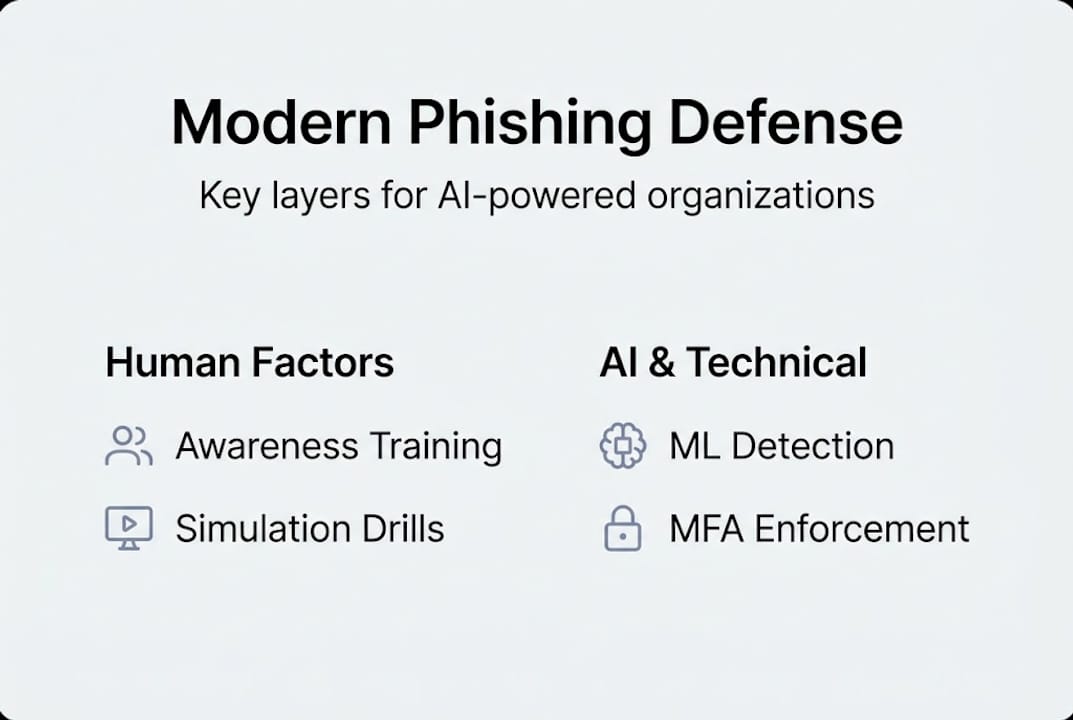
Machine learning detection has matured significantly. GWO-optimized random forest models tested against the PhishTank dataset achieve 98.7% accuracy with a 0.96 Matthews Correlation Coefficient, which is one of the strongest benchmarks in the field. These models analyze URL structure, domain age, page content, and behavioral signals simultaneously, catching attacks that signature-based filters miss entirely. Deploying ML-based detection at the email gateway, browser level, and within AI agent pipelines creates overlapping detection layers that are much harder to evade.

Security awareness training has a measurable and dramatic impact. Organizations that run regular simulated phishing campaigns see click rates drop from 33% to 4.6% over time. That is not a marginal improvement. It fundamentally changes the risk profile of your human attack surface. The key is consistency: one-time training events fade within weeks, but monthly simulations with immediate feedback loops create lasting behavioral change.
Multi-factor authentication remains one of the highest-leverage controls available. MFA prevents 99% of bulk credential-stuffing and phishing attacks that rely on stolen passwords alone. It is not a silver bullet against adversary-in-the-middle attacks that intercept session tokens in real time, but it eliminates the vast majority of opportunistic credential theft.
Here is a prioritized list of technical controls that deliver proven results:
- AI-aware email firewalls that validate sender identity at the protocol level, not just the display layer
- Adversarial training for AI models so they learn to recognize manipulated inputs and social engineering patterns
- MFA on all privileged accounts, including those used by AI agents to access external services
- Zero-trust network segmentation to limit lateral movement after a credential is compromised
- Real-time URL detonation that executes links in sandboxed environments before delivery
- Behavioral anomaly detection that flags unusual access patterns even when credentials are valid
Pro Tip: Layer your defenses so that no single control is a single point of failure. An attacker who bypasses your email gateway should still face MFA, then behavioral anomaly detection, then network segmentation. Defense-in-depth is not a buzzword here. It is the architecture that turns a potential breach into a blocked attempt.
The integration of human and AI defenses matters as much as the individual controls. Teams that treat email security, AI agent security, and human training as separate programs create gaps at the seams. Attackers actively target those seams.
Future of phishing: Evolving threats and proactive defenses
The trajectory is clear. Phishing is getting more automated, more personalized, and more difficult to attribute to a single channel or attack vector.
AI agentic phishing represents the most significant near-term escalation. Autonomous attack agents can conduct reconnaissance, generate personalized lures, manage delivery infrastructure, and adapt their approach based on target responses, all without human involvement. This means attack velocity and personalization will scale in ways that traditional threat intelligence cannot keep pace with.
Cross-channel orchestration is already emerging as a dominant pattern. Rather than a single phishing email, targets receive a coordinated sequence: a LinkedIn message establishing rapport, followed by an email referencing that conversation, followed by a phone call confirming the request. Each individual touchpoint looks legitimate. The attack only becomes visible when you correlate signals across channels, something most security operations centers are not currently equipped to do.
Voice phishing with AI-generated audio is accelerating. Deepfake voice cloning now requires only a few seconds of audio to produce convincing impersonations of executives or colleagues. Combined with caller ID spoofing, this creates a social engineering vector that bypasses email security entirely.
To stay ahead of these trends, organizations should prioritize:
- Continuous-learning detection models that update on new threat patterns without requiring manual retraining cycles
- Cross-channel correlation capabilities that unify signals from email, chat, voice, and web into a single threat view
- AI red-teaming programs where simulated agentic phishing attacks test both human and machine defenses under realistic conditions
Pro Tip: Run a red-team exercise specifically designed around AI-driven phishing. Task your red team with using publicly available AI tools to generate personalized lures targeting your AI agent integrations and your highest-risk human operators simultaneously. The results will almost always reveal gaps that standard penetration testing misses.
The organizations that will navigate this landscape successfully are those that treat phishing defense as a continuous discipline rather than a compliance checkbox. Threat actors are iterating constantly. Your defenses need to iterate at the same pace.
Phishing defense in practice: What most experts overlook
Here is the uncomfortable truth that most security frameworks do not address directly: the biggest gap in phishing defense is not technical. It is organizational.
Teams that separate human security training from AI security hardening are operating on a flawed assumption. They assume that phishing targeting a human operator and phishing targeting an AI agent are distinct problems requiring distinct solutions. Attackers do not see it that way. They probe both simultaneously, looking for whichever path offers less resistance. A well-trained human who operates a poorly secured AI agent is still a high-value target.
Conventional wisdom also underestimates attacker creativity. Security teams tend to defend against the last attack they saw, not the next one. AI-generated lures in 2026 are contextually aware enough to reference real internal projects, mimic writing styles, and time delivery to coincide with known business cycles like end-of-quarter approvals or annual HR reviews.
The practical lesson from working at the intersection of AI security and human resilience is this: feedback-driven, cross-disciplinary simulations consistently outperform isolated technical upgrades. When your red team runs exercises that simultaneously target your AI pipelines and your human operators, and when those exercises feed directly into updated training and configuration changes, you build resilience that compounds over time. A new firewall rule does not do that on its own.
Get help with AI-driven phishing defense
Closing the gap between knowing what works and actually implementing it is where most teams struggle. The research is clear, but execution requires tools built specifically for the reality of AI-human hybrid environments.
Thepitstop.ai was built to address exactly this challenge. The platform combines AI agent security with human resilience assessment in a single, integrated approach, so you are not defending two separate attack surfaces with two separate programs. Free automated tools let you assess your current exposure across both dimensions without a lengthy procurement process. Whether you are hardening AI connectors against identity spoofing or running simulated phishing campaigns against your operators, the platform gives you a unified view of your real risk posture and a clear path to improving it.
Frequently asked questions
What are the main phases of a phishing attack?
Phishing attacks follow five to seven phases, including reconnaissance, infrastructure setup, lure creation, delivery, interaction, and exploitation, each engineered to maximize success while avoiding detection.
How do phishing attacks compromise AI systems?
AI connectors misinterpret display names without verifying SPF/DKIM/DMARC records, and agentic AI enables attackers to automate multi-channel campaigns, making dedicated AI-targeted security controls essential.
What is the most effective way to reduce phishing risks for organizations?
Combining ML detection at 98.7% accuracy with regular simulated phishing training and MFA enforcement creates overlapping defenses that dramatically reduce both technical and human-layer phishing success rates.
How can professionals prepare for future phishing threats?
Invest in continuous-learning detection models, build cross-channel correlation into your security operations, and run regular AI-driven red-team exercises that target both human operators and AI agent integrations simultaneously.