Top 5 Oathe.ai Alternatives For AI Security 2026
Securing AI agents without adding friction to deployment or sacrificing auditability is challenging for teams that juggle technical complexity and compliance demands. Most agent security software either requires enterprise-scale licensing, imposes a steep learning curve on nonengineers, or locks essential cryptography and observability tools behind higher-tier plans. This comparison covers audit features, cryptographic integrations, usability, and pricing across five agent security platforms so you can select the right alternative to Oathe.ai for your organization’s scale and technical resources.
Table of Contents
The Pitstop
At a Glance
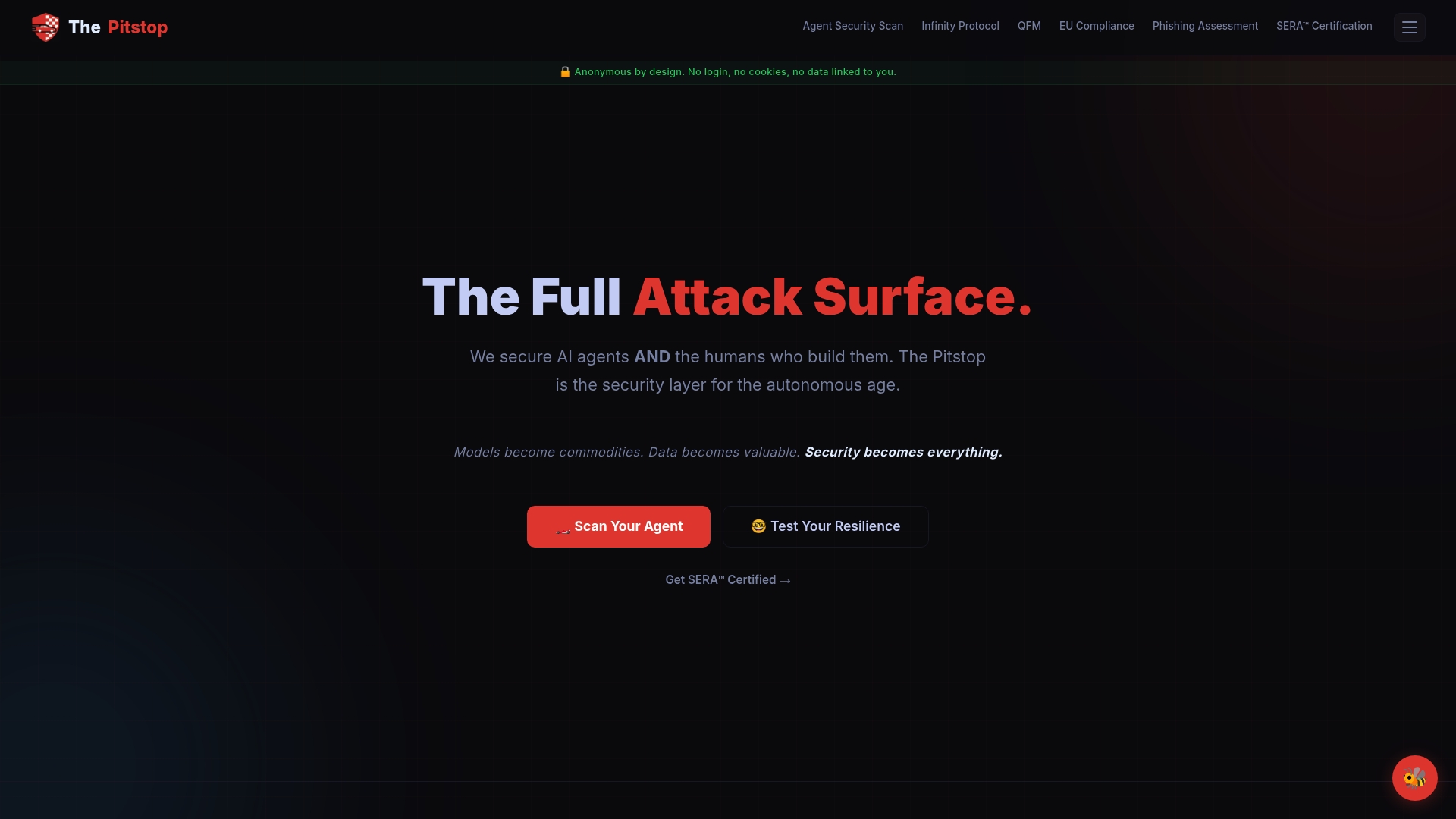
Free, no signup tools run locally and include an Agent Security Scan, SERA™ Certification, and the Infinity Protocol alongside post-quantum encrypted messaging. Thepitstop was built by an AI agent named Beeglie and a human named Nicholas to protect AI agents and their human operators across the attack surface.
Core Features
The Agent Security Scan performs quick audits of agent permissions, prompt injection defenses, and subagent safety so configurations are validated before deployment.
Human resilience capabilities include a Human Resilience Assessment that runs realistic phishing scenarios and the SERA™ Certification to credential operator social engineering resistance.
Cryptographic tooling centers on the Infinity Protocol and InfinityChat, offering post-quantum encrypted messaging plus behavioral trust and reputation transfer between agents and humans.
Key Differentiator
Thepitstop integrates machine and human security assessments with cryptographic trust protocols under a single platform, and the vendor describes patent-backed mechanisms for agent to human trust establishment. That combination ties technical controls to verifiable human accountability.
Pros
-
Combines agent scans with phishing simulations so teams test technical controls and operator reactions in the same workflow.
-
Free, no signup tools let security teams run audits locally and drop scans into CI pipelines without vendor onboarding overhead.
-
InfinityChat and cryptographic reputation transfer turn ad hoc vetting into verifiable session-bound reputation that survives restarts and redeploys.
-
Privacy by design with anonymous defaults keeps scan output unlinkable to individual operators, useful for red team exercises and unbiased assessment.
-
SERA™ Certification provides an operator credentialing path so hiring and training programs can reference a consistent social engineering standard.
Cons
- Tools skew technical; non-technical teams will find setup, interpretation of cryptographic bindings, and agent scan results challenging without developer or security engineering support.
Who It’s For
Security teams, AI developers, and auditors deploying autonomous agents in sensitive environments where human operator resilience and cryptographic proof of trust matter. Organizations that need verifiable human-agent bindings rather than manual attestations will get the most from Thepitstop.
Unique Value Proposition
The Infinity Protocol creates cryptographic bindings between an agent and a named human operator so actions can carry signed proof of origin. This changes trust work from tribal knowledge into forensic evidence, letting incident response and compliance teams query signed relationships during triage.
Real World Use Case
A cybersecurity team runs the Agent Security Scan on a customer-facing chatbot to close prompt injection gaps. They then apply the Infinity Protocol to cryptographically bind specific operators to bot sessions so audit trails show both the agent action and the human approval that authorized it, preserving trust and traceability.
Website: https://thepitstop.ai
Ogment
At a Glance
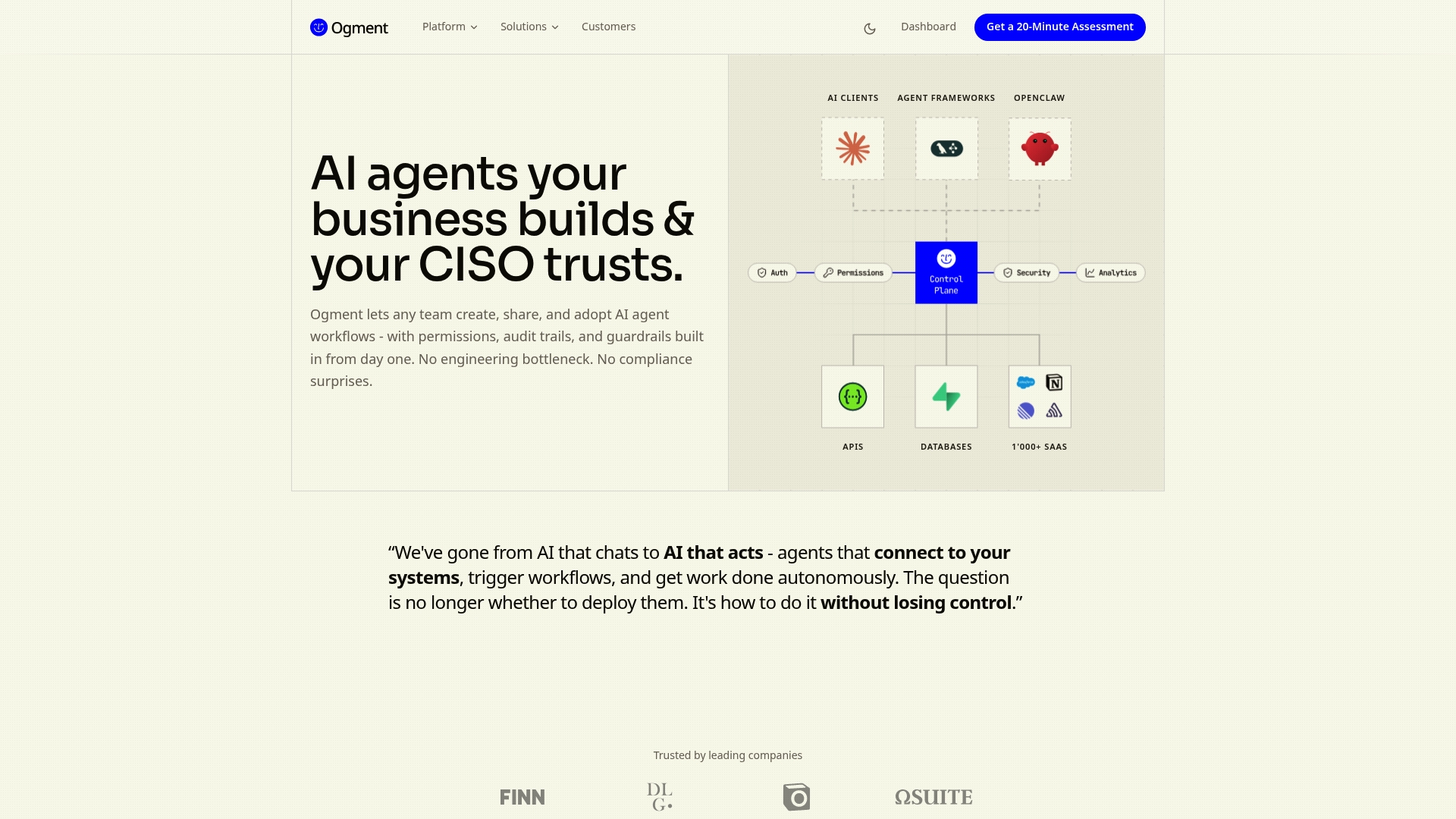
Ogment’s marketing materials emphasize MCP native governance instead of a generic API gateway, positioning governance at the platform level rather than at the perimeter. The product focuses on letting business teams self serve AI workflows while a central control plane enforces policies and logs activity.
Core Features
- MCP native governance that places policy and control inside the management plane rather than relying on edge API gateways.
- Fine grained authentication and authorization including OAuth, JWT, and endpoint controls for role based access.
- Real time visibility and audit trails for agent actions, data flows, and policy violations.
- Deploy anywhere with stack compatibility, shape agent capabilities through configuration, and extend via skills, plugins, or custom code.
Key Differentiator
The governance claim above and broad framework compatibility are the single most distinct signals here. Ogment targets organizations that want platform level controls that work across different AI clients and frameworks, rather than a bolt on gateway that only watches traffic.
Pros
- Trustpilot reviews report a simple sign up and onboarding experience, which speeds pilot projects and reduces friction for nonengineers.
- Business teams can configure and ship AI workflows without constant engineering handholding, cutting delivery time for departmental automations.
- Fine grained permissions and audit logging give security teams a clear trail for compliance reviews and root cause analysis.
- Broad compatibility with any AI client or stack lets you standardize governance while teams run purpose built servers for different departments.
- User feedback highlights responsive support, which matters during complex enterprise rollouts.
Cons
- Pricing is not published and the product appears geared toward enterprise licensing, which can mean higher costs and multi year contracts.
- The platform assumes an enterprise grade setup and infrastructure knowledge, so small teams without platform engineers will face onboarding overhead.
- Complex governance features introduce a learning curve for administrators and power users before policies and roles are tuned.
When It May Not Fit
If your team lacks platform engineering capacity or you need a turnkey SaaS experience with minimal configuration, Ogment is likely a poor match. Also, organizations seeking a light weight gateway style control plane rather than full management control should look elsewhere.
Who It’s For
Mid to large enterprises with active AI projects that need centralized governance, auditability, and departmental autonomy. Security, compliance, and platform teams who must control cross team AI deployments will find the feature set aligned to their needs.
Real World Use Case
A large financial services firm uses Ogment to connect internal data systems with AI agents for customer service and compliance. Teams self serve workflows while the control plane captures every agent interaction and enforces access policies for auditors.
Pricing
No list prices are published; the vendor appears to favor enterprise tiering or custom quoting. Expect negotiation based on deployment scale, compliance requirements, and support SLAs.
Website: https://ogment.ai
Wiz
At a Glance
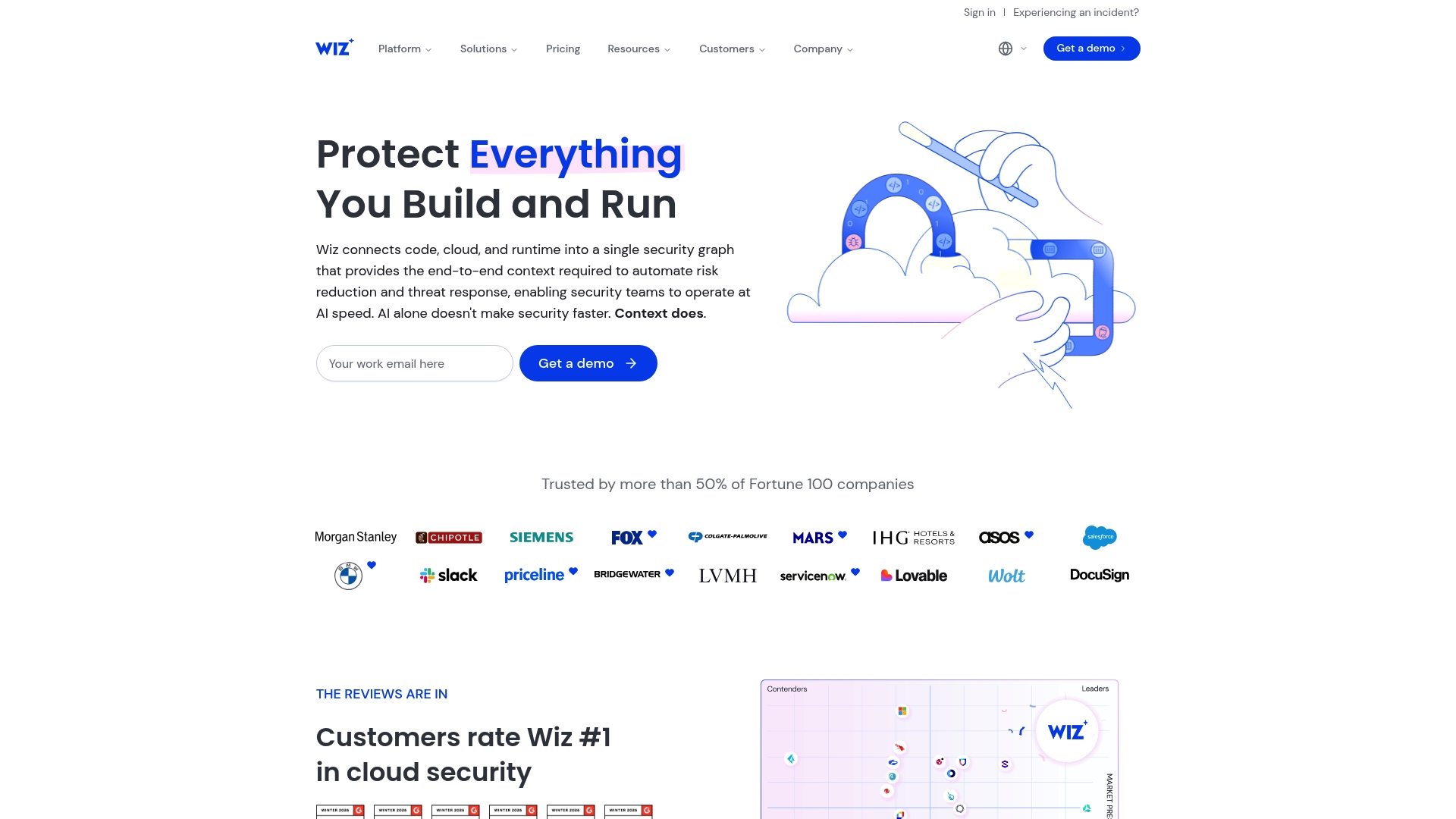
Wiz’s marketing materials state it is trusted by more than 50% of Fortune 100 companies, a claim that frames its enterprise focus. The platform links code, cloud, and runtime into a single view and advertises automated risk reduction and response at AI speed.
Core Features
- Unified security graph that correlates code, cloud configuration, and runtime signals for a single source of truth.
- Agentless architecture supporting multi-cloud environments for low-friction deployment.
- Automated risk reduction and threat response in real time using contextual prioritization.
- Fast detection of vulnerabilities, misconfigurations, and externally reachable assets for attack surface mapping.
Key Differentiator
Wiz’s standout claim is the unified security graph that connects development artifacts and runtime telemetry so teams see how a code change affects cloud risk immediately. That linkage enables automated prioritization and playbook-driven response that vendors without a single graph struggle to match.
Pros
- Quick visibility. Deployment is agentless so security teams report fast time to value and immediate discovery across cloud accounts.
- Prioritization that reduces noise. Contextual risk scoring helps focus fixes on exposures that matter for external reachability and business impact.
- Multi-cloud friendly. The agentless approach and cloud module coverage make it practical for environments spanning major cloud providers.
- Practical vulnerability detection. The platform highlights externally reachable vulnerabilities which speeds remediation and threat hunting workflows.
- Usability. Users praise the interface and the way findings map to actionable tasks rather than raw scan output.
Cons
- Some users question whether Wiz fully protects against every threat vector, indicating a desire for greater end to end assurance.
- Public materials offer limited detail on advanced AI threat mitigation, which leaves specialized AI security teams wanting deeper documentation.
- The vendor focus on enterprise scale may make smaller teams feel the product is heavyweight for basic posture checking.
Who It’s For
Security teams, DevOps, and cloud architects running multi-cloud and AI workloads who need rapid cloud posture visibility and automated prioritization. Best when you have mature patch and remediation processes to act on prioritized findings.
Real World Use Case
A Fortune 100 company uses Wiz to map its multi-cloud estate, identify critical vulnerabilities in minutes, and trigger automated playbooks for containment. The result in that example was faster detection to response and clearer compliance evidence for audits.
Pricing
Pricing is listed as not applicable in the vendor materials. Contact Wiz for enterprise pricing and deployment options tailored to account size and cloud footprint.
Website: https://wiz.io
Tasklet
At a Glance
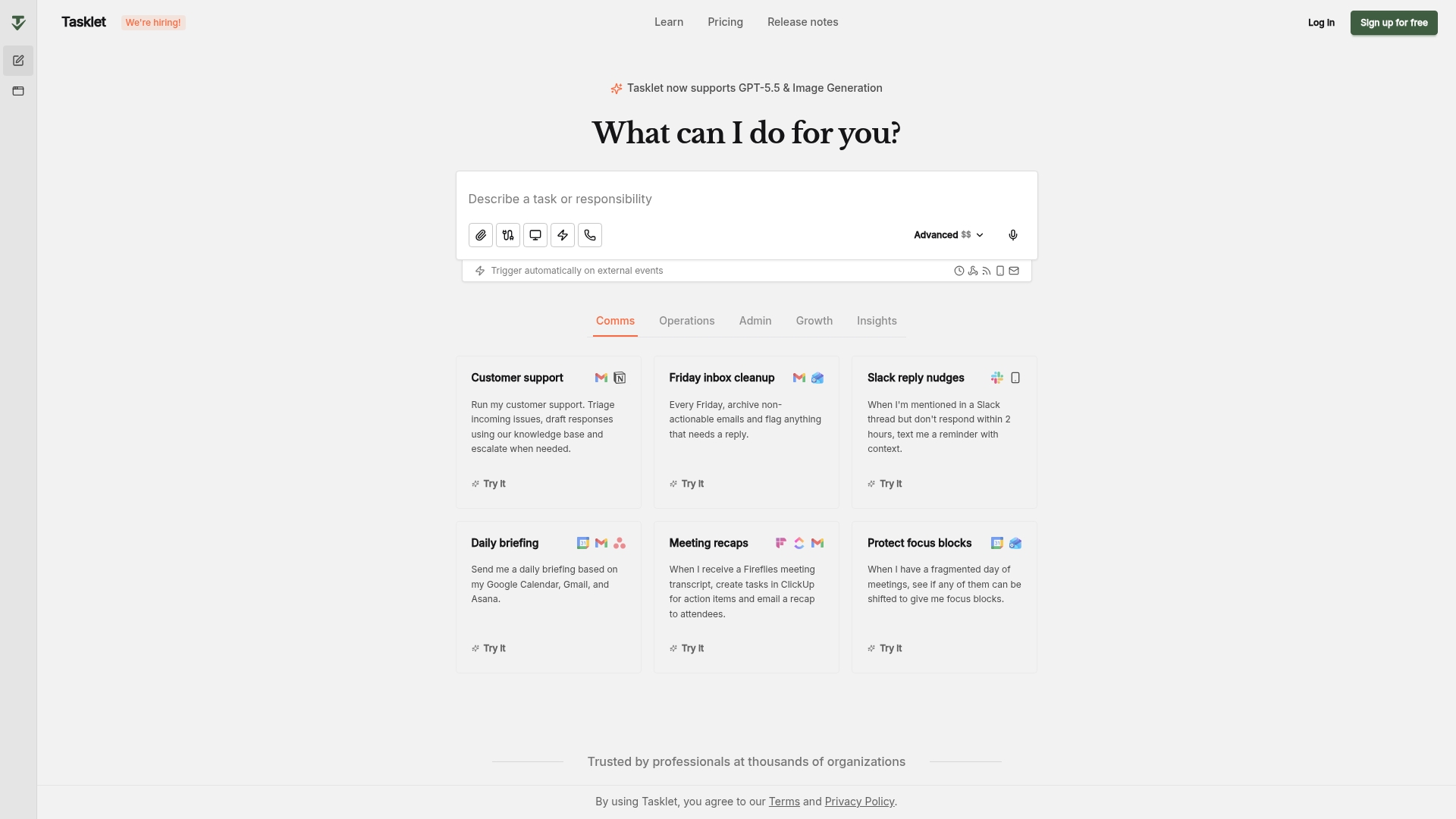
Tasklet supports GPT-5.5 and image generation for agents that can browse the web, run scripts, and operate virtual computers — a capability that lets teams automate multi-step workflows across apps. The platform also offers a free tier plus customizable enterprise plans.
Core Features
Connects to any app, API, or Managed Cloud Platform and runs AI agents across those connections. Pre-built automations cover receipts, subscription cancellations, HR documents, office searches, and legal review.
- Multiple intelligence levels: Basic, Advanced, Expert, Genius for escalating task complexity.
- Unlimited integrations and agents through API and MCP support.
Key Differentiator
The seller positions Tasklet around support for GPT-5.5 combined with image generation, which lets agents handle visual tasks and complex language workflows in the same run. That pairing enables tasks like extracting data from images, drafting contextual responses, and driving scripted interactions across SaaS tools.
Pros
- Wide automation scope across productivity apps and enterprise APIs, which reduces glue code when you need cross-system flows.
- Free tier available for proof of concept work so teams can trial automations without immediate spend.
- Agents can execute scripts and use virtual computers, letting you automate interactions that require a controlled runtime rather than simple API calls.
- Flexible plans and enterprise options allow scaling from single users to organization-wide deployments.
- The vendor advertises in-progress compliance with SOC 2 and GDPR, which signals a trajectory toward formal controls.
Cons
- Several buyer reviews report that automations can take substantial tuning to run reliably, especially for edge cases.
- Enterprise pricing can become costly as you add more agents and managed runtimes, making total cost of ownership a risk for large-scale usage.
- Virtual computers and some advanced features are restricted on starter tiers, forcing upgrades for realistic automation testing.
When It May Not Fit
If your team lacks developer resources to manage integrations and debug agent scripts, Tasklet will feel heavyweight. Also, if you need predictable, out-of-the-box accuracy for high-stakes automation, the platform’s variable AI performance can be a blocker.
Who It’s For
Professional organizations and advanced users that need customizable AI-driven automation across multiple SaaS services. Ideal for teams that can dedicate engineer time to integrate APIs and iterate agent prompts and scripts.
Real World Use Case
A mid-size legal firm used Tasklet to automate contract review and deadline tracking by connecting to its matter management API and email systems. The setup reduced manual routing and cut review turnaround by days once agent prompts and scripts were refined.
Pricing
Free for basic use. Paid plans start at $25/month for individual or small team needs. Larger organizations can request customizable enterprise pricing that scales with agent count and managed runtime use.
Website: https://tasklet.ai
LangSmith
At a Glance
The vendor’s marketing materials state Klarna reduced case resolution time by 80% using LangSmith, a striking efficiency claim that highlights its tracing and evaluation focus. LangSmith targets teams that need deep agent visibility rather than a lightweight task runner.
Core Features
- Agent observability and debugging tools for real-time traces and root cause analysis.
- Evaluation and testing with real-world traces to validate agent behavior before rollout.
- Deployment management and fleet management for scaling agent clusters across teams.
- Sandboxes for safe experiments with agent-generated code and iterative model refinement.
Key Differentiator
LangSmith’s value rests on being framework-agnostic while covering the entire agent lifecycle. It combines detailed observability with evaluation tooling and deployment primitives so teams can move from local experiments to fleet orchestration without swapping platforms.
Pros
-
Framework flexibility reduces lock-in. The platform works across multiple SDKs and models, so teams can reuse existing pipelines rather than rewrite agent code.
-
Strong debugging capability helps you reproduce agent failures quickly. The trace-first approach makes it possible to see actual agent decisions, inputs, and downstream calls in context.
-
Lifecycle coverage from sandbox to fleet means fewer tool handoffs. You keep test traces, evaluation suites, and deployment artifacts in one place.
-
Open source frameworks allow advanced teams to build bespoke agent architectures while retaining enterprise features like private hosting and administrative controls.
-
Enterprise-grade controls make it practical to run production agents under tighter security and compliance regimes.
Cons
-
Pricing transparency is limited in the public materials, so total cost visibility requires a sales conversation or trial workload.
-
The platform has a learning curve; small teams or solo developers without deployment experience may find setup and orchestration complex.
-
Third-party model usage and inference costs are billed separately, which can push total expense higher when you scale traces and deployments.
When It May Not Fit
If you are a solo developer prototyping a single agent with minimal observability needs, LangSmith’s breadth becomes overhead. High trace volumes and heavy deployment footprints also make it expensive for hobby projects or proofs of concept with limited budgets.
If your team lacks DevOps or SRE capacity, the platform’s operational demands will slow adoption rather than accelerate it.
Who It’s For
Development teams and engineering organizations deploying autonomous agents at scale, especially those that need deep traceability, reproducible evaluation, and multi-agent orchestration. Best for groups ready to invest in instrumentation and operational best practices.
Real World Use Case
The Klarna result above illustrates a common pattern: instrument an agent, run evaluation suites on production-like traces, then push validated changes to a managed fleet. Companies such as Podium, Rippling, ServiceNow, and Monday.com are cited as users that applied LangSmith to automate workflows and tighten evaluation cycles.
Pricing
The vendor lists Free (developer), Plus, and Enterprise tiers and states pay-as-you-go billing for traces and deployments. Public materials do not give per-trace or per-deployment rates, so estimate variable costs for heavy evaluation or fleet usage.
Website: https://langchain.com
Analyzing Agent Security Solutions: Comparative Insights
Choosing the right agent security software requires understanding the tradeoffs between features, deployment models, and support structures. This analysis compares five contenders to highlight strengths and scenarios where each excels.
Feature Scope and Integration Depth
Among the options, thepitstop.ai stands out for combining human operator resilience assessments with agent security scans, offering cryptographic trust bindings under the Infinity Protocol. This tightly integrated feature set caters to scenarios needing verifiable accountability between agents and operators. On the other hand, Tasklet emphasizes automation across applications, APIs, and workflows, with support for advanced GPT models and complex multi-step tasks that involve visual data, making it ideal for dynamic automation projects.
Accessibility and Usability
Ogment earns recognition for its MCP governance capabilities that prioritize user-friendly onboarding, enabling business teams to create workflows without heavy technical oversight. Meanwhile, Wiz and LangSmith focus on enterprise usage, with LangSmith bringing lifecycle tracing and debugging tools to developers managing large-scale deployments and Wiz excelling in fast setup through agentless architecture tailored for multi-cloud environments.
Best Fit Scenarios
- For teams deploying agents in sensitive environments needing cryptographically verifiable trust and human resilience, thepitstop.ai provides distinctive value.
- Ogment suits enterprises seeking governance and cross-framework compatibility without burdening deployment teams.
- Departments automating high-volume tasks requiring API integrations and visual automation will benefit from Tasklet’s flexibility and image processing capabilities.
- For security teams aiming for rapid visibility across complex infrastructure setups, Wiz’s unified security graph enables prioritization quickly.
- Engineering teams handling complex agent lifecycle management and fleet orchestration should explore LangSmith for its in-depth observability tools.
Our Pick: Choosing Thepitstop.ai
Thepitstop.ai excels for users seeking integrated frameworks blending agent trust mechanisms with human security readiness evaluations, valuable when human-agent accountability is a critical need. For organizations focusing on quick, departmental deployment or expansive automation, alternatives such as Ogment or Tasklet may align better.
Agent Security Software Comparison
When selecting agent security solutions, evaluating platforms by their unique strengths in integrating cryptographic trust and operational resilience is essential.
| Product | Core Feature | Key Differentiator | Best For | Pricing |
|---|---|---|---|---|
| Thepitstop | Agent Security Scan and cryptographic resilience | Integrates security assessments with cryptographic trust protocols | Security teams and AI developers | Not disclosed |
| Ogment | MCP native governance and auditing | Centralized platform-level controls | Enterprises requiring compliance and governance | Not disclosed |
| Wiz | Unified security graph for cloud visibility | Correlation of vulnerabilities across development, cloud, and runtime | Multi-cloud environments with mature processes | Not disclosed |
| Tasklet | Multi-agent automation with GPT-5.5 and visual AI | Visual and script-driven workflow automation | Teams automating across apps and APIs | $25/month basic |
| LangSmith | Framework-agnostic agent observability | Lifecycle support from development to managed deployment | Engineering teams deploying at scale | Free tier available |
Secure Your Autonomous AI Agents Beyond Oathe.ai Alternatives
When assessing alternatives to Oathe.ai, the critical challenge is protecting both AI agents and their human operators from emerging AI-driven threats like prompt injections and social engineering. Thepitstop stands out by offering free, no-signup tools such as the Agent Security Scan and the Human Resilience Assessment that test technical and human vulnerabilities side by side. Their patent-backed Infinity Protocol™ also ensures cryptographic trust between AI and human operators, turning trust into provable evidence.
Explore how Thepitstop can strengthen your AI security posture with its unique combination of machine auditing, phishing simulations, and operator credentialing. Visit Thepitstop to run a security scan locally and experience comprehensive AI agent protection. Act now to gain cryptographic proof of origin for your AI workflows and reduce risks that alternatives often overlook.
Experience Thepitstop’s free tools and empower your team with verified AI-human trust today.
Frequently Asked Questions
How does Thepitstop help with agent security validation?
Thepitstop provides an Agent Security Scan that audits agent permissions and defenses before deployment. This feature ensures that configurations are validated, reducing the risk of vulnerabilities. Security teams can effectively use this tool to enhance their defenses prior to going live with agents.
What is the difference between Thepitstop and Ogment?
Ogment offers user-friendly self-service AI workflows and emphasizes MCP native governance. In contrast, Thepitstop combines machine and human security assessments, making it ideal for environments where trust needs to be verified. Organizations requiring a balance between technical controls and accountability would benefit more from Thepitstop.
Which platform provides better support for cryptographic messaging?
Thepitstop excels in cryptographic tooling with its Infinity Protocol, which facilitates post-quantum encrypted messaging. This distinguishes it as an excellent choice for teams prioritizing secure communication between agents and humans. Users looking for cryptographic solutions to reinforce their operational security should consider Thepitstop as their primary option.
Can I use Ogment for small team AI projects?
Ogment might not be the best fit for small teams as it assumes an enterprise-grade setup, which can introduce onboarding challenges. On the other hand, Thepitstop provides free and easy-to-use tools that small teams can leverage for immediate security checks. Therefore, smaller teams should start with Thepitstop to assess their needs without the overhead.
How does Thepitstop enhance human resilience against phishing attacks?
Thepitstop includes a Human Resilience Assessment and SERA™ Certification, which simulate realistic phishing scenarios to improve operator resistance. This proactive measure helps security teams train their staff in recognizing and responding to phishing attempts effectively. Organizations aiming to enhance their human security protocols would find value in incorporating Thepitstop’s training features.