The role of interoperability in AI security: what you must know

Most security professionals assume interoperability means making systems talk to each other. Connect the APIs, establish the data flows, move on. But the role of interoperability in AI security is far more consequential than that, and treating it as a connectivity checkbox is exactly how organizations end up with autonomous agents sharing data across trust boundaries with no verification, no audit trail, and no accountability. When your AI agents are making decisions, delegating tasks, and calling external services without human approval on every step, the connective tissue between them becomes your most critical attack surface.
Table of Contents
- Understanding interoperability in AI security
- Key security challenges in interoperable AI systems
- Standards and protocols enabling secure AI interoperability
- Architectural principles for Zero Trust in interoperable AI ecosystems
- Designing trust boundaries and governance for secure AI interoperability
- The uncomfortable truth about interoperability and AI security
- Secure your AI agents before the next handoff
- Frequently asked questions
Key Takeaways
| Point | Details |
|---|---|
| Interoperability complexity | Interoperability means more than connection; it requires shared standards for secure AI agent collaboration. |
| Expanded attack surface | Each AI agent handoff adds a security boundary needing Zero Trust authentication and authorization. |
| Standards enable trust | Adopting cryptographic identity and authorization standards is essential for scalable AI security. |
| Zero Trust control plane | Interoperability forms the backbone that allows Zero Trust to function effectively across AI systems. |
| Governance is critical | Designing trust zones and auditability ensures secure data flows and accountability across AI ecosystems. |
Understanding interoperability in AI security
Interoperability in AI security means more than plugging systems together. It is the capacity for diverse AI agents, regardless of vendor, architecture, or deployment environment, to communicate, authenticate, delegate, and collaborate in ways that remain secure, auditable, and governed.
AI agent interoperability is defined as the ability for different systems, agents, and platforms to work together without custom engineering. That last part matters. Custom, point-to-point integrations do not scale. Each bilateral connection is a fragile contract between two specific systems that breaks when either system changes, and creates a security gap with no shared governance model.
Here is why the distinction between integration and interoperability matters in practice:
- Integration connects System A to System B through a bespoke API contract. It works until one system changes, and it carries no inherent trust model.
- Interoperability defines a shared language, shared identity model, and shared security expectations that any conforming system can join without custom negotiation.
- Secure interoperability goes further: it embeds authentication, authorization, and audit into the communication layer itself, not as an afterthought.
When AI agents delegate subtasks to other agents, share context about a user session, or invoke external tools, each of those actions crosses a security boundary. Without interoperable AI security challenges addressed at the architecture level, those boundary crossings are where attackers operate. Understanding this is the first step toward building an AI ecosystem that does not collapse under its own complexity.
Key security challenges in interoperable AI systems
Every inter-agent handoff is a new attack surface. That is not an abstraction. It is the operational reality of multi-agent systems in 2026, where an orchestrator agent might call a retrieval agent, a code execution agent, and an external API before a human ever sees output. Each of those transitions is a point of vulnerability.

Interoperable AI systems expand attack surfaces and introduce risks like prompt injection, data leakage, and agent identity spoofing. These are not theoretical risks. They are active attack vectors that traditional perimeter security was never designed to address.
The core threats in interoperable AI environments include:
- Prompt injection across agent boundaries: A malicious payload embedded in data retrieved by one agent can hijack the instructions of a downstream agent that consumes it.
- Unauthorized data sharing: Without fine-grained authorization at every handoff, agents may pass sensitive data to systems that should not have it, creating phishing and data leakage risks that span organizational boundaries.
- Agent identity spoofing: If agents cannot cryptographically verify who they are talking to, an attacker can impersonate a trusted agent and manipulate the entire pipeline.
- Insufficient audit trails: When responsibility is distributed across agents, forensic accountability becomes nearly impossible without standardized logging built into the communication layer.
“The challenge is not just that AI systems can be attacked. It is that interoperability without security governance means an attacker who compromises one agent can potentially influence the entire agentic chain.”
Pro Tip: Apply Zero Trust principles at every agent interaction, not just at system ingress. Treat each agent-to-agent call as if it originates from an untrusted network, requiring authentication, authorization, and logging every time. The AI cybersecurity impacts of failing to do this compound exponentially as your agent ecosystem grows.
Traditional security models assume a protected perimeter. Agentic AI has no perimeter. The security model must travel with the data and the agent identity, enforced at the interaction layer itself.
Standards and protocols enabling secure AI interoperability
If every organization builds its own trust model for AI agents, you end up with an ecosystem as fragile and inconsistent as the early internet before TLS. Standards exist precisely to prevent that outcome.
NIST’s AI Agent Standards Initiative promotes industry-led technical standards to enable interoperable and secure AI agents across vendors and platforms. This matters because it means shared identity schemas, shared authorization protocols, and shared audit expectations that any conforming agent can implement without bilateral negotiation.
Cross-organization AI agent federation requires cryptographic trust models using signed credentials and mutual TLS. Here is how a standards-based approach builds security from the ground up:
- Agent identity with Decentralized Identifiers (DIDs): Each agent holds a cryptographic identity that can be verified without relying on a central authority. This prevents spoofing even across organizational boundaries.
- Mutual TLS for transport security: Every channel between agents is encrypted and mutually authenticated. Neither side can be impersonated at the network layer.
- OAuth delegation chains: Authorization flows are explicit. An agent cannot access a resource on behalf of a user unless that delegation is cryptographically documented and scoped.
- Signed Agent Cards: Agents carry verifiable credential documents that describe their capabilities, ownership, and authorized scope. These are machine-readable contracts, not just documentation.
| Protocol/Standard | Function | Security Benefit |
|---|---|---|
| DID-based identity | Cryptographic agent identity | Prevents spoofing and impersonation |
| Mutual TLS (mTLS) | Encrypted mutual authentication | Secures transport between agents |
| OAuth 2.0 delegation | Scoped authorization chains | Limits privilege and tracks delegation |
| Signed Agent Cards | Verifiable capability credentials | Enables trust without custom negotiation |
| NIST AI Agent Standards | Shared governance framework | Reduces fragmentation and audit gaps |
The agent contract standards emerging from these efforts enable scalable governance. Instead of managing security policy for every bilateral connection, you define policy at the standards layer and any conforming agent inherits it.
Pro Tip: Review the AI agent standards white paper for a practical breakdown of how cryptographic agent identity applies to real deployment scenarios. The cryptographic trust protocols that underpin this model are not just theoretical; they are implementable today.
Architectural principles for Zero Trust in interoperable AI ecosystems
Zero Trust is not a product. It is an architectural commitment to verify continuously rather than trust implicitly. When applied to interoperable AI systems, it means every agent interaction requires verification, regardless of where it originates in the pipeline.
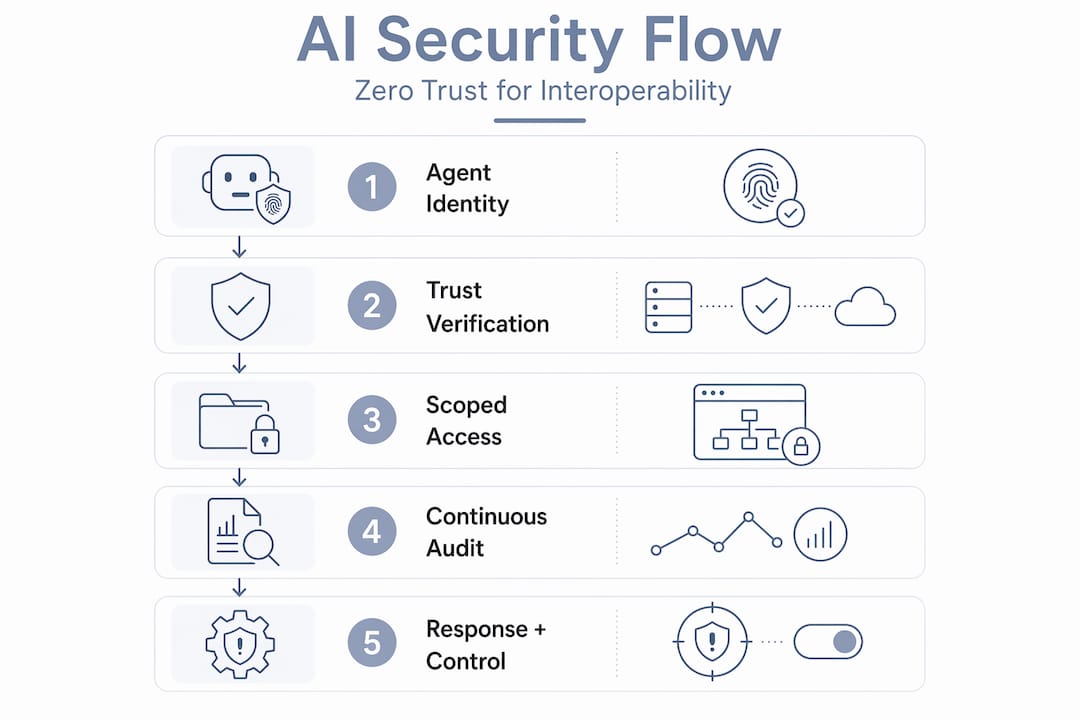
Interoperability is the control plane that makes Zero Trust Architecture function effectively, enabling cross-domain signal flow and coordination. Without interoperability, your security signals stay siloed. An anomaly detected in your retrieval agent never reaches the context processor that might have acted on it. Attackers exploit that gap, dwelling in agent systems for hours or days before anyone notices.
The architectural pillars that bring Zero Trust and interoperability together include:
- Interoperable identity layer: Every agent, human operator, and tool must share a compatible identity fabric. Mixed-vendor environments require this to enforce consistent authorization.
- Real-time signal sharing across agent boundaries: A behavioral anomaly in one agent should trigger re-verification or containment in adjacent agents within seconds, not after manual review.
- Centralized control plane with distributed enforcement: Policy is defined once, but enforced locally at every interaction point. This prevents policy drift and ensures consistency across a complex agent graph.
- Continuous verification, not session-based trust: Agents should not inherit trust from a past interaction. Each new call is a new trust decision.
- Automated containment responses: When a signal crosses a threshold, the architecture should isolate the affected agent automatically, not wait for a human to read an alert.
“The number of security tools you deploy matters far less than whether those tools can share signals and act in coordination. Architectural cohesion is the real measure of security resilience in an agentic environment.”
The Zero Trust and interoperability model shifts your thinking from protecting systems to protecting interactions. That reframe is what makes it effective against the attack patterns unique to autonomous AI.
Designing trust boundaries and governance for secure AI interoperability
Architecture principles tell you what to build toward. Design patterns tell you how to build it. When your AI ecosystem spans multiple vendors, cloud environments, and organizational domains, trust boundaries need explicit design, not organic emergence.
The UK NCSC recommends pipeline approaches with trust zones and control points to secure data flows between systems with different trust levels. This is the cross-domain security model adapted for AI. Here is how to operationalize it:
- Define explicit trust zones. Group agents by their data sensitivity, trust level, and organizational ownership. An agent handling PII lives in a different zone than one summarizing public documents.
- Enforce control points at zone boundaries. Every data flow that crosses a trust zone boundary passes through a mediation layer that validates identity, checks authorization, and logs the transaction.
- Implement adversarial detection within pipelines. Monitor data in transit between agents for signs of prompt injection or anomalous patterns. This is the AI equivalent of DLP (data loss prevention) at network choke points.
- Standardize audit formats across the ecosystem. When an incident occurs, you need logs from every agent in a common schema. Governance policies that mandate audit format from the design stage prevent forensic chaos later.
| Approach | Without governance | With trust boundary design |
|---|---|---|
| Data sharing | Implicit, unlogged | Explicit, authorized, and audited |
| Agent identity | Assumed from context | Cryptographically verified |
| Incident response | Manual, slow, incomplete | Automated, correlated, and fast |
| Cross-vendor trust | Ad hoc bilateral agreements | Standards-based, scalable policies |
Pro Tip: Align your certificate policies and trust anchors early. The governance and audit workflows that work for human operators need a parallel implementation for AI agents, with agent-specific identity certificates that expire, rotate, and revoke just like human credentials.
The organizations that will handle AI security incidents best are not those with the most tools. They are those who designed trust boundaries into their agent architecture from day one.
The uncomfortable truth about interoperability and AI security
Here is something most articles on this topic avoid saying directly: the security industry is not ready for interoperable AI at the scale it is being deployed. The standards are nascent. The tooling is immature. And most organizations are stitching together multi-agent systems with point-to-point integrations and calling it an AI platform.
The impulse to ship fast is understandable. But the pattern of deploying first and securing later does not work when the system in question can delegate tasks, access external APIs, and act autonomously between human checkpoints. The attack surface is not static. It grows with every agent you add and every integration you build.
What experience teaches is that the organizations that treat interoperability as a security design principle from the start, rather than a technical convenience to be secured retroactively, are the ones that maintain control as complexity scales. They invest in shared identity infrastructure before they need it. They define trust boundaries before agents start crossing them. They build audit into the communication layer, not as a log aggregation afterthought.
The role of interoperability in AI security is ultimately about control. Not control in the bureaucratic sense, but the ability to know what your agents are doing, verify they are who they claim to be, and respond when something goes wrong. Without interoperable security standards underpinning your agent ecosystem, that control is fiction.
Secure your AI agents before the next handoff
If this article raised questions about your current agent security posture, that is the right reaction. Multi-agent systems are already operating across most enterprise environments, and the trust models governing those interactions range from thoughtful to nonexistent.
At Thepitstop.ai, the Agent Security Scan assesses your AI agents for exactly the vulnerabilities described here: prompt injection exposure, identity weaknesses, data leakage paths, and supply chain risks. The Infinity Protocol provides a cryptographic trust mechanism specifically designed for securing agent-to-human and agent-to-agent interactions. These tools are free, automated, and built by practitioners who understand that securing the interaction layer is not optional when your agents act autonomously. Start with a scan and see where your trust boundaries actually stand.
Frequently asked questions
What is interoperability in AI security?
It is the ability of AI agents from different systems and vendors to securely communicate and collaborate without requiring custom engineering for each connection, including shared standards for authentication, authorization, and audit.
Why does interoperability increase AI security risks?
Each cross-agent interaction creates a new security boundary. Interoperable systems expand attack surfaces by enabling prompt injection, data leakage, and agent identity spoofing across those boundaries, requiring Zero Trust controls at every interaction, not just at system entry points.
How do standards improve security in interoperable AI?
Standards like NIST’s AI Agent Standards Initiative enable trusted cryptographic identities, scoped authorization protocols, and consistent audit formats, replacing fragile bilateral connections with governance that scales across the entire agent ecosystem.
What role does Zero Trust play in AI interoperability?
Zero Trust functions as the security control plane for interoperable AI by enabling continuous verification and real-time signal sharing across agent interactions, preventing attacker dwell time and lateral movement through agent pipelines.