Human and AI cybersecurity workflow guide for leaders

Your AI agents are making decisions right now. Blocking traffic, triaging alerts, querying threat intelligence. And somewhere in that chain, there is almost certainly a gap where no human knows what just happened or why. Designing an effective human and AI cybersecurity workflow is no longer a theoretical exercise for security architects. It is the operational challenge defining whether your AI deployment becomes a force multiplier or a liability. This guide walks you through the preparation, execution, and verification steps that actually work, based on what security leaders deploying real AI systems are learning the hard way.
Table of Contents
- Preparing your human and AI cybersecurity workflow
- Executing a secure human + AI incident triage and response workflow
- Verifying and monitoring your human-AI workflow for safety and compliance
- Common mistakes and pitfalls in human and AI cybersecurity workflows
- Reimagining cybersecurity leadership: why human-AI collaboration is the future
- How The Pitstop helps secure your human and AI cybersecurity workflows
- Frequently asked questions
Key Takeaways
| Point | Details |
|---|---|
| Human-AI collaboration | Combining AI speed with human oversight improves security decision accuracy and accountability. |
| Governance foundation | Establish clear autonomy boundaries and identity management before deploying workflows. |
| Workflow execution | Use AI for triage and enrichment, reserving human approval for high-impact actions. |
| Continuous verification | Monitor agent behavior and workflow outcomes to detect drift and incidents early. |
| Avoid common traps | Implement integrity checks and fallback mechanisms to prevent automation bypasses and errors. |
Preparing your human and AI cybersecurity workflow
Getting the governance layer right before writing a single automation rule is non-negotiable. Most teams skip this step and pay for it when an AI agent takes a high-impact action that nobody explicitly authorized and nobody knows how to attribute.
Start with an AI autonomy tier policy. This is a written document that classifies every action your AI agents can take into one of three buckets: fully autonomous, autonomous with logging, and human-approved-only. Block a known-malicious IP? Fully autonomous. Disable a user account? Human-approved-only. The NIST AI program structures AI governance around GOVERN, MAP, MEASURE, and MANAGE functions specifically to translate AI risks into treatments, including explicit human oversight requirements. That framework gives you a defensible starting point.
Machine identity management is where most organizations are already behind. Machine identities now outnumber human identities at a ratio of 109 to 1 in enterprise environments, and the majority lack behavioral monitoring, credential revocation schedules, or shutdown procedures. Every AI agent in your workflow is a machine identity. If you cannot revoke its credentials or shut it down in under five minutes, your governance posture has a serious hole.
Before deploying any AI agent into a security workflow, run through this checklist:
- Define the agent’s authorized tool set. List every API, database, and system it can call.
- Assign a risk tier to each tool action. Read-only queries are low risk. Write or delete operations are high risk.
- Set credential rotation schedules. AI agent credentials should rotate more frequently than human ones.
- Map accountability lineage. Every agent action must trace to a named human supervisor.
- Document shutdown procedures. Step-by-step kill process, tested and rehearsed.
- Establish behavioral baseline. What does normal look like for this agent in the first 30 days?
Understanding why AI security matters before your agents go live is essential context for building these controls. The AI agent liability gap is also a document worth reading before any governance conversation with leadership.
| Governance area | Key control | Owner |
|---|---|---|
| AI autonomy tiers | Written policy with action classification | CISO |
| Machine identity lifecycle | Credential rotation, revocation, shutdown | IAM team |
| Tool risk mapping | Action-consequence profiles per agent | Security architect |
| Accountability lineage | Agent-to-human supervisor mapping | SOC manager |
| Behavioral baseline | 30-day normal activity profile | AI ops team |
Pro Tip: Require every AI agent to have a designated human “supervisor of record” before it goes live. This one rule eliminates most accountability arguments after an incident.
Executing a secure human + AI incident triage and response workflow
With governance in place, you can build the operational pipeline. The goal is not to remove humans from the loop. The goal is to remove humans from the boring parts so they can focus on the decisions that actually need judgment.
Step-by-step triage pipeline:
- Collect and normalize alerts. Pull from SIEM, EDR, cloud logs, and network monitoring into a single normalized feed. Garbage in, garbage out. Enrichment before AI processing is not optional.
- Enrich with context. Add threat intelligence, asset criticality, user behavior baselines, and recent change logs before the AI touches the alert.
- AI classification and scoring. The AI model assigns a severity score, groups correlated alerts, generates a summary, and suggests a response action. It does not close anything yet.
- Apply routing rules. Use a combination of AI confidence scores and deterministic business rules to route cases. AutoSOC architecture auto-remediates issues below a defined severity threshold and requires human approvals above it. That threshold is a policy decision, not a technical one.
- Human review queue. Cases above the threshold land in a queue with the AI’s reasoning, evidence links, and suggested action. The analyst reviews, approves, modifies, or escalates.
- Remediation with controls. Any AI-executed remediation runs in dry-run mode first, generates a preview, waits for confirmation on high-impact actions, and applies rate limiting to prevent runaway execution.
- Post-action audit logging. Every action, automated or human-approved, writes to an immutable audit log.
Auto-close versus escalation routing decision factors:
- AI confidence score above 95% AND low asset criticality AND known threat signature: auto-close eligible
- AI confidence score 70-95% OR medium asset criticality: queue for analyst review
- AI confidence below 70% OR high asset criticality OR novel threat pattern: immediate escalation
Effective triage workflows combine AI predictions with deterministic rules and business context for routing decisions, not just a single confidence number. That distinction matters because a 90% confident AI recommendation to disable a C-suite account still needs a human to confirm it.
Pro Tip: Build a “staging remediation” environment where AI-proposed actions execute against a read-only replica first. Analysts review the impact before approving production execution. This cuts approval hesitation time significantly because the analyst can see what will happen, not just what is proposed.

Review your social engineering defense workflow and phishing simulation workflow alongside your triage design. Human operators in AI workflows face the same social engineering risks as any other user.
| Routing tier | AI confidence | Asset criticality | Action |
|---|---|---|---|
| Auto-close | >95% | Low | Automated, logged |
| Analyst queue | 70-95% | Medium | Human review required |
| Escalation | <70% | Any | Senior analyst + manager |
| Emergency escalation | Any | Critical | Immediate human intervention |
Verifying and monitoring your human-AI workflow for safety and compliance
A workflow that worked last Tuesday is not guaranteed to work today. AI agents drift. Threat actors learn your automation patterns. Human oversight boundaries get eroded by well-meaning efficiency improvements. Continuous monitoring is what keeps the system honest.
Behavioral telemetry to track for every AI agent:
- Action velocity. How many actions per hour is the agent taking? Sudden spikes indicate either an incident or a runaway process.
- Permission escalation rate. How often is the agent requesting permissions beyond its defined tier? Any escalation should trigger a review.
- Deviation from baseline. What changed in the agent’s behavior profile since last week? Tool calls it never made before are a signal worth examining.
- Delegation chain depth. How many layers of delegation separate the original human authorization from the current action? NIST AI RMF Agentic Profile recommends explicit monitoring of delegation chains to detect unauthorized authority expansion.
- Interaction anomalies. Is the agent communicating with systems outside its authorized tool set?
Build incident response playbooks specifically for these scenarios: agent credential compromise, behavioral hijacking via prompt injection, and runaway remediation loops. These are not theoretical. They are the AI-specific variants of the endpoint compromise playbooks your team already has.
Pro Tip: Set a weekly calendar reminder to review your AI-human decision boundary settings. Boundaries drift under operational pressure without anyone making a conscious policy change. A scheduled review catches the drift before an incident does.
Approval threshold trade-offs:
| Setting | Speed | Safety | Risk |
|---|---|---|---|
| Low auto-remediation threshold | Fast | Lower | Automation overreach |
| High auto-remediation threshold | Slower | Higher | Analyst bottleneck |
| Balanced with dry-run mode | Moderate | High | Minimal if controls active |
| No human approval gates | Fastest | Lowest | Unacceptable for production |
Operational safety for autonomous remediation depends on explicit approval thresholds combined with rate limits, dry-run modes, and fail-safe escalation fallback. Remove any one of those three and you are one misconfigured rule away from a significant outage. The AI security risks of skipping these controls go beyond operational failures into regulatory exposure.
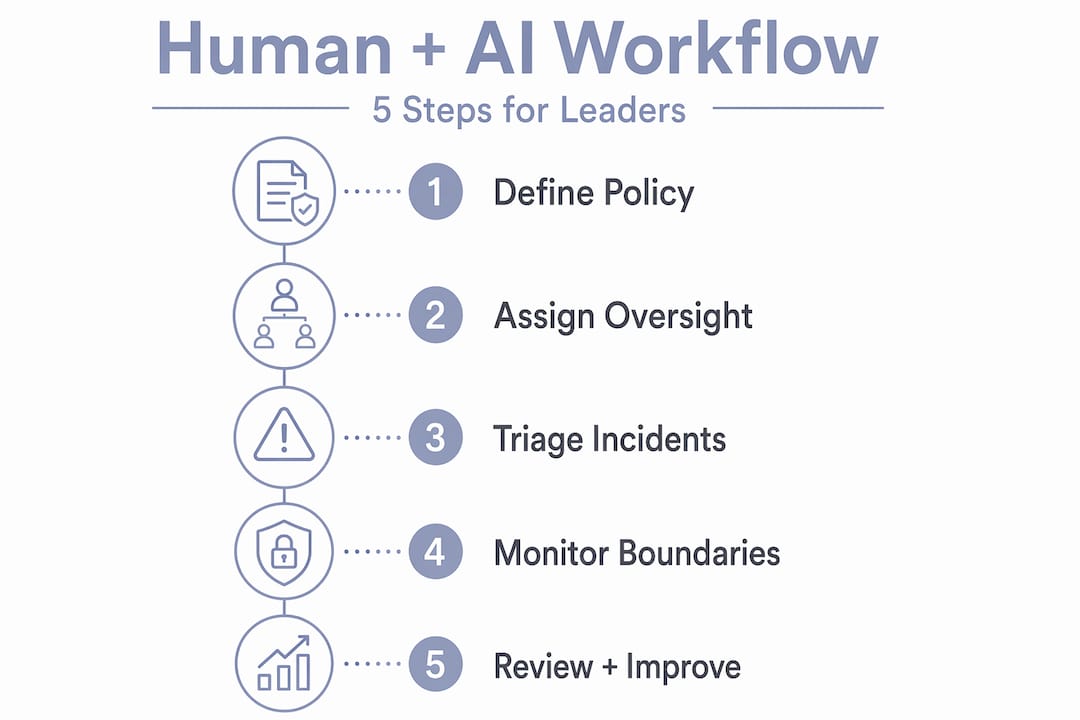
Common mistakes and pitfalls in human and AI cybersecurity workflows
Most failures in human and machine security workflows are not technical failures. They are design failures that technology faithfully executes.
The most dangerous mistakes security leaders make:
- Stateless human-in-the-loop design. If your approval workflow does not cryptographically verify the integrity of the request being approved, an attacker can manipulate the payload between AI generation and human review. Deterministic human-in-the-loop patterns prevent workflow bypass and tampering by ensuring what the human sees is exactly what the system will execute.
- Trusting AI confidence scores in isolation. A high confidence score means the model is certain. It does not mean the model is correct. Always pair AI scores with deterministic rules and business context before routing decisions.
- No throttling on automated remediation. Without rate limits, a single miscategorized threat can trigger hundreds of automated actions in seconds. Throttling is not a performance concern. It is a safety control.
- Hallucination-based escalation. AI-generated summaries can include plausible but incorrect details. Analysts must be able to trace every AI claim to primary evidence. If the evidence link is not there, the summary should not be trusted.
- Overloading analysts with AI output review. If your AI automation sends 300 items to the human review queue daily, you have not reduced analyst burden. You have just added an extra triage layer. Keep AI outputs actionable and pre-filtered.
“Overconfidence in AI, poor data quality, incorrect escalation, and accidental automation of destructive actions are the four most common workflow failures.” These AI triage workflow risks each require a separate mitigation strategy, not a single blanket policy.
Pro Tip: Audit your analyst review queue monthly. If analysts are approving more than 85% of AI recommendations without modification, either your AI is extremely well-calibrated or your analysts have stopped reading carefully. Both deserve investigation.
Reviewing your AI security challenges documentation regularly keeps your team aware of the threat landscape these pitfalls operate within.
Reimagining cybersecurity leadership: why human-AI collaboration is the future
Here is an uncomfortable truth about the machine versus human security debate: framing it as a competition is the mistake. The organizations struggling most with AI security are the ones that deployed AI agents to replace human judgment rather than to extend human capacity.
Fully automated security systems are fast, consistent, and scale effortlessly. They are also brittle when facing novel attack patterns, ethically blind when making decisions with human consequences, and incapable of the contextual reasoning that distinguishes a genuine emergency from a false positive in a critical business moment. Human-only security teams, meanwhile, cannot match the volume, speed, or consistency that modern AI-powered threats demand.
Human-in-the-loop remains essential precisely because ambiguous threats and high-consequence decisions require human judgment and accountability. An AI can detect the pattern. Only a human can weigh the business context, the legal exposure, the customer impact, and the ethical dimension in a single decision.
The evidence increasingly supports collaborative architectures that outperform purely human or purely AI approaches by improving transparency and alignment between automated systems and human operators. The keyword there is alignment. The security leaders getting this right are not the ones with the most sophisticated AI tools. They are the ones who have invested in making the AI’s reasoning visible and its boundaries explicit.
This is a leadership challenge as much as a technical one. Building a culture where analysts trust AI outputs enough to act on them quickly, but remain critical enough to catch AI errors, requires ongoing investment in training, tooling, and workflow design. The social engineering defense workflow is a practical place to start building that culture, because it directly addresses how human operators make decisions under pressure.
Cybersecurity leadership in 2026 means designing systems where humans and AI make each other better. Not faster AI. Not more humans. Better decisions.
How The Pitstop helps secure your human and AI cybersecurity workflows
Designing a secure workflow is one thing. Operating it against real threats, with real AI agents, in a production environment is where most organizations discover their gaps. The Pitstop was built specifically to close those gaps for teams deploying AI agents alongside human operators.
Start with the AI agent liability gap white paper to understand where your current deployment creates accountability and compliance exposure. Then run the free AI agent security scan to get an automated assessment of your agent and human workflow security posture across your actual attack surface. The Infinity Protocol™ provides cryptographic trust between your AI agents and human operators, making the stateless HITL bypass problem structurally impossible rather than just policy-controlled. Every tool The Pitstop offers is designed for security leaders who need answers about their AI deployments today, not after the next incident.
Frequently asked questions
What is a human-in-the-loop cybersecurity workflow?
It is a security process where AI automates routine tasks like alert triage and enrichment while humans review and approve high-impact decisions to ensure accountability and prevent errors. Human validation is essential because AI handles volume but humans make the final call on high-stakes actions.
How do organizations manage the risk of AI agents acting autonomously?
They define explicit autonomy boundaries, require approvals for designated action categories, monitor behavioral telemetry continuously, and maintain accountability by linking every agent action to a responsible human. Agentic AI governance specifies autonomy boundaries, pause conditions, delegation authorities, and accountability lineage as core requirements.
Why is identity management critical in human and AI cybersecurity workflows?
AI and machine identities vastly outnumber human identities, making access control, behavioral monitoring, and lifecycle management essential to prevent unauthorized actions. 109 machine identities exist per human identity in enterprise environments, and most lack the behavioral monitoring and revocation controls that prevent breaches.
Can AI fully automate security incident response?
No. While AI can accelerate triage and enrich evidence, human judgment is required for high-impact approvals and escalations to ensure safety and reduce costly errors. AI handles investigation but humans make judgment calls for significant remediations to avoid unintended consequences.
What are common pitfalls to avoid in human-AI cybersecurity workflows?
Avoid stateless human-in-the-loop designs without cryptographic integrity checks, sole reliance on AI confidence scores, poor data quality feeding the AI, and absent fallback controls that allow automation errors to escalate unchecked. Deterministic HITL with integrity checks prevents workflow bypass and tampering at the structural level.