How to Mitigate Data Exfiltration in AI Systems

AI agents are no longer passive tools waiting for input. They browse, call APIs, write to external systems, and make decisions autonomously. That combination makes knowing how to mitigate data exfiltration in AI one of the most pressing skills in modern security practice. When an agent can be hijacked through a single malicious prompt and instructed to exfiltrate sensitive data through a webhook or a markdown image tag, legacy defenses look like screen doors on a submarine. This guide walks you through preparation, execution, and ongoing verification of defenses built specifically for AI environments in 2026.
Table of Contents
- Key takeaways
- How to mitigate data exfiltration in AI: understanding the threat first
- Preparing your AI environment: policies and data classification
- Executing behavioral detection and egress controls
- Verifying and maintaining your defenses
- Common mistakes that leave you exposed
- My perspective on where defenders need to focus
- Scan your AI agents before attackers do
- FAQ
Key takeaways
| Point | Details |
|---|---|
| AI exfiltration is prompt-driven | Attackers exploit prompt injection to hijack agents and exfiltrate data through covert outbound channels. |
| Legacy DLP cannot keep up | Signature-based tools miss AI-transformed outputs; behavioral detection models are now required. |
| Least privilege limits blast radius | Per-agent permissions and sealed tool patterns contain damage when an agent is compromised. |
| Human-in-the-loop gates work | Mandatory human approval for high-risk outbound actions dramatically reduces autonomous exfiltration risk. |
| Continuous monitoring closes gaps | Integrating agent telemetry into SIEM/XDR and updating behavioral baselines keeps defenses current. |
How to mitigate data exfiltration in AI: understanding the threat first
Before you can contain a threat, you need to understand exactly where it enters. Data exfiltration in AI refers to unauthorized transmission of sensitive information from an AI system to an external destination, often without any obvious network alert firing. What makes AI-specific exfiltration so dangerous is the channel diversity.
Prompt injection is the primary vector documented in 2026, where attackers embed malicious instructions inside content that an agent processes, turning the agent into an unwitting collaborator in data theft. The payloads are creative: markdown image tags that encode stolen data in a URL parameter, direct tool calls to attacker-controlled webhooks, or search query manipulations that leak context through the search string itself.
Autonomous AI agents compound the risk significantly. When an agent has outbound network access and the ability to call external tools, every permission it holds becomes a potential exit route for sensitive data. Consider an AI agent with access to a CRM, email drafting tools, and web search. A single injected instruction can chain all three to exfiltrate customer records in a sequence that looks like routine activity.
The gap between what legacy DLP was built to detect and what AI agents actually do is wide. Legacy tools scan for known patterns in known formats at known endpoints. AI agents transform, summarize, and reformulate data before sending it, which defeats signature-based content scanning entirely. Understanding this gap is the foundation of every mitigation strategy worth deploying.
“Legacy security assumptions fail under AI data flows. Focusing on agent-centric behavioral detection is critical going forward.” — ARMO Security Research
Preparing your AI environment: policies and data classification
Preparation is where most teams underinvest. The mitigation steps in later sections only work if your environment is properly configured before you deploy any detection tooling.

Tenant-level and agent-level data handling policies are the first line of defense. Tenant-level data policies for platforms like Microsoft Copilot and Google Gemini are actively recommended in 2026 precisely because they constrain what an agent can render or transmit before any runtime detection kicks in. These policies sit upstream of the agent’s decision-making layer, which means they cannot be bypassed by a compromised prompt.
Data classification is equally non-negotiable. You cannot protect what you have not labeled. Structured data is easier to classify, but unstructured data such as meeting transcripts, email threads, and document drafts is what AI agents process most frequently. Build classification into the data pipeline, not as an afterthought.
Here is a configuration checklist to work through before enabling any agentic AI tool in a production environment:
- Apply data sensitivity labels at the source system level, not only at the DLP layer
- Enforce least privilege on every tool the agent can invoke, per agent role, not per user
- Implement URL provenance controls that annotate whether a URL originates from a generative source or a trusted non-generative source
- Configure markdown sanitizers to block image tags and links that point to external domains not on an approved list
- Set aggressive retention limits to reduce the volume of sensitive data available to the agent at any given time
| Configuration area | Minimum control | Stronger control |
|---|---|---|
| Data access | Role-based access per agent | Per-task scoped credentials with TTL |
| URL handling | Blocklist of known bad domains | Allowlist of approved domains only |
| Output rendering | Markdown sanitization | Intent-based payload inspection |
| Retention | Standard policy | Aggressive limits tied to agent context |
| Tool permissions | Per-user permissions | Per-agent sealed tool patterns |
Pro Tip: Review your AI model access control policies before deploying any agentic workflow. An agent that can only read what it needs for the current task has a dramatically smaller exfiltration surface than one inheriting broad user permissions.
Executing behavioral detection and egress controls
Preparation sets the stage. Execution is where preventing AI data leaks actually happens. The core architecture here is a tiered observe-to-enforce model, which moves through logging, alerting, and blocking as behavior deviations become more severe.
Here is the sequence to implement:
-
Baseline agent behavior. Before you can detect anomalies, you need to know what normal looks like. Capture query patterns, tool invocation sequences, outbound call volumes, and destination domains for each agent role over a meaningful observation period.
-
Deploy behavioral runtime detection. Runtime AI workload security focuses on agent behavior patterns rather than perimeter or destination-based detection. Anomalies missed by conventional egress monitoring become visible when you watch what the agent does, not just where it sends traffic.
-
Implement network egress proxies with strict allowlisting. Egress allowlisting combined with anomaly detection blocks transmissions to unauthorized endpoints even when an agent has been successfully compromised. Every outbound destination the agent is permitted to reach should be explicitly listed.
-
Apply intent-based guardrails. Standard DLP looks at content. Intent-based guardrails inspect semantic alignment between what the user asked and what the agent is about to send outbound. This catches cases where the agent has been manipulated into repackaging sensitive content in a format that evades content scanning.
-
Require human approval for high-risk actions. Human-in-the-loop approval gates are now an industry-standard control for any outbound action that plausibly involves sensitive content. The latency tradeoff is real, but the risk reduction for irreversible actions justifies it.
-
Implement sealed tool patterns. Sealed tools with per-tool egress allowlists prevent a compromised agent from freely authoring network requests. Each tool can only call its designated endpoints, regardless of what the agent’s prompt instructs.
| Detection method | Effective against AI exfiltration | Limitation |
|---|---|---|
| Signature-based DLP | No | Transformed outputs evade pattern matching |
| Behavioral baselining | Yes | Requires observation period to build baseline |
| Egress allowlisting | Yes | Requires accurate and maintained allowlist |
| Intent-based guardrails | Yes | Computationally intensive at scale |
| Human-in-the-loop gates | Yes | Adds latency to agent workflows |
Pro Tip: Do not rely on sandbox isolation alone. Secondary intent checks at sandbox egress verify that outbound payloads align with the original user prompt, catching manipulation that sandbox walls cannot stop.
Verifying and maintaining your defenses
Deploying controls is not a finish line. The threat evolves, agents are updated, and new tools get connected. Verification is the discipline that keeps your defenses from drifting into irrelevance.
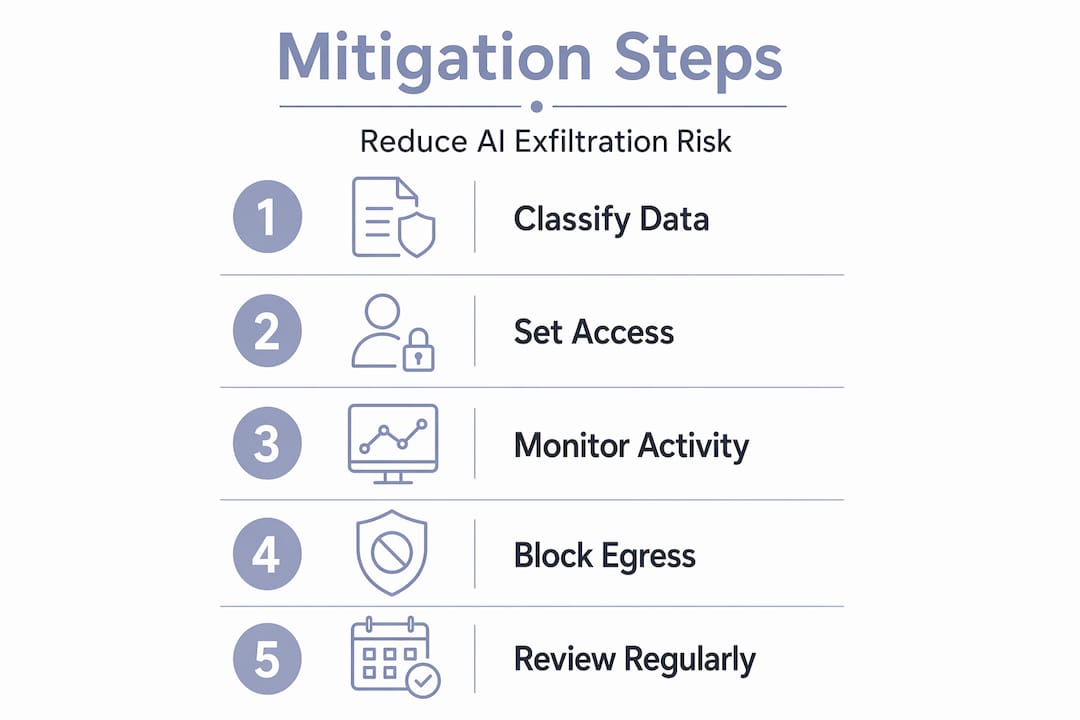
Integrate agent telemetry into your SIEM or XDR platform so that AI agent activity is part of the same threat visibility picture as the rest of your environment. This is not optional for mature programs. Without centralized telemetry, you are blind to cross-system attack chains that span an AI agent and traditional infrastructure.
Your incident response workflow needs AI-specific classification tiers. A prompt injection attempt that did not result in data leaving the environment is different from one that did, and your escalation paths should reflect that. Build those tiers before you need them.
Key ongoing practices to maintain:
- Review agent permission grants and tool access monthly, revoking any that are no longer needed for current workflows
- Update behavioral baselines after any significant change to agent capabilities, connected data sources, or user base
- Validate URL provenance controls and prompt injection defenses after each platform update from your AI vendor
- Track outbound volume anomalies as a leading indicator, spikes in data sent by an agent often precede confirmed exfiltration incidents
- Run tabletop exercises that specifically simulate AI agent compromise to test your detection and response times
Pro Tip: Treating AI security resilience as a continuous program rather than a one-time deployment is what separates teams that catch incidents early from those that discover breaches in retrospect.
Common mistakes that leave you exposed
Even well-resourced teams make predictable errors when approaching AI data security measures. Recognizing these patterns early saves significant remediation effort later.
- Overrelying on legacy DLP. If your primary AI exfiltration defense is a signature-based DLP tool, you have a detection gap. AI agents routinely transform data into formats those tools were never designed to recognize.
- Ignoring unstructured data. Meeting transcripts, document drafts, and email threads are the highest-value targets for exfiltration and the least likely to have classification labels applied.
- Using one behavior policy for all agents. A customer-facing chatbot and a developer copilot with code repository access have completely different normal behavior profiles. Applying a single policy to both produces either too many false positives or too many missed detections.
- Incomplete egress visibility. Teams often allowlist primary agent endpoints but miss secondary tool calls that agents make as part of multi-step workflows.
- Skipping human review for autonomous actions. Speed is a legitimate engineering goal, but removing human gates from irreversible high-risk operations creates an exfiltration path that no technical control fully closes.
- Underestimating shadow AI. Employees using unauthorized AI tools outside your governance perimeter represent a blind spot. Those tools often have no DLP, no behavioral monitoring, and no egress controls at all.
“Organizations must adopt a layered protection strategy emphasizing data hygiene, behavioral baselining, egress controls, and human oversight.” — Solutions Review, 2026
Building a social engineering defense workflow alongside technical controls closes the human-side gap that shadow AI and phishing-assisted prompt injection exploit.
My perspective on where defenders need to focus
I’ve spent considerable time working at the intersection of AI deployment and security operations, and one pattern stands out clearly. Organizations that frame AI exfiltration as primarily a technical problem keep losing ground. The teams that make real progress treat it as a governance and behavior problem that technical controls support.
What I’ve learned is that layered controls fail when there is no clear owner for the behavioral layer. Everyone owns the firewall. Nobody owns the agent behavior baseline. That accountability gap is where attackers find their opening.
I’m also skeptical of the instinct to move human review gates out of agent workflows as fast as possible in the name of productivity. The latency cost of a human approval on a high-risk outbound action is measured in seconds. The cost of an exfiltration incident is measured in regulatory fines, customer trust, and incident response hours. That tradeoff calculus is not close.
The emerging use of AI for detection, not just for productivity, is where I see real promise. Behavioral anomaly detection that uses AI to identify AI misbehavior is catching things that rules-based systems simply cannot articulate. It also scales in a way that human review alone never will.
The role of cryptographic trust in establishing verified agent-human communication channels is an area I expect to see mature rapidly. When you cannot trust that an instruction came from a legitimate source, every subsequent agent action is suspect. Solving the provenance problem for instructions, not just for data, is the next frontier.
— Nicholas
Scan your AI agents before attackers do
If this guide gave you a clearer picture of how AI data exfiltration actually works, the next step is knowing how exposed your own agents are right now. Thepitstop was built specifically to answer that question. The AI Agent Liability Gap white paper documents the security gaps that autonomous agents introduce and maps them directly to mitigation strategies like the ones covered here. The free AI agent security scan runs automated checks across your agent’s attack surface, including prompt injection exposure and unauthorized egress paths. For teams who want to validate human resilience against social engineering and phishing-assisted prompt injection, the SERA™ Certification program provides a structured assessment credential. The SIEM Dashboard centralizes agent telemetry for the monitoring workflows described in this guide.
FAQ
What is data exfiltration in AI?
Data exfiltration in AI refers to the unauthorized transfer of sensitive information from an AI system to an external destination, typically triggered through prompt injection or compromised agent tool calls.
What are common examples of AI exfiltration techniques?
Common techniques include prompt injection that redirects agent behavior, markdown image tags encoding data in URL parameters, direct webhook calls by compromised agents, and search query manipulations that leak sensitive context.
Why does legacy DLP fail against AI exfiltration?
Signature-based DLP cannot detect AI-transformed outputs because agents reformulate and repackage data before transmission, defeating pattern-matching tools that scan for known content formats.
How do human-in-the-loop gates reduce exfiltration risk?
Requiring human approval before any outbound action that involves plausibly sensitive content prevents fully autonomous agents from completing exfiltration chains without a human noticing and intervening.
How often should AI agent behavioral baselines be updated?
Update baselines after every significant change to agent capabilities, connected data sources, or platform updates from your AI vendor, and conduct a full review at minimum on a monthly cadence.