How to Build Cyber Resilient Teams in 2026

Cyber resilience is defined by NIST SP 800-160 as a team’s capacity to anticipate, withstand, recover, and adapt from cyber incidents while maintaining critical business functions. Building cyber resilient teams is no longer a security department concern alone. Business leaders and HR professionals now share direct accountability for workforce readiness, role design, and the cultural conditions that determine how fast an organization bounces back from an attack. This guide draws on NIST CSF 2.0, the NICE Framework, ISC2 2026 research, and AWS architecture guidance to give you a practical, structured path forward.
How to build cyber resilient teams: assess and upskill your workforce first
The most common mistake organizations make is treating cyber resilience as a hiring problem. It is a development problem. 75% of cybersecurity hiring managers prioritize professional development for existing staff, and 60% report retention challenges. That data tells you the talent market will not solve your gap. Your current team is your best asset.
Start with a structured skills audit. Map each team member against four capability categories:
- Technical skills: threat detection, incident response, vulnerability management, and cloud security
- AI readiness: understanding how AI-driven tools make decisions, where they fail, and when human review is required
- Soft skills: risk communication, ethical reasoning, and cross-functional collaboration
- Regulatory knowledge: familiarity with frameworks like NIST CSF 2.0, ISO 27001, and sector-specific compliance obligations
ISC2’s 2026 research makes clear that ethical reasoning and AI checkpoints in incident response workflows are now professional skills, not optional extras. A team member who can interpret an AI alert but cannot communicate the risk to a CFO is only half-equipped.
Certification programs from ISC2, ISACA, and CompTIA provide structured paths for upskilling. Pair certifications with internal mentorship so junior staff gain applied experience alongside credentials. Career pathing matters too. Staff who see a clear progression from analyst to architect to security lead are significantly more likely to stay.

Pro Tip: Run a skills gap analysis against your risk register, not just a generic competency framework. If ransomware is your top-rated risk, your training calendar should reflect that priority directly.
What does role design look like when tied to enterprise risk?
Workforce planning disconnected from risk management produces teams that train for the wrong threats. NIST CSF 2.0 explicitly links workforce decisions to enterprise risk management, and the NICE Framework provides the role taxonomy to make that connection operational.
The practical approach is to map each role in your security team to a specific risk category in your organization’s risk register. A financial services firm with high exposure to third-party vendor risk needs dedicated roles focused on supply chain security and vendor assessment. A healthcare organization with ransomware as its primary threat needs roles centered on backup governance and recovery validation.
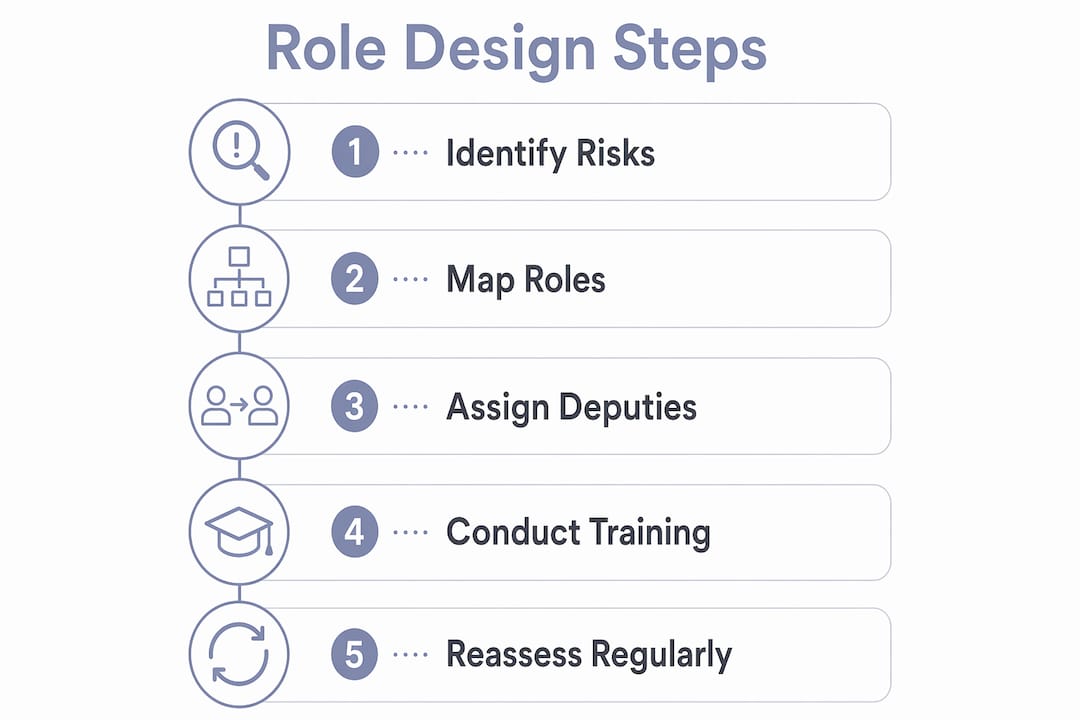
Documenting critical dependencies and regulatory obligations before designing roles prevents a common failure: building a team that protects the wrong assets. NIST recommends this documentation step as the foundation of any workforce plan.
Deputy roles and shared decision-making structures are equally important. Appointing deputies and distributing accountability removes single points of failure from your team. When your CISO is unreachable during an incident at 2 a.m., someone else must have the authority and training to act.
| Role design element | Why it matters |
|---|---|
| Risk-aligned role mapping | Connects training priorities to actual organizational exposure |
| Deputy and backup roles | Eliminates single points of failure during incidents |
| Regulatory obligation mapping | Prevents compliance gaps during workforce transitions |
| NICE Framework job categories | Provides standardized role definitions for hiring and development |
| Periodic gap re-analysis | Keeps workforce capability aligned with evolving threats |
Using risk registers to re-run workforce gap analyses periodically is not bureaucratic overhead. It is the mechanism that keeps your team relevant as the threat environment shifts.
How does AI change the way cyber resilient teams operate?
AI changes team operations in two directions simultaneously. It automates detection and triage at a speed no human team can match, and it introduces new failure modes that only humans can catch. The organizations getting this right are not replacing analysts with AI. They are redesigning workflows so AI handles volume and humans handle judgment.
The key design principle is explicit human review checkpoints. Defining human review steps in incident response workflows builds trust in AI-generated outputs and reduces the risk of automated errors propagating through a response. Without these checkpoints, a misconfigured AI model can escalate a false positive into a full incident response mobilization.
Training your team for AI-human collaboration requires a specific curriculum:
- Algorithm literacy: understanding what the AI tool is optimizing for and where its training data may be incomplete
- Decision audit skills: reviewing AI recommendations critically before acting, especially for high-stakes containment decisions
- Playbook redesign: updating incident response procedures to specify which steps are automated, which are AI-assisted, and which require human sign-off
- Ethical reasoning: recognizing when an AI recommendation conflicts with legal obligations, privacy requirements, or organizational values
Building a social engineering defense workflow for AI teams is one concrete area where this human-AI collaboration model proves its value. Social engineering attacks increasingly target both human operators and AI agents, and your playbooks need to account for both attack surfaces.
Pro Tip: Treat your incident response playbook as a living document with a quarterly review cycle. Every AI tool upgrade or new threat vector should trigger a playbook update, not just a team briefing.
A continuous learning culture is the organizational condition that makes all of this sustainable. Teams that treat curiosity as a professional value adapt faster, retain staff longer, and spot emerging threats earlier than teams that treat training as a compliance checkbox.
How do you operationalize cyber resilience through drills and recovery practices?
Resilience that exists only in documentation is not resilience. Annual business impact assessments and regular testing cadence are the operational mechanisms that convert plans into capability. TechTarget’s guidance on operationalizing cyber resilience is direct: test continuously, automate where possible, and know your minimum required business availability before an incident occurs.
Here is a practical operational cadence for 2026:
- Quarterly tabletop exercises: Simulate ransomware, insider threat, and supply chain compromise scenarios with cross-functional participants including legal, finance, and operations.
- Semi-annual recovery drills: Test full recovery from backup, including isolation of recovery environments and validation of backup integrity before use.
- Annual business impact assessment: Update your minimum availability thresholds, critical asset inventory, and recovery time objectives as the business evolves.
- Continuous backup validation: Automated checks on backup integrity, combined with human sign-off before any backup is used in a live recovery.
- Post-incident reviews: Every security event, regardless of severity, generates a written lessons-learned document that feeds back into training and playbook updates.
Recovery roles require explicit ownership and go/no-go criteria. AWS architecture guidance on cyber resilience identifies backup vault governance, recovery environment isolation, and validation pipelines as the three structural elements that prevent recovery path compromise. Each of these requires a named owner, documented procedures, and regular rehearsal.
Incident response training integrated into risk management is the NIST CSF 2.0 standard. That means IR exercises are not standalone events. They feed directly into your risk register updates and workforce development plans.
The comparison that matters for business leaders is this: organizations that test their recovery capabilities quarterly recover from ransomware in hours. Organizations that test annually recover in days or weeks. The difference is not technology. It is practiced human judgment under pressure.
You can explore ways to test human cyber resilience in 2026 to build a structured testing program that covers both technical and human dimensions of your team’s readiness.
Key takeaways
Building cyber resilient teams requires aligning workforce development, role design, AI integration, and operational testing into a single, risk-informed program.
| Point | Details |
|---|---|
| Upskill before you hire | 75% of hiring managers prioritize development; your existing team is your fastest path to resilience. |
| Tie roles to risk registers | Map every security role to a specific risk category so training reflects actual organizational exposure. |
| Design AI-human workflows | Define explicit human review checkpoints in every AI-assisted incident response process. |
| Test recovery, not just plans | Quarterly drills and continuous backup validation separate documented resilience from real capability. |
| Build a learning culture | Teams that treat continuous learning as a professional value adapt faster and retain staff longer. |
The leadership investment most organizations are still avoiding
I have spent years watching organizations treat cyber resilience as a technology procurement decision. Buy the right SIEM, deploy the right endpoint protection, and the team will figure out the rest. That assumption is wrong, and it is getting more wrong as AI enters the picture.
The shift I see in the most resilient organizations is not technical. It is psychological. Teams that perform well under pressure share one characteristic: they have psychological safety. People speak up when they see something wrong with an AI recommendation. Analysts challenge playbooks that no longer fit the threat environment. Junior staff ask questions without fear of looking incompetent. That culture does not emerge from a training program. It comes from leadership behavior, specifically from leaders who visibly reward honesty over confidence.
The soft skills conversation in cybersecurity still makes some technical leaders uncomfortable. Ethical reasoning, risk communication, and the ability to explain a threat to a board member are not soft. They are the skills that determine whether your technical capability actually translates into organizational protection. I have seen technically excellent teams fail catastrophically because no one could communicate the severity of a threat to the people who controlled the response budget.
My practical recommendation: treat your social engineering assessment program as a leadership development tool, not just a security test. The results tell you where your team’s judgment breaks down under pressure, and that information is more valuable than any penetration test report.
The organizations that will lead on cyber resilience in the next three years are investing in continuous learning as a strategic function, not a line item that gets cut when budgets tighten. That investment pays off in retention, in faster recovery times, and in teams that can actually use the AI tools you are deploying.
— Nicholas
How Thepitstop helps you build and validate cyber resilient teams
Thepitstop is built specifically for the challenge this article describes: securing both AI agents and the human operators who work alongside them. The platform’s SERA™ Certification gives your team members a professional credential for social engineering resilience, directly addressing the soft skill and ethical reasoning gaps that most training programs miss. The AI Agent Liability White Paper provides the governance framework leaders need to deploy AI in security operations responsibly. For teams managing incident detection at scale, the SIEM Dashboard provides real-time visibility across your attack surface. Thepitstop’s tools are free, automated, and designed to assess both machine security and human resilience in a single platform.
FAQ
What is a cyber resilient team?
A cyber resilient team is a workforce capable of anticipating, withstanding, recovering from, and adapting to cyber incidents while maintaining critical business functions. NIST SP 800-160 defines these four goals as the foundation of cyber resiliency.
How do you assess cybersecurity skill gaps in your team?
Audit your team against four categories: technical skills, AI readiness, soft skills like risk communication, and regulatory knowledge. Map the gaps to your risk register so training priorities reflect your actual threat exposure.
Why does AI integration require new team training?
AI tools automate detection but introduce new failure modes that require human judgment to catch. Teams need algorithm literacy, decision audit skills, and updated incident response playbooks that specify which steps require human sign-off.
How often should cyber resilience drills be conducted?
TechTarget recommends at least annual business impact assessments and regular testing cadence. Leading organizations run quarterly tabletop exercises and semi-annual recovery drills to build practiced judgment under pressure.
What role does leadership play in cyber resilience?
Leadership determines whether teams have the psychological safety to challenge AI recommendations, communicate risks honestly, and adapt to new threats. Technical capability without leadership investment in culture produces teams that underperform when it matters most.