How to Audit AI Attack Surface in 2026

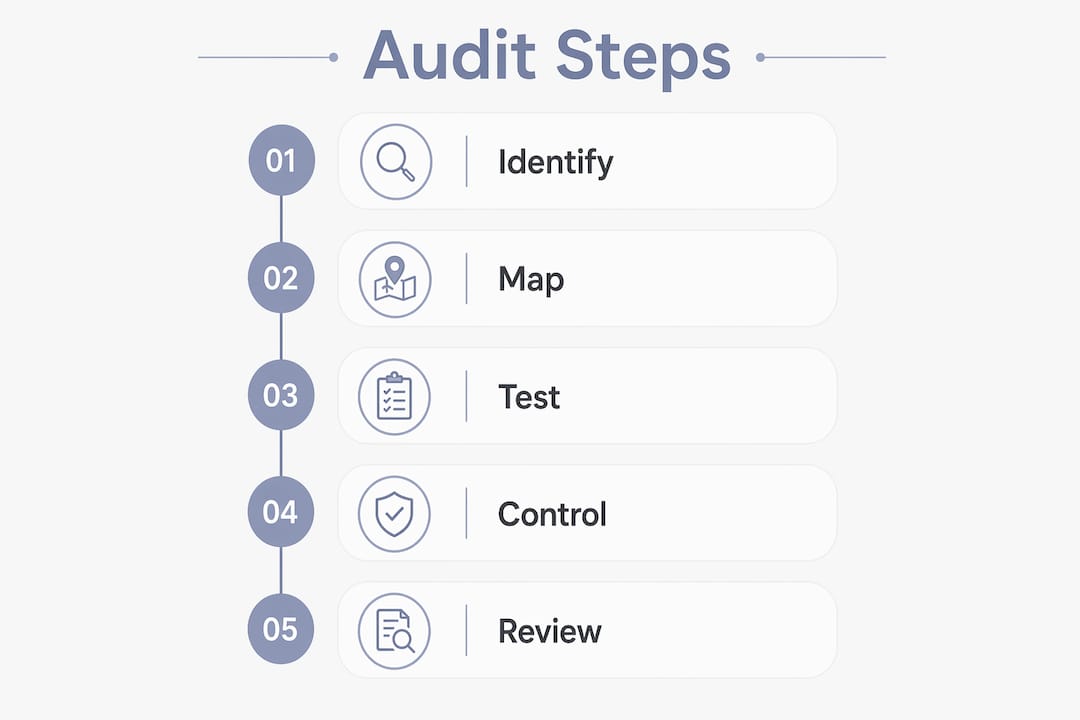
AI attack surface auditing is the systematic process of identifying, mapping, and testing every input channel, tool integration, identity boundary, and data flow that an AI system exposes to potential exploitation. In 2026, this discipline has become non-negotiable. Agentic AI systems now chain tool calls, delegate subtasks, and operate with minimal human oversight, which multiplies the attack vectors far beyond what a traditional penetration test covers. Frameworks like the OWASP LLM Top 10 and tools like PyRIT from Microsoft have become the standard starting points for any credible 2026 AI security audit. This guide walks you through how to audit AI attack surface 2026 with the precision and depth the threat environment now demands.
What frameworks and prerequisites do you need before auditing AI attack surfaces?
The OWASP LLM Top 10 (2025 edition) is the canonical taxonomy for AI vulnerability coverage. It catalogs threats including prompt injection, data poisoning, excessive agency, and improper output handling in machine-readable formats that map directly to audit evidence. Starting your audit without this taxonomy means you will miss entire vulnerability classes before you write a single test case.
Beyond the framework, you need three foundational prerequisites in place:
- Threat register: Build a structured catalog of threat scenarios before testing begins. Each entry should name the attack type, the affected component, the potential impact, and the detection method.
- Logging infrastructure: Set up cryptographically signed logs that are append-only and correlated with unique IDs. Without tamper-evident logs, detecting or investigating agent misuse is unreliable.
- Identity controls: Every AI agent must carry a distinct identity with least-privilege permissions enforced deterministically. AI agent identity cannot be managed by the AI itself. Zero Trust principles apply here without exception.
| Prerequisite | Tool or Standard | Purpose |
|---|---|---|
| Vulnerability taxonomy | OWASP LLM Top 10 (2025) | Systematic coverage of known AI threat classes |
| Red-team automation | PyRIT | Multi-turn attack simulation and refusal rate measurement |
| Audit logging | Append-only, signed logs | Forensic investigation and regulatory compliance |
| Identity governance | Zero Trust, least privilege | Prevent credential abuse and unauthorized tool access |
Pro Tip: Map every OWASP LLM Top 10 category to at least one test case in your threat register before running a single automated scan. Gaps in the taxonomy become gaps in your audit coverage.
How do you perform system-level threat modeling on AI attack surfaces?
System-level threat modeling treats the entire AI pipeline as the attack surface, not just the model endpoint. This distinction matters because model-only red teaming misses tool misuse, credential abuse, and multi-step escalation paths that emerge when agents chain tool calls together.
Follow this sequence for a complete system-level assessment:
- Map the full data flow. Document every input source, tool integration, external API call, and output channel. Include human operator touchpoints and any inter-agent communication paths.
- Identify chained attack paths. Look for sequences where a prompt manipulation leads to a tool call that accesses a credential store, then exfiltrates data. Single-step tests will not surface these.
- Run automated prompt injection testing. PyRIT automates multi-turn attacks using targets, converters, scorers, and orchestrators to simulate realistic campaigns and measure refusal rates across large prompt sets.
- Apply bounded autonomy controls. Define explicit permission scopes for each agent action. An agent that can read a database should not also be able to write to it unless that permission is explicitly granted and logged.
- Execute multi-turn escalation campaigns. PyRIT’s Crescendo strategy gradually escalates prompt complexity to bypass safety layers. This simulates how real attackers probe systems over time rather than with a single aggressive prompt.
Comparing testing approaches clarifies why system-level methods outperform model-only tests:
| Testing Approach | What It Covers | What It Misses |
|---|---|---|
| Model-only red teaming | Direct prompt injection, jailbreaks | Tool misuse, credential abuse, chained exploits |
| System-level threat modeling | Full attack paths, tool call chains, identity boundaries | Nothing, when done correctly |
| Automated PyRIT campaigns | Multi-turn escalation, refusal rate measurement | Manual social engineering vectors |
Pro Tip: Capture every tool call sequence during red-team exercises, not just the final outcome. The call chain is where the real attack path lives, and it is what you need to fix.

Which control layers build an effective defense-in-depth for AI systems?
Defense-in-depth for AI systems requires multiple independent verification layers that an attacker must defeat sequentially. A single guardrail is not a defense. It is a speed bump.
The minimum viable control stack for a 2026 AI deployment includes:
- Input mediation: Filter prompt injection attempts before they reach the model. This includes both direct user inputs and indirect inputs from external data sources like web pages or documents.
- Schema validation: Enforce strict schemas on tool call inputs and outputs. Unexpected data shapes are a reliable early indicator of exploitation attempts.
- Intent alignment checks: Verify that each agent action aligns with the declared task context before execution. Runtime enforcement depends on confirmed agent identity and trust-tagged context.
- Content filtering: Apply output mediation to catch sensitive data leakage, policy violations, and unexpected content before it reaches downstream systems or users.
- Anomaly detection: Establish behavioral baselines for each agent and alert on deviations. An agent that suddenly queries a new data source or calls an unusual API endpoint warrants immediate investigation.
| Control Layer | Primary Defense | Detection Signal |
|---|---|---|
| Input mediation | Blocks prompt injection | Flagged input patterns |
| Schema validation | Rejects malformed tool calls | Schema mismatch errors |
| Intent alignment | Prevents scope creep | Context mismatch alerts |
| Anomaly detection | Catches behavioral drift | Baseline deviation alerts |
Pair these technical controls with per-agent identity enforcement. Zero Trust identity governance means each agent operates with the minimum permissions required for its current task, and those permissions are revoked the moment the task completes.
Pro Tip: Test each control layer in isolation before testing the full stack. A layer that appears to work in combination may be silently failing while another layer compensates. Isolation testing reveals the real coverage.
How do you use audit evidence for continuous improvement?
Audit artifacts are only valuable if you treat them as first-class security data. Prompt transcripts captured during testing reveal the exact attack chains that led to tool misuse or authorization boundary crossing. Success and failure metrics alone tell you nothing about how to fix the vulnerability.
Structure your evidence pipeline this way:
- Store prompt transcripts with full context. Log the input, the model’s reasoning steps where available, every tool call made, and the final output. Correlation IDs tie each transaction to a specific agent session.
- Maintain append-only, signed logs. Cryptographically signed audit logs satisfy regulatory requirements and make forensic investigation reliable. Any log that can be altered after the fact is worthless in an incident investigation.
- Build behavioral baselines. Run your agents under normal conditions for a defined period before red-team testing begins. The baseline is your reference point for anomaly detection thresholds.
- Translate findings into the threat register. Every confirmed vulnerability from a red-team exercise becomes a named entry in the threat register with a severity rating, a remediation owner, and a retest date.
- Test your incident response runbook. AI-specific incidents, including prompt injection chains that exfiltrate data, require response procedures that differ from traditional breach playbooks. Test the runbook against simulated AI incidents at least quarterly.
For teams managing data exfiltration risks in AI systems, the audit evidence pipeline is also the primary detection mechanism. Anomaly alerts tied to behavioral baselines catch exfiltration attempts that signature-based tools miss entirely.
The layered security pattern from OWASP LLM Top 10 requires combining input validation, policy enforcement, runtime anomaly detection, and human oversight to achieve scalable attack surface reduction. No single tool or control achieves this alone.
Key takeaways
A complete AI attack surface audit in 2026 requires system-level threat modeling, OWASP LLM Top 10 coverage, PyRIT-driven red teaming, layered controls, and cryptographically signed logs working together as an integrated program.
| Point | Details |
|---|---|
| Start with OWASP LLM Top 10 | Map every vulnerability category to a test case before running any automated scans. |
| Model-only testing is insufficient | System-level threat modeling captures tool misuse and chained exploits that endpoint tests miss. |
| Enforce per-agent Zero Trust identity | Each agent needs a distinct identity with least-privilege permissions enforced deterministically. |
| Treat prompt transcripts as audit artifacts | Full transcripts reveal attack chains; success metrics alone do not support remediation. |
| Layer controls independently | Test each control layer in isolation to confirm it works without relying on adjacent layers. |
The mistake i see most often in AI security audits
Most teams I work with arrive at an AI security audit with the wrong mental model. They treat the AI model as the attack surface. They run a batch of adversarial prompts, measure refusal rates, and call it done. That approach would have been adequate in 2023. In 2026, it is a liability.
The real attack surface is the system. It is the tool call that reads from a credential store. It is the inter-agent message that carries a poisoned instruction. It is the output that writes to a downstream database without a human in the loop. I have seen red-team exercises where the model itself behaved perfectly and the system still leaked sensitive data through a chained tool call that nobody thought to test.
The second mistake is telemetry gaps. Teams deploy anomaly detection but skip the behavioral baseline phase. Without a baseline, your anomaly detector has no reference point. Every deviation looks like noise, and real attacks get buried in alert fatigue.
My recommendation is to run PyRIT’s Crescendo campaigns against your full system, not just the model endpoint. Log every tool call with a correlation ID. Build your behavioral baseline before you go live. And revisit your threat register every time you deploy a new agent capability, because every new capability is a new attack surface.
The AI agent liability gap is real, and it grows every time a team ships an agentic feature without updating its threat model. The teams that stay ahead of it are the ones treating the audit as a continuous program, not a one-time checkbox.
— Nicholas
Audit your AI attack surface with Thepitstop
Thepitstop was built specifically for the threat environment described in this guide. The platform offers a free Agent Security Scan that automates attack surface assessment across your AI agents, covering prompt injection vectors, tool misuse paths, and identity boundary gaps without requiring a manual setup process.
For teams that need cryptographic trust between agents and human operators, the Infinity Protocol™ establishes verified, tamper-evident partnerships that satisfy the audit trail requirements described above. The SERA™ Certification addresses the human side of the attack surface, testing operators against social engineering attempts that target AI-assisted workflows. Thepitstop’s SIEM dashboard connects your AI telemetry to a centralized monitoring view built for the anomaly detection workflows this guide recommends.
FAQ
What is an AI attack surface in 2026?
An AI attack surface is every input channel, tool integration, identity boundary, and data flow that an AI system exposes to potential exploitation. In 2026, agentic systems with tool-calling capabilities have significantly expanded this surface beyond traditional model endpoints.
How does PyRIT help with AI attack surface auditing?
PyRIT automates multi-turn red-team campaigns using targets, converters, scorers, and orchestrators to simulate realistic attack sequences and measure refusal rates. Its Crescendo strategy gradually escalates prompt complexity to surface safety bypasses that single-prompt tests miss.
Why is model-only red teaming insufficient?
Model-only testing misses tool misuse, credential abuse, and chained exploit paths that emerge when AI agents interact with external systems. System-level threat modeling captures the full attack path from prompt manipulation through tool call execution.
What logs are required for a compliant AI security audit?
Audit logs must be append-only, cryptographically signed, and correlated with unique IDs. This structure enables reliable forensic investigation and satisfies regulatory requirements for tamper-evident records of AI agent actions.
How often should you audit an AI attack surface?
Audit the full attack surface whenever you deploy a new agent capability, integrate a new tool, or change permission scopes. Run continuous automated red-teaming between full audits to catch regressions before they reach production.