Build a resilient phishing simulation workflow

Despite years of mandatory phishing awareness training, organizations deploying AI systems continue to experience repeated social engineering failures. The uncomfortable reality is that most training programs do not reliably reduce phishing failures across the board, because the workflow surrounding training matters as much as the training itself. If your team runs simulations without a structured feedback loop, psychological safety, or adaptive scenario design, you are essentially running drills that feel productive but change very little. This guide walks you through every stage of building a simulation workflow that creates genuine, measurable human resilience.
Table of Contents
- Identifying workflow requirements and key prerequisites
- Designing the simulation workflow: step-by-step process
- Troubleshooting common mistakes and optimizing for resilience
- Verifying results: measuring impact and next steps
- Rethinking phishing simulation impact: the uncomfortable truth
- Boost your human resilience with proven solutions
- Frequently asked questions
Key Takeaways
| Point | Details |
|---|---|
| Training alone is not enough | Empirical studies show that mandated training rarely reduces phishing failures significantly. |
| Psychological safety matters | Workflows must frame results as learning opportunities to encourage real reporting. |
| Defense-in-depth is essential | Combine technical controls, identity protection, and ongoing education for resilience. |
| Measure and adapt | Use simulation data to drive continuous improvement, not just compliance. |
| Avoid common mistakes | Minimize punitive feedback and one-size-fits-all training to optimize impact. |
Identifying workflow requirements and key prerequisites
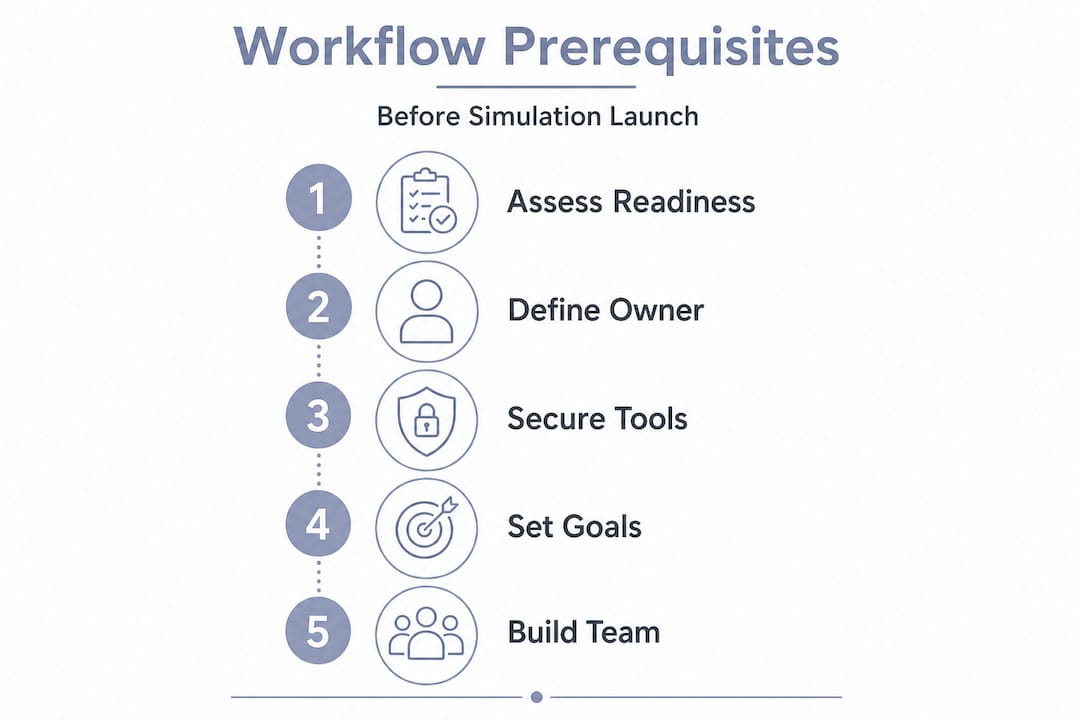
Before you schedule your first simulation campaign, you need to honestly assess what you are working with. Skipping this step is one of the most common reasons phishing programs plateau after a few months.
Assessing organizational readiness
Start by measuring your baseline. Pull your current phishing click rates, suspicious email reporting rates, and time-to-report metrics. If your organization has no baseline data, that itself is critical information. You cannot improve what you do not measure. Beyond numbers, assess your reporting culture. Do employees feel safe flagging suspicious emails without fear of being labeled the person who “fell for it”? In organizations where blame culture is strong, employees under-report threats because reporting feels like admitting weakness.
Next, identify who owns the workflow. A phishing simulation program without a designated human owner and executive sponsor will drift. Assign a security awareness lead, confirm budget, and get explicit sign-off from legal and HR before your first send. Running simulations without HR awareness is a governance gap that creates liability.
Technical and human resources you need
| Resource | Minimum requirement | Recommended |
|---|---|---|
| Simulation platform | Ability to track clicks and send feedback | Full reporting dashboard with segmentation |
| Training content library | Basic phishing scenarios | Role-specific and AI-themed scenarios |
| Reporting mechanism | Email alias for suspicious messages | One-click report button integrated in email client |
| SIEM or tracking tool | Log click events | Correlate simulation data with real incident logs |
| Feedback delivery | Automated landing page | Personalized micro-learning with human follow-up |
Your simulation tool should integrate with your email client and, ideally, connect to your identity protection tools so you can cross-reference simulation behavior with real-world risk signals. This matters especially in AI-driven organizations where human operators interact with autonomous agents that can be manipulated through social engineering.
Setting clear, attainable goals
A critical mistake is expecting dramatic click-rate reductions from simulation alone. Research shows embedded training reduces the likelihood of clicking phishing links by only about 2 percentage points on average. That is a modest but real gain. Set goals accordingly: improve reporting rates, reduce time-to-report, increase scenario variety, and track whether employees engage with follow-up training after a simulated click.
Pro Tip: Define success as “reporting behavior improved” rather than “click rate dropped.” Employees who click but immediately report are far more valuable to your security posture than employees who neither click nor report because they deleted the email without thinking.
Avoid framing simulation as a compliance mandate. Mandated programs produce compliance behavior, not resilient behavior. The goal is embedding phishing awareness into how your team thinks, not checking a box on an annual audit. A layered defense-in-depth strategy that includes simulation, technical controls, and reporting culture will outperform any single-track approach.
Designing the simulation workflow: step-by-step process
With prerequisites in place, let’s look at how to design and run an effective simulation workflow. This is where theory meets practice.
The core workflow: five stages
- Scenario design. Build phishing scenarios that reflect real threats your organization faces. For AI-driven teams, this means including AI-themed lures: fake model update notifications, spoofed vendor emails about API keys, and impersonation of AI orchestration tools. Rotate scenarios every quarter so familiarity does not breed false security.
- Delivery and targeting. Segment your audience by role, risk level, and past behavior. A finance employee and a developer face different phishing threats. Blanket campaigns miss the specificity that makes training land. Schedule sends at realistic times, not always Monday morning.
- Immediate feedback. When an employee clicks a simulated phishing link, deliver instant, non-punitive feedback. A landing page that explains what cues they missed, why the scenario was designed that way, and what to do next is far more effective than a shame message.
- Reporting pathway. Make it effortless to report. If reporting takes more than two clicks, employees will not do it consistently. Your phishing simulation data tools should capture both click events and report events so you can track the full behavioral picture.
- Debrief and iteration. After each campaign, hold a brief debrief with your security team. What scenarios had the highest click rates? Which roles struggled most? Use that data to design the next round.
Establishing psychological safety
This is the factor most organizations underinvest in. CISA explicitly notes that the reporting and feedback path must be psychologically safe and ethically framed. That means leadership publicly normalizes reporting near-misses. It means managers do not use simulation results to embarrass individuals in team meetings. It means HR confirms that clicking a simulated phishing email is not a disciplinary event.
“Psychological safety is not a soft concept. It is a measurable predictor of whether employees report real threats in time to stop damage. If your culture punishes mistakes, you will be the last to know about a real incident.”
Tracking and continuous learning
| Metric | What it tells you | How to use it |
|---|---|---|
| Click rate | Baseline susceptibility | Track trend over time, not single snapshots |
| Report rate | Proactive security behavior | Prioritize increasing this over reducing click rate |
| Time-to-report | Speed of human detection | Faster reporting reduces dwell time for real attacks |
| Training completion after click | Learning engagement | Measure whether feedback is actually consumed |
| Repeat click rate | Retention of prior training | Identify employees who need additional support |

Pro Tip: Integrate simulation data into your SIEM or security operations dashboard so phishing behavior sits alongside real incident data. This removes the false separation between “training data” and “real security data” and gives you a unified picture of human risk.
Troubleshooting common mistakes and optimizing for resilience
Even with a solid workflow, many organizations stumble at optimizing for results. Here’s how to troubleshoot and elevate your process.
The most common mistakes
- Punitive feedback. Naming individuals who clicked in team reports destroys reporting culture. Employees become focused on not getting caught rather than on building vigilance.
- One-size-fits-all scenarios. Sending the same generic “you won a gift card” email to every employee ignores the actual threat landscape your roles face. Spear phishing is role-specific by design.
- Infrequent campaigns. Running one simulation per year creates a spike of awareness followed by 11 months of forgetting. CISA emphasizes ongoing reinforcement and adaptation as the threat landscape evolves. Quarterly at minimum; monthly for high-risk roles.
- Measuring the wrong outcome. Obsessing over click rate while ignoring report rate gives you an incomplete picture of resilience.
- No integration with real incidents. Simulation data that never connects to actual security events misses the feedback loop that makes training meaningful.
Optimizing for resilience
The path to resilience is iterative, not linear. After each campaign cycle, use your data to answer three questions: Who is most vulnerable? What scenarios produced the most learning? What did we change in our technical controls based on human behavior patterns?
“If your phishing simulation results never change your technical controls, your program is decoration. Real optimization means simulation insights inform firewall rules, email filtering exceptions, and privileged access decisions.”
Research from UC San Diego confirms that phishing simulations work best as one component of defense-in-depth, not as a standalone solution. Technical controls catch what training misses and vice versa. Layer them deliberately.
Adaptive scenario design is your most powerful optimization lever. As AI-generated phishing becomes more convincing, your simulations need to match that sophistication. Include deepfake voice lures, AI-written spear phishing emails, and scenarios that mimic the tools your AI agents use day to day. Your empirical impact quiz can help your team calibrate how realistic your current scenario library actually is compared to active threat campaigns.
Pro Tip: Schedule a quarterly “red team review” where your security team tries to fool itself. Take your three most recent simulation scenarios and ask: would these fool a moderately sophisticated attacker into thinking they are real? If the answer is no, your employees are not training against realistic threats.
Verifying results: measuring impact and next steps
With workflow errors addressed, it’s time to verify the impact and look ahead to continuous improvement.
What you can actually measure
- Click rate trend across campaigns (aim for gradual downward movement, not perfection)
- Report rate trend (aim for consistent upward movement)
- Time-to-report across departments
- Training completion rates following simulated click events
- Role-specific vulnerability patterns over time
- Reduction in repeat offenders after targeted support
Understanding the limits
Be honest with your stakeholders about what simulation can and cannot prove. Large-scale field studies have found little or no significant impact on click or reporting behavior when organizations rely on simulation alone without layered controls and ongoing reinforcement. This does not mean simulation is useless. It means the bar for “success” needs to be realistic and contextually defined.
Dramatic reductions in click rates, from 30% down to 2% in a single quarter, are almost never sustainable or meaningful. They usually reflect scenario fatigue, where employees recognize the sender domain after repeated exposure, not genuine resilience. Measuring behavior in realistic, novel scenarios is a far more accurate indicator of actual preparedness.
Data-driven next steps
After three to four campaign cycles, you should have enough data to segment your organization into risk tiers. High-risk individuals and roles get more frequent, more sophisticated simulations and additional one-on-one support. Lower-risk groups maintain a steady cadence with scenario variety. Use your impact assessment quiz to get a calibrated read on where your program stands relative to industry benchmarks.
Build a quarterly report for executive leadership that tells a story, not just shows numbers. Connect phishing simulation trends to actual security incident data where possible. Executives respond to risk language, not awareness metrics.
Rethinking phishing simulation impact: the uncomfortable truth
Here is what most articles about phishing simulation workflows do not say clearly enough. Simulation is a valuable tool, but it is a modest one. The research is consistent. Training programs show minimal effectiveness in real-world environments when studied rigorously. That does not make simulation worthless. It makes over-reliance on simulation dangerous.
The organizations that get the most from phishing simulation are the ones that treat it as intelligence gathering rather than as training delivery. They run simulations to find out where their human attack surface is weakest, and then they use that information to strengthen technical controls, adjust access privileges, and redesign processes that rely too heavily on human judgment.
The culture shift matters more than the training content. We have seen organizations run sophisticated, well-designed simulations for two years straight with almost no improvement in reporting rates because leadership implicitly communicated that security awareness was an IT problem, not a leadership responsibility. Reporting culture is set from the top, not from a phishing simulation landing page.
Defense-in-depth is not a fallback when training fails. It is the strategy from day one. Simulations, email filtering, zero-trust access controls, privileged access management, AI agent security, and robust incident response are all layers of the same protection. Read our deep dive on liability gaps to understand where organizations carry unexamined exposure even when their simulation programs look healthy on paper.
The hardest lesson: your employees will always be fallible. Design your security architecture to absorb human error, not to prevent it entirely. Simulation workflows are most powerful when they teach you where to strengthen the architecture, not when you use them as evidence that “the humans are trained.”
Boost your human resilience with proven solutions
Running a phishing simulation workflow is a strong start, but building genuine human resilience across an AI-driven organization requires calibrated assessments and professional credentials that go beyond click-rate dashboards.
At Thepitstop.ai, we built tools specifically for security leaders managing the intersection of AI agents and human operators. The SERA™ social engineering certification gives your team a recognized, credential-backed benchmark for resilience against phishing and social engineering. For teams that want to pressure-test their current program quickly, our free phishing quiz delivers an empirical read on your organization’s susceptibility in under ten minutes, with actionable recommendations tied directly to your simulation workflow gaps.
Frequently asked questions
What is a phishing simulation workflow?
A phishing simulation workflow is the structured process for running mock phishing campaigns, capturing results, and using feedback to train and improve employee resilience. CISA recommends ongoing reinforcement and training to help employees spot and report suspicious messages as part of any effective workflow.
Does mandated annual training actually reduce phishing failures?
Empirical studies show annual training rarely leads to significant reductions in phishing failures. Research confirms that phishing training programs do not reliably reduce failure rates across all organizational programs, suggesting that frequency, feedback quality, and layered controls matter far more than a single annual session.
How can organizations avoid punitive framing in phishing simulations?
Treat simulation results as learning opportunities and prioritize psychological safety throughout your workflow. CISA notes that punitive “gotcha” framing can actively reduce real-world threat reporting by making employees fear consequences rather than focus on security.
What is defense-in-depth in phishing resilience?
Defense-in-depth means combining technical controls, human training, and robust reporting culture instead of relying on training alone. Research confirms that phishing simulations function best as one component of a layered security strategy rather than as the primary defense.
What are common mistakes in phishing simulation workflows?
The most frequent mistakes include punitive feedback delivery, one-size-fits-all scenario design, and failing to iterate based on real-world behavioral data. CISA highlights ongoing reinforcement and adapting to an evolving threat landscape as essential elements that most organizations underinvest in.