Automated Security Assessment for IT Pros: 2026 Guide

Automated security assessment is defined as a continuous, machine-driven process that tests security controls for correct configuration and effectiveness in threat prevention. The industry term for its most mature form is Automated Security Control Assessment, or ASCA. For IT professionals and security analysts managing AI systems, this process replaces periodic, point-in-time reviews with real-time scanning that surfaces gaps before attackers find them. Tools like SAST (Static Application Security Testing), DAST (Dynamic Application Security Testing), and NIST’s Security Content Automation Protocol (SCAP) form the technical backbone of any serious automated security testing program. The core advantage over manual reviews is simple: automation never sleeps, and your threat surface never stops changing.
How does automated security assessment work?
Automated security testing uses tools like SAST, SCA, DAST, and infrastructure scanning to find vulnerabilities by simulating real-world attack behaviors during development and delivery phases. Each methodology targets a different layer of your environment.
Here is how a complete security assessment process runs in practice:
- Scan initiation. Automated tools trigger on a schedule or on code commit, scanning source code, dependencies, containers, and live endpoints simultaneously.
- Normalization. Raw findings are translated into machine-readable formats using standards like SCAP, which allows results to flow into dashboards, ticketing systems, and CI/CD pipeline gates without manual reformatting.
- Scoring and prioritization. Each finding receives a severity score. High-priority items block deployment; lower-priority items enter a remediation backlog.
- Control validation. ASCA platforms continuously interrogate controls across enterprise security stacks to surface gaps and misconfigurations, not just code-level bugs.
- Remediation tracking. Developers receive specific, contextualized findings. The pipeline re-scans after fixes are applied to confirm closure.
- Reporting. Machine-readable reports feed SIEM dashboards, compliance auditors, and risk management teams without additional manual effort.
For AI systems specifically, the security assessment process requires an extra layer. Multi-turn, context-dependent tests like prompt injections form repeatable, CI/CD-friendly payload suites mapped to threat categories. A single-check scan will miss the chained vulnerabilities that make AI agents exploitable. The Crucible AI Security Testing Framework structures these tests as payload suites that produce machine-readable reports suitable for pipeline gating.
Pro Tip: Integrate automated vulnerability scanning directly into your CI/CD pipeline at the pull-request stage, not just at deployment. Catching a prompt-injection vector before code merges costs a fraction of what it costs to patch a production AI agent.

Why use automated security over manual reviews?
Automated assessments provide continuous, real-time visibility, enabling rapid detection and remediation of vulnerabilities across complex IT environments. That single capability changes the economics of security operations.
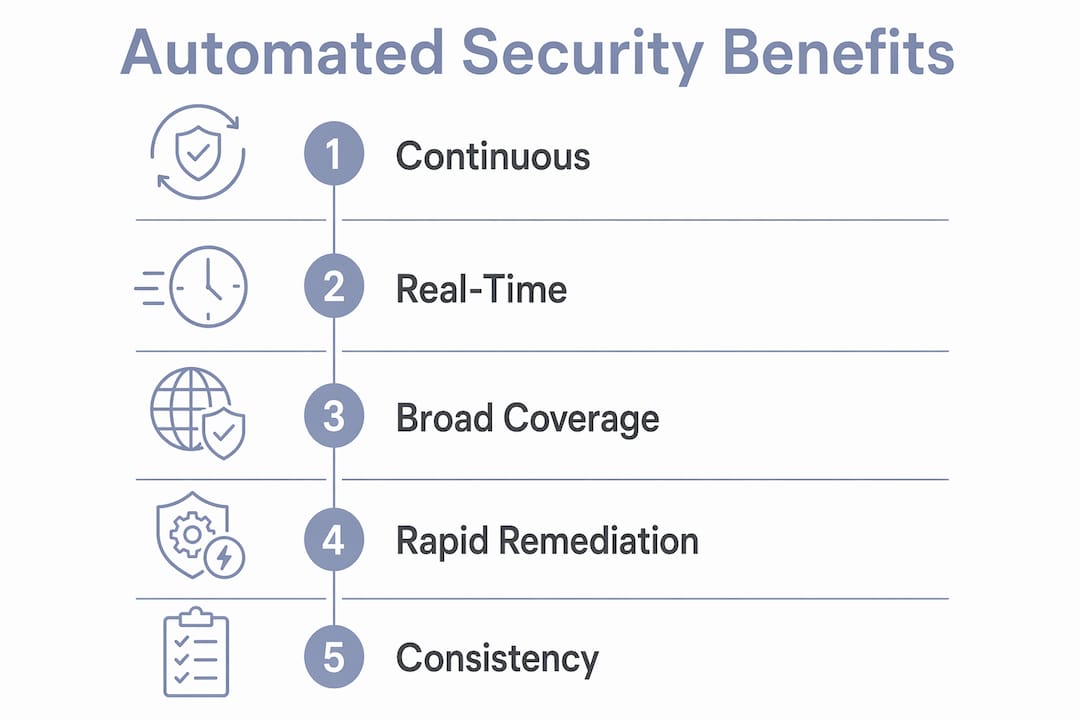
Manual reviews produce a snapshot. Your environment changes the moment the auditor leaves. Configuration drift, new assets, and updated dependencies all introduce new risk between review cycles. Continuous validation addresses security posture drift caused by changing configurations and new assets, eliminating the “aging” problem that makes point-in-time assessments unreliable within weeks of completion.
The practical benefits for security teams include:
- Scale without proportional headcount. A single automated scanner covers thousands of endpoints simultaneously. A manual team cannot.
- Faster remediation cycles. Developers receive findings in the same workflow where they write code, reducing the time between discovery and fix from weeks to hours.
- Consistent coverage. Automated tools apply the same checks every time. Human reviewers vary in focus, fatigue, and expertise.
- Audit-ready reporting. Automated compliance checks generate timestamped evidence trails that satisfy SOC 2, PCI DSS, and FedRAMP auditors without additional documentation work.
- Reduced stale data risk. Periodic manual reviews leave organizations operating on outdated security posture information. Automation eliminates that gap.
“Automation serves as guardrails in software delivery pipelines that catch vulnerabilities early and help teams move quickly without critical failures.” — Tricentis
That said, automation does not remove the need for human judgment. Business-logic flaws, deep exploitation chains, and novel attack patterns still require skilled analysts to interpret and validate. The right model treats automated scanning as the first filter, not the final word.
What are the challenges of implementing automated assessments?
The biggest operational failure in automated security audit programs is not a tool problem. It is a noise problem. Teams that deploy scanners without tuning them quickly drown in findings, most of which are low-severity or false positives.
Managing noise and false positives with adjudication or quality gates is the difference between a program that drives remediation and one that gets ignored. Effective quality gates filter findings by severity, asset criticality, and exploitability before they reach developer queues.
Additional challenges security teams face during implementation:
- DevSecOps integration friction. Scanners that slow build pipelines get disabled. Tools must be fast enough to run on every commit without blocking developer velocity.
- Coverage gaps in AI-specific threats. Standard DAST tools do not test for prompt injection, data exfiltration via model outputs, or supply chain vulnerabilities in AI dependencies. You need purpose-built AI security testing layers.
- Keeping threat scenarios current. Automated tools are only as good as their rule sets. Outdated signatures miss new attack classes entirely.
- Balancing automation with skilled validation. High-severity findings from automated scans should always receive human review before remediation priority is set. Automated risk assessment scores context poorly.
- Toolchain sprawl. Running SAST, DAST, SCA, and infrastructure scanners independently creates overlapping findings and inconsistent severity ratings. A unified platform or normalization layer resolves this.
Pro Tip: Set a quality gate threshold before you deploy any scanner. Define which severity levels block the pipeline, which generate tickets, and which get logged for trend analysis. Without that policy, your first scan will produce hundreds of findings with no clear owner.
For AI agent environments, the social engineering defense workflow matters as much as technical scanning. Human operators remain the most exploitable surface in any AI-driven system.
Which standards and frameworks guide automated security assessment?
Standards give automated security assessment its interoperability. Without them, findings from one tool cannot feed into another, and compliance reporting requires manual translation.
| Standard / Framework | Primary Function | Relevance to Automation |
|---|---|---|
| NIST SP 800-53 | Defines security and privacy controls for federal systems | Provides the control catalog that automated assessments validate against |
| SCAP (Security Content Automation Protocol) | Standardizes vulnerability and configuration data formats | Enables machine-readable checks, patch verification, and workflow automation |
| NIST SP 800-137 | Continuous monitoring framework for federal information systems | Defines the cadence and scope of automated monitoring programs |
| OWASP Top 10 for LLMs | Identifies critical vulnerabilities in large language model applications | Guides AI-specific automated test coverage, including prompt injection |
| CIS Benchmarks | Prescriptive configuration guidelines for operating systems and applications | Used as baseline rules in automated configuration scanning tools |
SCAP version 1.4 defines specifications for communicating software flaw information and security configurations, enabling automation and integration across tools and processes. Standardized nomenclature allows findings from Tenable, Qualys, or any SCAP-compliant scanner to feed into the same risk management platform without data loss.
NIST SP 800-53 is the control catalog most enterprise automated assessments validate against. When an ASCA platform reports a control gap, it maps that gap to a specific 800-53 control identifier. That mapping makes remediation assignments precise and audit evidence unambiguous.
For AI systems, the OWASP Top 10 for LLM Applications coverage mapping provides the AI-specific test coverage that general frameworks lack. Prompt injection, insecure output handling, and training data poisoning each require dedicated automated test payloads that standard vulnerability scanners do not include by default.
Standardization of vulnerability and configuration representation through SCAP is the key to integrating automated security checks into enterprise workflows at scale. Without it, every tool integration becomes a custom engineering project.
Key takeaways
Automated security assessment is the most reliable method for maintaining continuous, evidence-based visibility into your security posture across both traditional IT and AI system environments.
| Point | Details |
|---|---|
| Continuous over periodic | Automated assessments eliminate stale posture data by scanning in real time, not on a quarterly schedule. |
| AI systems need specialized tests | Prompt injection and multi-turn probes require purpose-built payload suites, not standard DAST tools. |
| Standards enable scale | SCAP and NIST SP 800-53 make findings portable, auditable, and actionable across any tool stack. |
| Quality gates prevent noise overload | Define severity thresholds before deployment to keep findings actionable and developer queues manageable. |
| Automation complements human judgment | Automated scans catch known patterns early; skilled analysts handle business-logic flaws and novel attack chains. |
Automation is not a silver bullet, and that is the point
I have watched security teams deploy enterprise scanners, generate thousands of findings on day one, and then quietly disable the tool by week three because no one could process the volume. The problem was never the automation. The problem was treating the scanner as a solution rather than a signal generator.
The shift I have seen work consistently is reframing automated assessment as a continuous feedback loop, not a compliance checkbox. When you integrate scanning at the pull-request level and tie severity thresholds to deployment gates, developers start treating security findings the same way they treat failing unit tests. That cultural change is worth more than any individual tool.
For AI systems, the stakes are higher and the tooling is less mature. Standard scanners miss the attack classes that matter most: prompt injections, context manipulation across conversation turns, and data exfiltration through model outputs. I have found that teams who map their AI agent tests directly to the OWASP LLM vulnerability categories get coverage that actually reflects their real threat model, rather than a generic CVE list that was never designed for language models.
The future of this field is not more scanners. It is tighter integration between automated findings and human decision-making, with AI agents themselves participating in their own security validation cycles. That is the direction worth building toward.
— Nicholas
See how Thepitstop handles AI security assessment
Thepitstop was built specifically for the security gaps that standard automated tools miss in AI-driven environments. The platform’s free Agent Security Scan tests AI agents against prompt injection, data exfiltration, and supply chain vulnerabilities using continuous, automated scanning designed for autonomous systems.
For teams that need a deeper look at the liability and risk landscape, the AI Agent Liability Gap white paper maps the specific control failures that automated assessments must address in AI deployments. Thepitstop also offers SERA™ Certification for human operators, covering the social engineering vectors that no technical scanner can fully address. Both resources are free and built for security analysts who need answers, not sales decks.
FAQ
What is automated security assessment?
Automated security assessment is a continuous, machine-driven process that tests security controls for correct configuration and effectiveness in threat prevention. It uses tools like SAST, DAST, and SCAP-compliant scanners to surface vulnerabilities across code, infrastructure, and configurations in real time.
How does automated vulnerability scanning differ from manual penetration testing?
Automated vulnerability scanning runs continuously and covers broad surface areas consistently, while manual penetration testing applies human creativity to find business-logic flaws and complex exploitation chains. The two methods are complementary, not interchangeable.
What standards govern the automated security assessment process?
NIST SP 800-53 defines the control catalog most assessments validate against, while SCAP standardizes how vulnerability and configuration data is communicated across tools. Together they enable interoperable, auditable automated security programs.
Can automated assessments test ai-specific vulnerabilities?
Standard automated tools do not cover AI-specific threats like prompt injection or multi-turn context manipulation without purpose-built extensions. Frameworks like Crucible structure these tests as payload suites mapped to threat categories and produce machine-readable reports for pipeline gating.
How do you reduce false positives in automated security testing?
Quality gates and adjudication workflows filter findings by severity, asset criticality, and exploitability before they reach developer queues. Defining these thresholds before deployment is the most effective way to keep automated security findings actionable.