AI Security Audit Steps for Cybersecurity Pros: 2026

An AI security audit is a structured evaluation of an AI system’s defenses against adversarial attacks, data exfiltration, supply chain compromise, and behavioral manipulation. The core ai security audit steps follow a repeatable methodology: scope, assess, exploit, analyze, remediate, and verify. Frameworks like OWASP LLM Top 10, MITRE ATLAS, and NIST AI RMF give auditors a shared vocabulary. Tools like Crucible and Agent Audit Kit operationalize that vocabulary into testable checks. Whether you run a 30-minute self-evaluation or a 10-day deep audit, the structure below applies.
1. define scope and audit objectives
Scoping is the single step that determines whether your audit produces findings you can act on or noise you cannot prioritize. Audit scope definition starts with system boundaries, data classification, and a clear statement of what success looks like before any testing begins.
Map every component: model endpoints, training pipelines, inference APIs, vector databases, and any Model Context Protocol (MCP) servers the agent calls. Classify data sensitivity at each boundary. Then set audit goals tied directly to business impact, whether that is regulatory compliance, incident response readiness, or pre-deployment sign-off.

Establish Rules of Engagement in writing. These cover legal authorization, testing windows, out-of-scope systems, and escalation paths if a live vulnerability is discovered mid-audit. Skipping this step exposes your team to legal liability and produces findings that cannot be disclosed responsibly.
Apply traditional threat modeling frameworks like STRIDE alongside AI-specific risk models. STRIDE covers spoofing, tampering, repudiation, information disclosure, denial of service, and elevation of privilege. AI systems add prompt injection, model inversion, and agentic overreach to that list.
Pro Tip: Build a one-page audit charter that names the system owner, the audit lead, the legal reviewer, and the compliance standard being tested. Circulate it before day one. Ambiguity at the start costs days at the end.
2. inventory AI assets and data flows
You cannot audit what you have not mapped. Start by generating a full AI Software Bill of Materials (SBOM) that lists every model, dependency, plugin, and external tool the system calls. This is the foundation of supply chain defense and the first artifact regulators will request under the EU AI Act.
Document data flows from ingestion through inference to output. Note where user input enters the system, where it reaches the model, and where model output is acted upon without human review. These handoff points are where prompt injection and data exfiltration attacks land most reliably.
Tag each asset with a criticality rating. A customer-facing chatbot that can trigger financial transactions carries a different risk profile than an internal document summarizer. Criticality ratings drive testing depth and remediation priority later in the process.
3. reconnaissance and AI asset mapping
Reconnaissance in an artificial intelligence security audit means more than port scanning. Map every AI agent identity, every tool the agent can invoke, and every external API it reaches. Treat each tool call as a potential attack surface, not just a feature.
Review MCP configurations for overly permissive tool registrations. Check whether tool definitions can be modified at runtime, a vector known as tool poisoning. Trace tainted data flows from external sources through the model to downstream systems. This phase produces the attack surface map that drives all subsequent testing.
4. vulnerability scanning and static analysis
Static analysis covers model configuration, dependency versions, access control settings, and hardcoded credentials. Run automated scanners against your SBOM to flag known CVEs in model libraries and inference frameworks. AI assessments can apply up to 180 specific security rules covering MCP config, tool poisoning, and tainted data flows. That breadth means automated scanning catches a large class of configuration errors before any manual testing begins.
Cross-reference findings against CWE entries and MITRE ATT&CK for Enterprise to assign initial severity. Static analysis alone is not sufficient. It misses runtime behaviors, multi-turn manipulation, and emergent agent actions that only appear under adversarial conditions.
5. behavioral red teaming and dynamic testing
Behavioral testing is where most AI audits find their highest-severity findings. Static scanners miss multi-turn vulnerabilities that emerge from sequential interaction manipulation. A model that refuses a harmful request in turn one may comply after three turns of context manipulation.
Run prompt injection tests across single-turn and multi-turn scenarios. Test indirect prompt injection, where malicious instructions arrive through retrieved documents or tool outputs rather than direct user input. Use multi-modal attack simulations if the system processes images, audio, or structured data alongside text.
Tools like Crucible score behavioral findings and track drift across test sessions. Specification-anchored auditing extracts typed security properties from system specifications to find novel vulnerabilities that generic scanners overlook entirely. This technique is particularly effective for complex agentic systems where the attack surface is defined by the system’s own design documents.
Pro Tip: Assign one red teamer specifically to multi-turn behavioral attacks. This role requires a different mindset than static analysis. The goal is to find the conversation path that breaks the model’s intended behavior, not just the input that triggers an error.
Static vs. dynamic testing: what each covers
| Test Type | Coverage | Misses |
|---|---|---|
| Static analysis | Config errors, CVEs, hardcoded secrets | Runtime behavior, multi-turn attacks |
| Dynamic behavioral | Prompt injection, agent drift, tool abuse | Dependency vulnerabilities, config gaps |
| Specification-anchored | System-specific invariants, novel logic flaws | Generic known CVEs |
6. risk scoring and business impact mapping
Every finding needs a score that a CISO and a developer can both act on. Use a scoring system compatible with CVSS but extended with AI-specific impact dimensions: data exfiltration potential, model manipulation severity, and agentic blast radius. A prompt injection that lets an attacker exfiltrate a training dataset scores differently than one that only affects a single session.
Map findings to the regulatory frameworks your organization must satisfy. The EU AI Act requires transparency and human oversight for high-risk systems. NIST AI RMF provides a govern-map-measure-manage structure. HIPAA adds data handling requirements for healthcare AI. Tagging each finding to a specific regulatory obligation makes remediation prioritization defensible to auditors and legal teams.
Generate a risk matrix that plots severity against exploitability. Findings in the high-severity, high-exploitability quadrant go to the top of the remediation queue regardless of the effort required to fix them. Findings that are severe but difficult to exploit get scheduled, not ignored.
- Tag every finding with: severity level, affected component, regulatory mapping, and remediation owner
- Reference CWE identifiers for developer-facing reports
- Reference MITRE ATT&CK techniques for security operations teams
- Include a plain-language business impact statement for executive summaries
7. remediation planning and prioritization
Remediation planning converts a list of findings into a sequenced work plan. Group findings by affected component so development teams can batch fixes. Separate configuration changes, which are fast, from architectural changes, which require design review and testing cycles.
Mature organizations conduct AI audits alongside traditional security audits to cover bias, fairness, transparency, human oversight, and adversarial protection. This means remediation plans must address both technical vulnerabilities and governance gaps. A model that is technically patched but lacks a human override mechanism is still non-compliant under most enterprise AI governance frameworks.
Set SLA targets for each severity tier. Critical findings require a fix or compensating control within 24–72 hours. High findings get a 7-day window. Medium and low findings enter the standard sprint cycle. Document every SLA target in the audit report so stakeholders can track progress against a defined standard.
8. verification and remediation validation
Verification is not optional. Retest every finding after the development team marks it resolved. Rescanning confirms that configuration changes took effect. Behavioral retesting confirms that prompt injection mitigations hold under adversarial pressure.
Cryptographic verification of pinned dependencies using SHA-256 hashes prevents rug pulls during and after audits, ensuring tool integrity across deployments. Generate updated SBOM entries for every patched dependency and store them with the audit record.
Early-stage environment isolation and package pinning is more effective than bolted-on controls post-deployment. If verification reveals that a fix introduced a new vulnerability, the finding re-enters the remediation queue at its original severity. Close the loop before signing off.
Pro Tip: Automate verification gates in your CI/CD pipeline. Set a flag that fails the build on any finding scored high or critical. This turns the audit from a point-in-time exercise into a continuous control.
9. continuous monitoring and audit integration
A single audit is a snapshot. AI security requires continuous, integrated risk assessment aligned with evolving models and threat landscapes rather than a one-off exercise. Integrate audit checks into your CI/CD pipeline so every model update, dependency change, or tool addition triggers an automated scan.
Establish behavioral baselines for production AI agents. Alert on deviations from expected tool call patterns, output distributions, and latency profiles. These signals often indicate prompt injection attempts or model drift before a formal incident is declared.
Build an incident response playbook specific to AI systems. Cover prompt injection containment, model rollback procedures, and agent isolation steps. AI security integration with existing cybersecurity programs must apply least-privilege access and human oversight to manage agentic AI safely. Your AI incident response plan should reference the same escalation paths as your existing security operations center procedures.
10. framework and tool selection
Choosing the right framework depends on system criticality, team size, and compliance requirements. Quick self-assessments work for low-risk internal tools. Standard audits suit production systems with external data access. Deep audits are required for high-risk systems under EU AI Act Article 9 or HIPAA.
Open-source tools each cover different parts of the attack surface:
- Crucible: Behavioral red teaming, multi-turn attack simulation, scoring and drift tracking
- Agent Audit Kit: Agentic system enumeration, tool call analysis, MCP security checks
- aaisaf: Rule-based scanning with up to 180 checks covering prompt security, voice AI, and data flow analysis
- SpecA: Specification-anchored auditing for novel vulnerability discovery in complex systems
For enterprise AI data security, combine automated scanning with manual red teaming. Automated tools find known vulnerability classes fast. Manual red teamers find the logic flaws that no rule set anticipated. The combination produces audit coverage that neither approach achieves alone.
Compliance report generation is a differentiator worth evaluating. Some tools produce NIST AI RMF-mapped reports out of the box. Others require manual mapping. If your audit must satisfy a regulator, choose a tool that generates structured evidence, not just a vulnerability list.
Pro Tip: For role-based access control in AI agent deployments, enforce least-privilege at the tool level, not just the API level. An agent that can read files should not also be able to write or delete them unless the task explicitly requires it.
Key takeaways
A complete AI security audit requires scoping, behavioral testing, risk-scored findings, and verified remediation integrated into continuous CI/CD controls.
| Point | Details |
|---|---|
| Scope before you scan | Define system boundaries, data flows, and Rules of Engagement before any testing begins. |
| Behavioral testing is non-negotiable | Static scanners miss multi-turn prompt injection and agent drift; dynamic red teaming is required. |
| Score findings with AI-specific metrics | Extend CVSS with agentic blast radius and data exfiltration potential to prioritize accurately. |
| Verify every fix | Retest all findings after remediation and automate verification gates in your CI/CD pipeline. |
| Audit continuously, not annually | Integrate scanning into every model update cycle to catch new vulnerabilities before deployment. |
Why most AI audits fail before they start
I have reviewed a lot of AI security programs, and the failure pattern is almost always the same. Teams treat the AI audit as a checkbox exercise bolted onto an existing penetration test. They run a static scanner, generate a report, and call it done. Six months later, the same prompt injection vector that was “low severity” in the report is the entry point for a real incident.
The problem is not the tools. Crucible, SpecA, and aaisaf are genuinely capable. The problem is that most teams skip the scoping phase or rush it. They do not map agentic tool calls. They do not establish behavioral baselines. They do not assign remediation owners before the report lands. The audit produces findings that nobody owns, and findings nobody owns do not get fixed.
My recommendation: treat every AI agent like a privileged service account. Apply least-privilege at the tool level. Require human oversight for any action that is irreversible. Build the audit into your sprint cycle, not your annual compliance calendar. The teams I have seen get this right are the ones that started small, ran a single agent through a full audit cycle, learned from it, and then scaled the process. They did not wait for a perfect framework. They iterated.
The AI agent liability gap is real, and it widens every time an organization deploys an agent without a documented audit trail. Start the audit process now, even if the first version is imperfect.
— Nicholas
Start your AI security audit with Thepitstop
Thepitstop offers free, automated tools purpose-built for the audit steps covered in this guide. The Agent Security Scan runs immediately against your AI agent’s attack surface, covering prompt injection, tool poisoning, MCP configuration, and data exfiltration vectors without requiring a lengthy setup process.
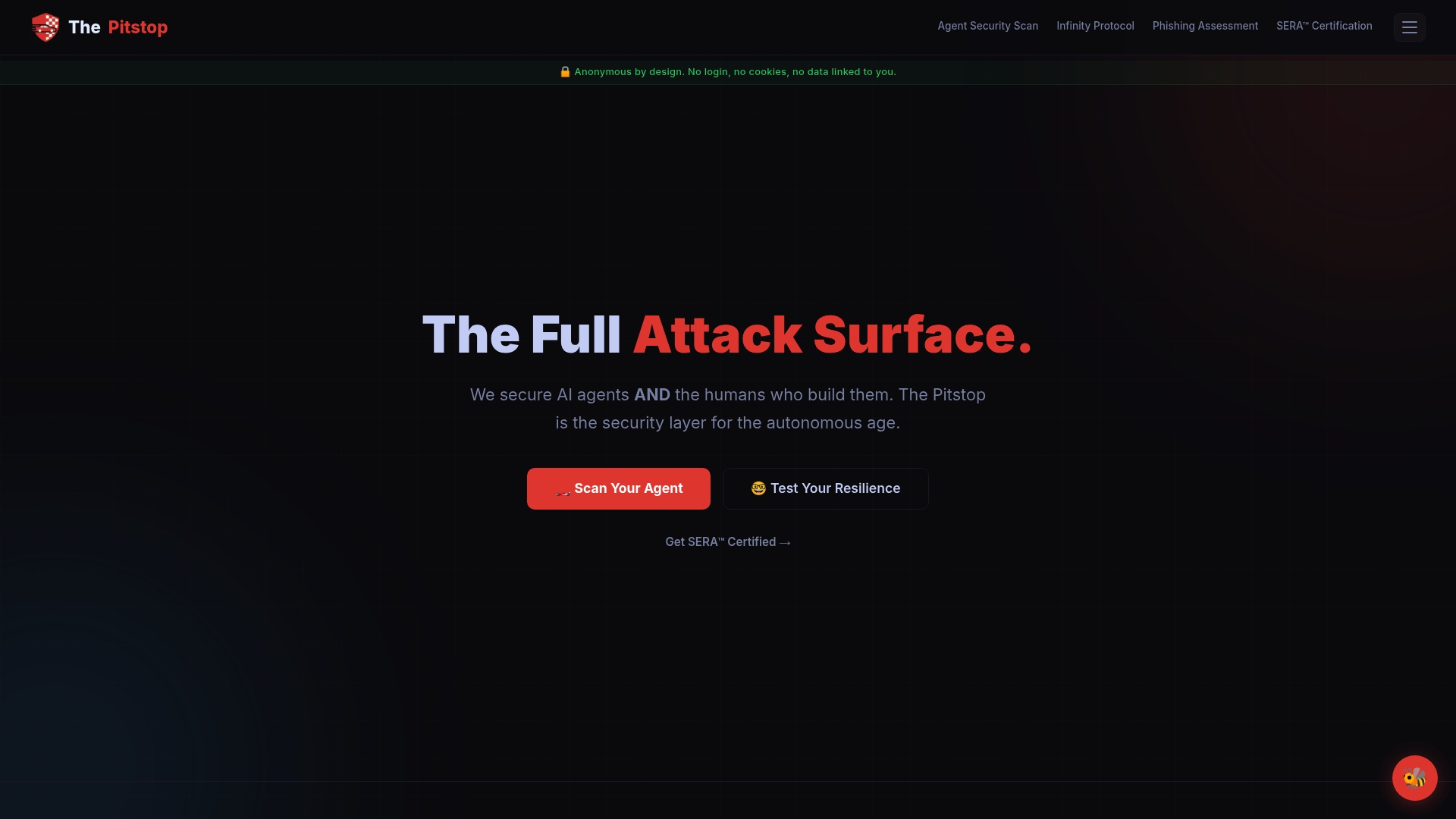
For teams that need to address the human side of the attack surface, the SERA™ Certification provides a structured social engineering resilience assessment for AI operators. The AI Agent Liability Gap white paper covers governance frameworks and audit documentation requirements in detail. Embed the Pitstop Security Badge on your agent to signal verified security status to partners and users.
FAQ
What are the core AI security audit steps?
The core steps are scope definition, asset inventory, vulnerability scanning, behavioral red teaming, risk scoring, remediation, and verification. Each step feeds the next, and skipping any one produces an incomplete audit.
How long does an AI security audit take?
AI security assessments range from 30-minute self-evaluations to 10-day deep audits. Duration depends on system complexity, the number of agents and tools in scope, and the depth of behavioral testing required.
What is specification-anchored auditing?
Specification-anchored auditing extracts typed security properties from system specifications to find vulnerabilities that generic scanners miss. It is particularly effective for complex agentic systems where the attack surface is defined by the system’s own design.
How do i prevent supply chain attacks during an AI audit?
Generate an AI SBOM and verify cryptographic hashes for all pinned dependencies within your CI pipeline. This confirms tool integrity and prevents rug pulls where a dependency is silently replaced with a malicious version.
How often should AI systems be audited?
AI systems require continuous assessment rather than annual reviews. Integrate automated scanning into every CI/CD deployment cycle and schedule full behavioral red team exercises whenever the model, its tools, or its data sources change significantly.