AI Security Audit Steps: A 2026 Guide for Professionals

AI security audit steps are the structured stages used to evaluate the security, compliance, and resilience of AI systems against evolving threats. Unlike traditional software audits, an artificial intelligence security audit must account for prompt injections, supply chain vulnerabilities, behavioral drift, and agentic decision-making risks. Frameworks like OWASP, MITRE ATLAS, and NIST AI RMF define the boundaries of what a thorough audit covers. Tools such as Crucible and the Agent Audit Kit operationalize those frameworks into testable, repeatable processes. Whether you run a 30-minute self-assessment or a 10-day deep-dive, the ai security audit steps you follow determine whether your findings are defensible and complete.
1. Define scope and objectives before anything else
Scoping is the foundation of every effective AI security audit. Audits begin with scope definition, goal setting, Rules of Engagement, and legal alignment before any testing starts. Skipping this step produces findings that are either too narrow to matter or too broad to act on.
Start by classifying the AI system: is it an autonomous agent, a decision-support model, or an embedded inference engine? Each type carries a different attack surface. Map all components, including data pipelines, API integrations, model weights, and human operator touchpoints.

Set audit goals tied directly to business impact and compliance requirements. If your system processes health data, HIPAA alignment is non-negotiable. If it operates in the EU, the EU AI Act mandates specific transparency and oversight controls. Align your Rules of Engagement to those obligations before a single test runs.
Pro Tip: Apply the STRIDE threat model (Spoofing, Tampering, Repudiation, Information Disclosure, Denial of Service, Elevation of Privilege) to each AI component during scoping. It surfaces AI-specific risks that generic checklists miss.
- Classify the AI system type and deployment context.
- Map all data flows, model dependencies, and external tool integrations.
- Define compliance obligations (EU AI Act, NIST AI RMF, HIPAA).
- Draft Rules of Engagement and get legal sign-off.
- Assign stakeholder roles: red team lead, system owner, compliance officer.
2. Conduct reconnaissance and asset mapping
Reconnaissance in an AI security evaluation means mapping every asset the system touches, not just the model itself. AI agents interact with external tools, memory stores, vector databases, and third-party APIs. Each connection is a potential entry point.
Document the Model Context Protocol (MCP) configuration if the system uses agentic tooling. MCP misconfigurations are a leading source of tool poisoning vulnerabilities. Identify all tool definitions, their permissions, and whether they are cryptographically pinned.
Map tainted data flows from ingestion through inference to output. A compromised data pipeline can corrupt model behavior without triggering any traditional intrusion detection alert. This phase feeds directly into the vulnerability testing that follows.
3. Apply a structured rule set covering AI-specific threats
AI security assessments range from 30-minute self-evaluations to 10-day deep audits using up to 180 specific security rules. That range reflects the difference between a quick posture check and a full adversarial simulation. The rule set you apply determines what you find.
Coverage areas should include MCP configuration security, tool poisoning vectors, prompt injection patterns, data exfiltration paths, and voice AI attack surfaces. Generic vulnerability scanners do not cover these categories. Use AI-specific frameworks like the aaisaf assessment framework or the Agent Audit Kit to fill that gap.
Pro Tip: Run a specification-anchored audit alongside your standard rule set. This technique extracts typed security properties from the system specification itself, finding vulnerabilities that no generic scanner would catch.
Specification-anchored auditing is emerging as a key technique for complex AI systems. It defines security invariants from formal specs and automates their verification, which improves detection accuracy for system-specific flaws.
4. Execute static and dynamic vulnerability testing
Static analysis reviews model configurations, dependency manifests, and code without executing the system. It catches misconfigurations, insecure defaults, and known vulnerable packages before runtime. Run static checks against every layer: infrastructure, application, and model.
Dynamic testing runs the system under adversarial conditions. Behavioral integrity testing via multistep attacks is critical because static scanners miss vulnerabilities that emerge from sequential interaction manipulation. A model may behave correctly in isolation but drift dangerously across a multi-turn conversation.
Use Crucible for behavioral red teaming. Crucible scores AI systems against attack simulations and produces structured findings. Combine it with manual prompt injection testing to cover both automated and creative attack paths.
| Test type | What it finds | What it misses |
|---|---|---|
| Static analysis | Misconfigs, known CVEs, insecure packages | Runtime behavioral drift |
| Dynamic behavioral testing | Multistep prompt injections, agent manipulation | Configuration-level flaws |
| Specification-anchored audit | System-specific invariant violations | Generic known vulnerabilities |
5. Perform adversarial red teaming and behavioral simulation
AI red teaming with multistep and multimodal attack simulations reveals real-world exploitation paths that no automated scanner surfaces. Red teamers must craft complex prompt injections, behavioral drift scenarios, and cross-tool manipulation chains. This requires skills beyond traditional penetration testing.
Simulate the full attack chain: initial prompt injection, lateral movement through tool calls, data exfiltration via model output, and privilege escalation through agentic decision loops. Each step maps to a real threat actor technique documented in MITRE ATLAS.
Document every attack path with reproducible steps. Findings without reproduction steps are not findings. They are observations. The difference matters when you present results to a compliance auditor or a board.
6. Score findings and map them to business impact
Risk scoring for AI systems requires more than a standard CVSS score. CVSS measures technical severity. It does not capture the business impact of a model that leaks PII through its outputs or an agent that executes unauthorized transactions.
Use a scoring system that layers CVSS severity with AI-specific impact metrics: data sensitivity, decision autonomy, regulatory exposure, and blast radius. Map every finding to a regulatory requirement where one applies. The EU AI Act, NIST AI RMF, and HIPAA each have specific controls that findings should reference.
- Tag each finding with a severity level: critical, high, medium, low.
- Map findings to CWE identifiers and MITRE ATT&CK techniques.
- Assign a business impact score based on data sensitivity and system autonomy.
- Flag findings that trigger specific regulatory obligations.
- Prioritize remediation by combined severity and business impact, not severity alone.
Mature organizations conduct AI audits alongside traditional security audits to cover bias, fairness, transparency, human oversight, and adversarial protection. That broader scope means your report must address governance dimensions, not just technical vulnerabilities.
7. Generate a structured, business-focused audit report
The audit report is the deliverable that drives remediation. A report that only lists CVEs without business context gets filed and forgotten. Structure findings so that a CISO and a developer can both act on them.
Each finding should include: a plain-language description, the attack path, the affected component, the regulatory mapping, the severity score, and a specific remediation recommendation. Reference CWE identifiers for developer clarity and MITRE ATT&CK techniques for threat intelligence alignment.
Include an executive summary that states the overall risk posture in one paragraph. Decision-makers read the summary. Engineers read the findings. Write both sections for their respective audiences.
8. Verify remediation and retest
Remediation verification is where most audit programs fail. Teams fix the reported issue but do not retest to confirm the fix works and did not introduce a new vulnerability. Rescanning after remediation is non-negotiable.
Cryptographic verification of pinned dependencies using SHA-256 hashes prevents rug pulls during audits and ensures tool integrity post-remediation. Pin every tool definition and dependency in your AI system’s manifest. Verify hashes in your CI pipeline on every build.
Pro Tip: Generate an AI Software Bill of Materials (SBOM) and verify all cryptographic hashes within your CI pipeline. This defends against supply chain attacks that target model dependencies and third-party tool integrations.
- Rerun the full rule set against the patched system.
- Repeat behavioral red teaming on previously vulnerable components.
- Verify cryptographic hashes for all pinned dependencies.
- Confirm regulatory mapping findings are resolved or formally accepted as risk.
- Update the audit report with remediation status for each finding.
9. Integrate AI security audits into CI/CD pipelines
Early-stage implementation of environment isolation and package pinning is more effective than bolted-on controls post-deployment. Security controls applied at the development pipeline level catch vulnerabilities before they reach production. This is the difference between prevention and incident response.
Configure your CI/CD pipeline to fail on high-severity findings automatically. Automation flags like fail-on-high-severity force developers to address critical issues before merging. This shifts security left without requiring a manual review gate for every commit.
AI security requires continuous, integrated risk assessment aligned with evolving models and threat landscapes. A one-time audit is a snapshot. Continuous integration of audit checks turns that snapshot into a live security posture.
10. Establish ongoing monitoring and incident response
Ongoing monitoring closes the gap between audits. AI systems change through retraining, fine-tuning, and dependency updates. Each change can introduce new vulnerabilities that your last audit did not cover.
Define incident response playbooks specific to AI threats: prompt injection attacks, model output manipulation, agent hijacking, and data exfiltration through inference. Traditional incident response playbooks do not cover these scenarios. Build them before you need them.
Applying least-privilege access and human oversight to agentic AI is a core control recommended by the NCSC. Treat every AI agent as a software principal with a defined permission boundary. Review those boundaries after every model update.
You can also explore enterprise-grade access controls for AI agents to enforce least-privilege policies at scale across complex deployments.
11. Compare AI security audit frameworks and tools
Choosing the right framework depends on system criticality, audit depth, and available resources.
| Framework or tool | Audit depth | Strengths | Best for |
|---|---|---|---|
| aaisaf | Quick to deep (30 min to 10 days) | 180-rule coverage, MCP security, data flows | Broad AI system assessments |
| Crucible | Dynamic and behavioral | Multistep prompt injection, behavioral scoring | Agentic and conversational AI |
| SpecA | Deep, specification-driven | Invariant verification, novel vulnerability detection | Complex, formally specified systems |
| Agent Audit Kit | Standard | Prompt security, tool poisoning | Developer-led self-assessments |
Quick self-assessments suit teams validating a known configuration. Standard audits work for production systems with defined compliance requirements. Deep-dive audits are appropriate for high-autonomy agents handling sensitive data or financial transactions.
Open-source tools like Crucible, the Agent Audit Kit, and aaisaf each cover different parts of the attack surface. No single tool covers everything. The strongest programs combine automated scanning with manual behavioral red teaming and specification-anchored verification.
For data security controls that complement your audit findings, enterprise teams need a layered approach that addresses both model-level and infrastructure-level risks.
Key takeaways
A complete AI security audit combines scoped planning, behavioral red teaming, risk-scored findings, cryptographic verification, and continuous CI/CD integration to produce a defensible security posture.
| Point | Details |
|---|---|
| Scope first, test second | Define system boundaries, compliance obligations, and Rules of Engagement before any testing begins. |
| Behavioral testing is non-negotiable | Static scanners miss multistep prompt injection and agent drift; dynamic red teaming is required. |
| Score by business impact, not just severity | Layer CVSS scores with AI-specific metrics like data sensitivity and decision autonomy. |
| Verify remediation cryptographically | Pin dependencies with SHA-256 hashes and retest every patched component before closing findings. |
| Integrate audits into CI/CD | Automated fail-on-high-severity flags catch new vulnerabilities before they reach production. |
Why I think most teams audit AI too late
The hardest lesson I have learned working at the intersection of AI and security is that teams treat the audit as a final checkpoint rather than a continuous practice. They build the agent, deploy it, and then ask whether it is secure. By that point, the architecture is fixed, the dependencies are locked, and remediation costs triple.
The NCSC is explicit: AI agents need least-privilege access and human oversight baked in from the start, not added after a red team embarrasses you. I have seen organizations spend weeks remediating prompt injection vulnerabilities that a 30-minute scoping exercise would have prevented entirely.
The other gap I see consistently is the human side. Technical audits cover the model. They rarely cover the operators who interact with it. Social engineering attacks targeting AI operators are a real and growing vector. An agent that is technically hardened but operated by a team with no phishing resilience is still a liability.
My recommendation: start with a quick self-assessment using an open-source framework, find the two or three highest-impact gaps, fix those, and then schedule a deeper audit. Iterate. Do not wait for a perfect audit program before you start. The threat landscape does not wait.
— Nicholas
Start your AI security assessment with Thepitstop
Thepitstop provides free, automated tools to assess your AI agent’s full attack surface, from prompt injection exposure to supply chain vulnerabilities.
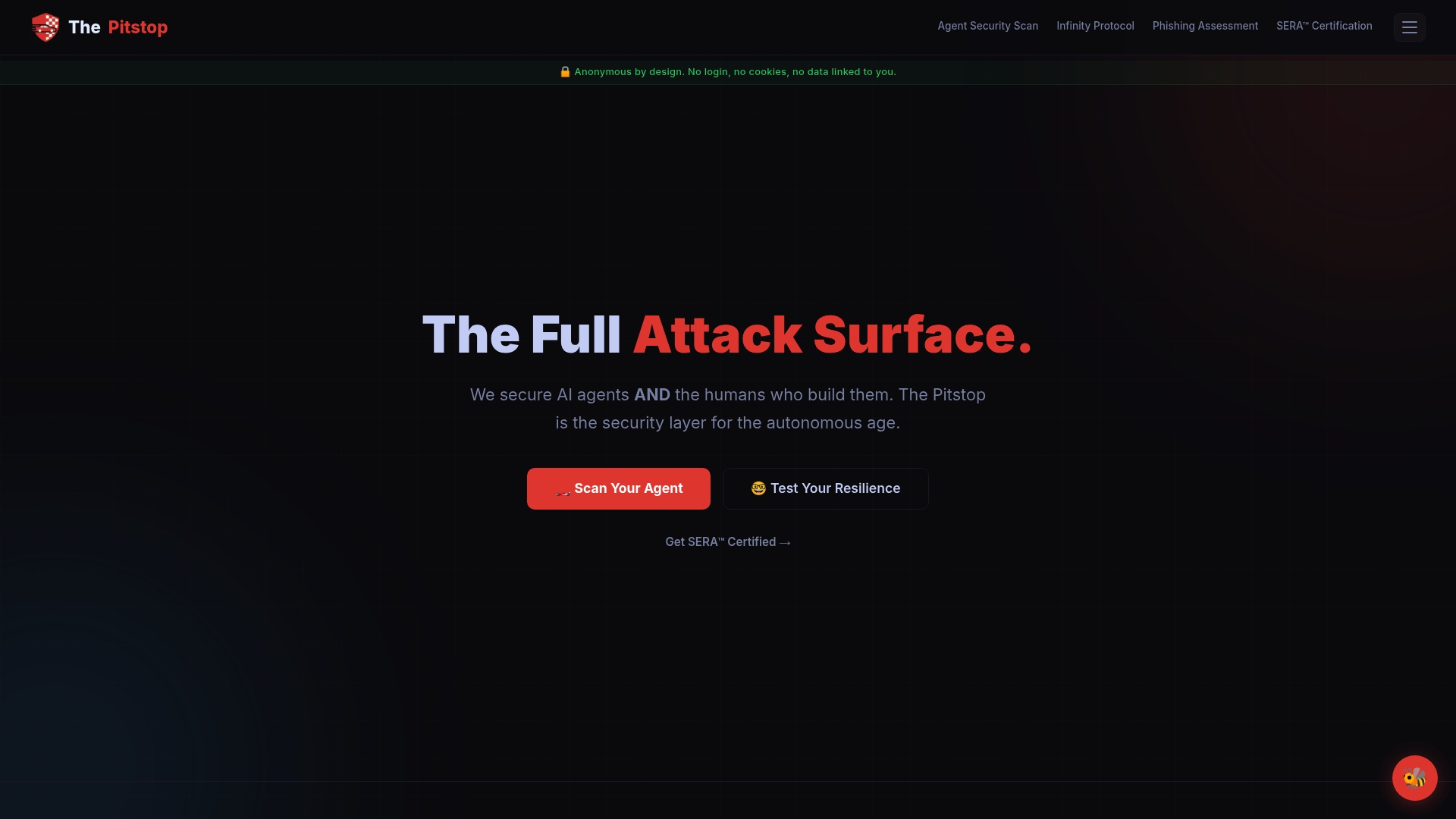
Run a free Agent Security Scan to get an immediate read on your system’s current posture. If your team handles sensitive data or operates autonomous agents, the AI Agent Liability Gap white paper maps the governance risks that technical audits alone do not cover. Teams that want to validate human operator resilience can pursue SERA™ Certification, Thepitstop’s credential for social engineering defense. Embed the Pitstop Security Badge to signal verified trust to partners and users.
FAQ
What are the core AI security audit steps?
The core steps are: scope definition, asset mapping, vulnerability scanning, behavioral red teaming, risk scoring, report generation, remediation verification, and CI/CD integration. Each step builds on the previous one to produce a complete security picture.
How long does an AI security audit take?
Audits range from 30-minute self-assessments to 10-day deep audits depending on system complexity and audit depth. High-autonomy agents handling sensitive data require the longer, more thorough approach.
What is specification-anchored auditing?
Specification-anchored auditing extracts typed security properties from a system’s formal specification to find vulnerabilities that generic scanners miss. It is most effective for complex AI systems with formally defined behavior.
How does AI security auditing differ from traditional security auditing?
AI audits extend traditional security audits to cover prompt injections, behavioral drift, model bias, agentic decision-making risks, and supply chain attacks on model dependencies. Traditional tools and frameworks do not address these vectors without AI-specific extensions.
What compliance frameworks apply to AI security audits?
The EU AI Act, NIST AI RMF, and HIPAA are the primary frameworks for most organizations. Each maps to specific audit controls around transparency, human oversight, data protection, and adversarial robustness.