AI-Driven Threat Detection Explained for Security Teams

AI-driven threat detection is defined as the use of machine learning models, behavioral analytics, and automated response systems to identify cyber threats in real time across an organization’s full attack surface. Unlike traditional rule-based systems that match known signatures, AI-powered detection learns from telemetry patterns and flags anomalies that no static ruleset could anticipate. For IT security professionals and business leaders, understanding what AI-driven threat detection delivers, and where it falls short, is the difference between a security program that scales and one that drowns in alert noise. This guide covers the technology, the tradeoffs, and the implementation realities.
What is AI-driven threat detection and how does it work?
AI-driven threat detection, known in the industry as AI-powered or ML-based threat detection, monitors security telemetry continuously across endpoints, networks, identities, cloud environments, and applications. The system ingests raw signals, applies machine learning models to score risk, and surfaces prioritized alerts to analysts or automated response workflows. The core advantage over signature-only methods is the ability to detect threats that have never been seen before, including zero-day exploits and novel attacker behaviors.
The telemetry inputs that feed these systems are broad by design. Endpoint activity logs, network traffic flows, authentication events, cloud API calls, and application data all contribute to the detection picture. When a machine learning model observes a user authenticating from two geographically distant locations within minutes, or a service account suddenly querying sensitive directories it has never touched, the system flags the deviation without needing a pre-written rule to match it.
Behavioral analytics establish a baseline of normal activity for each user, device, and workload in the environment. Deviations from that baseline trigger risk scores rather than binary pass/fail alerts. This probabilistic approach is what separates AI-driven detection from legacy intrusion detection systems built on static signatures.

How does AI detect threats? Key technologies and data sources
The detection pipeline in a modern AI security system combines several distinct technical methods working in sequence:
- Pattern recognition: Machine learning models trained on historical attack data identify sequences of events that match known attack chains, even when individual events appear benign in isolation.
- Anomaly detection: Unsupervised models flag statistical outliers in user behavior, network traffic volume, or process execution patterns without requiring labeled training data for every threat type.
- Risk scoring: AI platforms assign confidence scores based on evidence quantity, signal quality, and attack pattern matches. Low confidence triggers monitoring; medium confidence prompts human review; high confidence enables safe automatic containment actions.
- Alert clustering: Rather than surfacing thousands of individual events, AI groups related signals into coherent incident narratives. Research documents cases where 925 raw alerts collapsed into 20 meta-alerts, a 97.8% reduction while retaining every critical threat. That compression is what makes AI detection operationally viable at enterprise scale.
- Automation: Response playbooks trigger automatically for high-confidence detections, isolating endpoints, revoking tokens, or blocking IP addresses without waiting for analyst action.
The quality of all these outputs depends entirely on telemetry completeness. Missing or inconsistent logs reduce detection reliability and increase false positives. Before any AI model can perform accurately, your environment needs full end-to-end log coverage, normalized data formats, and consistent collection from every asset class.
Traditional rule-based detection vs. AI-driven detection
The fundamental difference between these two approaches is adaptability. Rule-based systems match events against a fixed library of known attack signatures. They are fast and precise for threats that have been seen before, but they are blind to anything outside the ruleset. AI-driven systems learn continuously from new data, which means their detection capability improves as the threat environment evolves.
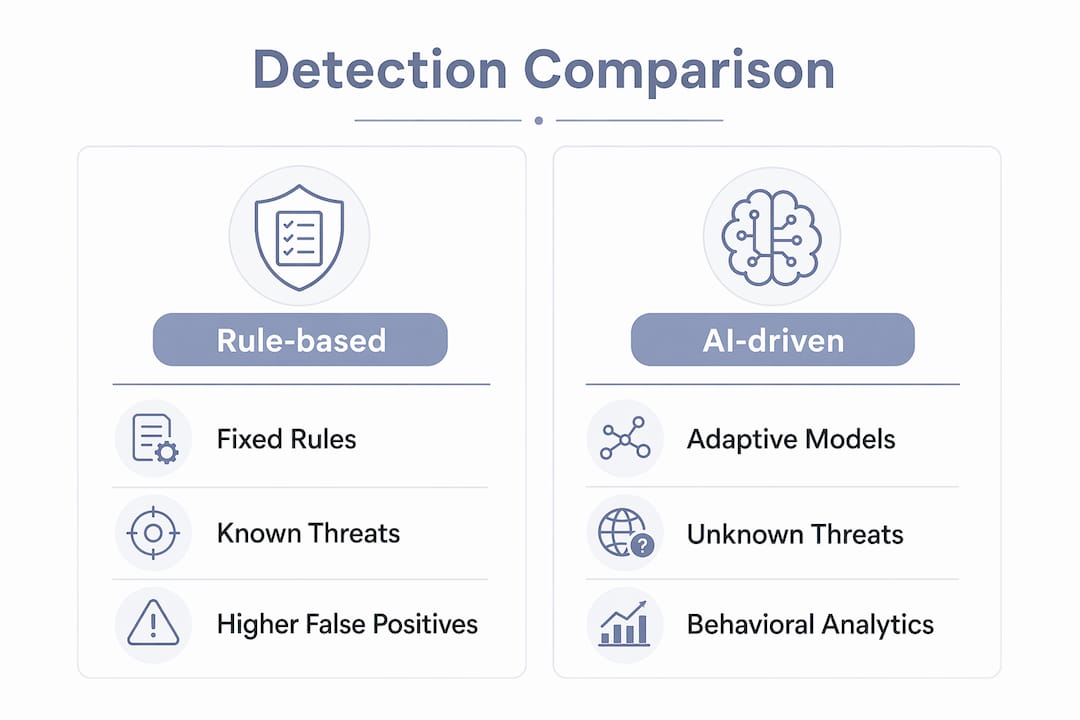
| Factor | Rule-based detection | AI-driven detection |
|---|---|---|
| Known threat detection | High accuracy, low latency | High accuracy with added context |
| Unknown threat detection | Cannot detect without a rule | Detects via anomaly and behavior models |
| Alert volume | High, many false positives | Reduced through clustering and scoring |
| Scalability | Degrades as environment grows | Scales with data volume |
| Transparency | Fully explainable rules | Model explainability varies by architecture |
| Maintenance burden | High, rules require constant updates | Lower, models retrain on new data |
AI-driven detection does not eliminate false positives. Anomaly detection by definition flags unusual events, and unusual is not always malicious. Alert clustering and prioritization reduce the noise significantly, but analyst validation remains necessary to confirm whether a flagged deviation represents a genuine threat or a legitimate change in user behavior.
Pro Tip: Map your AI detection outputs to the MITRE ATT&CK framework from day one. Mapping detections to MITRE ATT&CK exposes coverage gaps immediately and gives your SOC team a structured way to prioritize defensive improvements rather than reacting to individual alerts.
Best practices for implementing AI-driven detection securely
Deploying AI-driven threat detection is an organizational transformation, not a technology installation. The World Economic Forum’s guidance on AI in cybersecurity is direct: strategic alignment and process readiness must precede technical deployment. Organizations that skip this step consistently report poor detection quality and analyst distrust of AI outputs.
A structured implementation follows this sequence:
- Audit telemetry coverage first. Identify every log source in your environment and confirm consistent, normalized collection. Encryption gaps and logging inconsistencies are the leading cause of AI detection failures. Fix observability before deploying models.
- Define success metrics before launch. Establish baseline values for mean time to detect (MTTD) and mean time to respond (MTTR), alert volume per analyst per day, and false positive rate. Without a baseline, you cannot measure improvement.
- Run a scoped pilot. Deploy AI detection in one business unit or one asset class, such as cloud workloads or privileged identity events, before expanding. Validate model outputs against known incidents from your threat history.
- Integrate with existing SIEM and SOC workflows. AI detection works as an additional layer within your Security Information and Event Management platform, not as a replacement for it. Analysts need to receive AI-enriched alerts inside the tools they already use.
- Establish a continuous tuning process. Assign ownership for reviewing false positives weekly, retraining models on confirmed incidents, and updating detection logic as your environment changes.
- Build governance documentation. Record which models are running, what data they consume, who owns them, and how decisions are reviewed. This documentation is required for regulatory compliance and for building organizational trust in AI outputs.
Pro Tip: Treat your first AI detection deployment as a validation exercise, not a production rollout. Run the model in shadow mode alongside existing detection for 30 days and compare outputs before giving it any automated response authority.
Understanding data exfiltration risks in AI systems is also critical at this stage. AI detection platforms ingest sensitive telemetry, and the platform itself becomes a high-value target for attackers who want to blind your defenses.
How AI-driven detection changes security workflows and analyst roles
The practical effect of AI-driven detection on a Security Operations Center is a shift from volume management to quality judgment. Before AI, analysts spent the majority of their time triaging individual alerts. With AI, SOC teams manage billions of logs daily through automated clustering, and analysts receive a much smaller number of enriched, contextualized incidents to investigate.
The specific workflow changes include:
- Automated triage: AI handles the first pass on every alert, scoring it, correlating it with related signals, and attaching relevant context such as asset criticality, user risk history, and threat intelligence matches.
- Evidence collection: Routine evidence gathering, pulling process trees, network connections, and authentication history, runs automatically before an analyst opens the incident.
- Incident enrichment: AI adds external threat intelligence context, maps the activity to MITRE ATT&CK techniques, and suggests containment actions based on similar past incidents.
- Analyst focus shift: With routine triage automated, analysts concentrate on high-fidelity incidents, threat hunting, and validating AI outputs. The role evolves from alert processor to threat investigator.
The operational value of AI detection depends on analysts understanding why the AI flagged an alert, not just that it did. Effective SOC workflows build in a validation step where analysts review the evidence chain behind each AI decision. This practice reduces false positive rates over time and builds the organizational trust that makes higher automation levels safe to deploy.
Challenges and future trends in AI-driven threat detection
The limitations of current AI detection systems are real and worth naming directly. False positives remain a persistent problem, particularly in environments with incomplete telemetry or rapidly changing user behavior patterns. Model transparency is an ongoing challenge. Many high-performing detection models are difficult to explain to non-technical stakeholders, which creates friction in governance and compliance contexts.
The adversarial dimension is accelerating. National cybersecurity agencies advise that attackers now use AI tools to generate more convincing phishing content, automate vulnerability discovery, and adapt malware to evade detection. Defensive AI must keep pace with offensive AI, which means detection models need continuous retraining on current threat data, not just historical datasets.
Several trends are shaping the next phase of AI-driven detection:
- Agentic AI capabilities: Autonomous AI agents that can investigate, contain, and remediate threats without human approval for each step are moving from research into production deployments.
- Explainability improvements: Interpretable machine learning techniques are being integrated into detection platforms to produce human-readable explanations for every alert, addressing the transparency gap.
- MITRE framework integration: Mapping AI detection outputs to both MITRE ATT&CK and MITRE D3FEND is becoming standard practice for identifying defensive coverage gaps.
- Foundational cyber hygiene: AI detection amplifies good security practices and exposes weak ones. Organizations with poor patch management, excessive privilege, and inconsistent logging get less value from AI detection than those with strong fundamentals. Cyber hygiene in AI security is not a prerequisite you can defer.
Key takeaways
AI-driven threat detection delivers measurable improvements in detection speed and analyst efficiency only when deployed on a foundation of complete telemetry, structured governance, and continuous human oversight.
| Point | Details |
|---|---|
| Core definition | AI-driven detection uses ML models and behavioral analytics to identify known and novel threats in real time. |
| Telemetry is the foundation | Incomplete or inconsistent logs directly degrade AI detection accuracy and increase false positives. |
| Alert compression is the key ROI | AI clustering can reduce raw alert volume by over 97%, freeing analysts for high-value investigation. |
| Governance precedes technology | Strategic alignment, process readiness, and human oversight must be established before deploying AI models. |
| Adversarial AI is a real threat | Attackers use AI offensively, making continuous model retraining and defensive AI investment a necessity. |
Why AI detection is only as good as the team behind it
I have watched organizations deploy AI-driven detection platforms with genuine enthusiasm and then quietly shelve them six months later. The technology was not the problem. The gap was always the same: the team did not have clean telemetry, did not own a tuning process, and did not build analyst workflows that incorporated AI outputs into actual decisions.
The multiplier effect of AI detection is real, but it multiplies what you already have. Strong telemetry coverage and disciplined SOC processes become dramatically more effective with AI. Fragmented logging and overloaded analysts become more fragmented and more overloaded, because now there is also a model producing outputs that nobody trusts.
My honest recommendation is to treat the first deployment as a trust-building exercise between your team and the AI system. Run it in shadow mode. Compare its outputs to what your analysts would have caught manually. Tune aggressively in the first 90 days. The organizations that get the most value from AI detection are the ones that treat it as a collaborative tool, not an autonomous replacement for human judgment.
The future of this field is agentic. AI agents that can investigate and contain threats autonomously are coming faster than most security programs are ready for. The AI Agent Liability Gap white paper from Thepitstop addresses exactly this readiness question, and it is worth reading before your organization makes autonomous response decisions.
— Nicholas
Strengthen your AI security posture with Thepitstop
Thepitstop is built specifically for the security challenges that come with AI-driven environments. If you are deploying AI detection tools or managing AI agents in your security stack, the free AI Agent Security Scan gives you an automated assessment of your AI attack surface, including prompt injection risks, supply chain vulnerabilities, and data exfiltration exposure. The SERA™ Certification tests your human operators against social engineering attacks that AI systems alone cannot stop. Both tools are free, automated, and designed for security teams that need answers quickly. Thepitstop also offers the AI Agent Liability Gap white paper for organizations working through governance and readiness decisions before expanding AI detection authority.
FAQ
What is AI-driven threat detection in simple terms?
AI-driven threat detection is the use of machine learning and behavioral analytics to monitor IT environments and identify cyber threats automatically, including threats that no pre-written rule would catch. It processes telemetry from endpoints, networks, identities, and cloud systems to score and prioritize risks in real time.
How does AI detect threats it has never seen before?
AI detects novel threats through anomaly detection, which flags statistical deviations from established behavioral baselines rather than matching known attack signatures. When a user or system behaves outside its normal pattern, the model assigns a risk score regardless of whether that specific behavior has been seen in prior attacks.
What are the main benefits of AI-driven security over traditional methods?
The primary benefits are faster detection of unknown threats, significant reduction in alert volume through clustering, automated triage and evidence collection, and the ability to scale across large, complex environments without proportional increases in analyst headcount.
What data does AI threat detection need to work effectively?
AI detection requires complete, normalized telemetry from all asset classes, including endpoint logs, network traffic, authentication events, cloud API calls, and application data. Gaps in log coverage directly reduce detection accuracy and increase false positive rates.
Can AI threat detection replace human security analysts?
AI-driven detection automates triage, evidence collection, and routine response tasks, but human analysts remain necessary for validating AI outputs, investigating complex incidents, and making judgment calls that require business context. The most effective security programs treat AI as a force multiplier for skilled analysts, not a replacement for them.