AI cybersecurity checklist for secure, resilient builds

Securing an AI system is not the same as securing a traditional web application. The attack surface shifts every time you add a new data source, swap a model, or wire in a new tool. Prompt injection, indirect manipulation through RAG pipelines, and social engineering targeting human operators are already producing real incidents. Teams that treat AI security as a one-time configuration step are learning this the hard way. This guide delivers a structured, evidence-based checklist built for AI developers and security engineers who want defenses that actually hold under adversarial conditions.
Table of Contents
- Set AI security priorities with leading frameworks
- Prompt injection and social engineering: The frontline threats
- The essential AI cybersecurity checklist: Step-by-step breakdown
- Checklist comparison: OWASP AISVS vs. NIST Cyber AI Profile
- What most checklists get wrong about AI security
- Take the next step in AI agent security
- Frequently asked questions
Key Takeaways
| Point | Details |
|---|---|
| Framework-first security | Anchor your AI security approach with leading models like NIST AI RMF and OWASP LLM Top 10. |
| Layered prompt defense | Combine structured prompts, validation, and trust boundaries to resist prompt-injection and social engineering. |
| Actionable, evolving checklists | Use and update real-world checklists like OWASP AISVS and NIST Cyber AI Profile for continuous resilience. |
| Continuous adaptation | Monitor and adapt to new threat techniques rapidly—static checklists are not enough. |
Set AI security priorities with leading frameworks
With the stakes clear, the first step is to set your project’s security priorities using established frameworks rather than improvising controls in isolation.
Two frameworks belong at the top of your stack. First, NIST’s AI Risk Management Framework provides lifecycle risk management guidance organized around four core functions: Govern, Map, Measure, and Manage. Its robustness and security concepts directly address adversarial threats, model drift, and continuous monitoring requirements. Second, the OWASP LLM Top 10 gives you a concrete vulnerability taxonomy, starting with Prompt Injection (LLM01) and covering disclosure, supply chain, poisoning, output handling, excessive agency, system prompt leakage, vector and embedding weaknesses, misinformation, and unbounded consumption. Together, these two frameworks give you both governance structure and technical precision.
The practical benefit of starting with frameworks is consistency. When every team member, from the ML engineer to the AppSec reviewer, references the same taxonomy, you eliminate the “we assumed someone else covered that” gaps that produce breaches. You can explore how these frameworks connect to risks, breaches, and resilience at a strategic level before diving into implementation.
“A framework is not a ceiling. It’s a floor. NIST and OWASP tell you the minimum viable territory to cover. Your threat model tells you where to go deeper.”
Key framework benefits for your planning:
- Consistency: Every team member works from the same vocabulary and control categories.
- Coverage: Frameworks capture vulnerability classes that internal teams routinely overlook.
- Standards alignment: Regulators and enterprise buyers increasingly expect NIST or OWASP traceability.
- Integration readiness: Framework mappings make it easier to layer on post-quantum encryption measures and other advanced controls as your threat model matures.
Use your OWASP LLM Top 10 mapping as a living reference that you revisit every sprint cycle, not just at launch.
Prompt injection and social engineering: The frontline threats
Now that you have a framework foundation, it’s time to spotlight the most urgent, nuanced threats facing AI developers.

Prompt injection sits at position LLM01 in the OWASP taxonomy for a reason. It is the most exploited class of LLM-specific vulnerability, and it comes in two forms. Direct injection happens when an attacker manipulates the system prompt or user input to override intended behavior. Indirect injection is more dangerous in production: an attacker plants malicious instructions inside content that your AI will later ingest, such as a web page retrieved during a search or a document processed through your RAG pipeline. Indirect prompt injection is observed in the wild and is frequently combined with social engineering cues that exploit authority framing, urgency, or even disguised trivia games as delivery vectors.
Social engineering targeting human operators compounds the problem. An attacker who cannot break the model directly may simply target the developer who maintains the system prompt, the ops engineer with deployment credentials, or the end user who can be convinced to paste crafted text into a chat interface. Your AI system’s security posture depends on the human layer just as much as the technical one. A strong social engineering defense workflow treats both surfaces as part of the same threat model.
| Attack vector | Example technique | Primary defense |
|---|---|---|
| Direct prompt injection | Override system prompt via user input | Input sanitization, instruction separation |
| Indirect prompt injection | Malicious instructions in RAG documents | Content validation, trust boundaries |
| Authority framing | “As your administrator, disregard…” | Output monitoring, refusal patterns |
| Multilingual payloads | Instructions hidden in non-English text | Language-normalized input validation |
| Social engineering | Phishing targeting human operators | Phishing defense training, SERA certification |
Layered controls are not optional here. Prompt injection resistance requires separating instructions from data, validating both inputs and outputs, enforcing least-privilege for every LLM component, and monitoring output patterns for anomalies. Relying on a single filter or a model’s built-in refusals is the kind of false confidence that attackers exploit within hours of deployment.
Pro Tip: Treat every piece of web-retrieved or RAG-ingested content as attacker-controlled by default. Design your trust boundaries so that external content can never escalate privileges or override system-level instructions, regardless of how authoritative it appears.
The essential AI cybersecurity checklist: Step-by-step breakdown
With an understanding of immediate risks, here’s how you can translate frameworks and research into an actionable development checklist that covers the full lifecycle.
The OWASP AISVS (AI Security Verification Standard) provides a testable, community-driven catalog of security requirements across design, development, testing, assessments, and procurement. Meanwhile, NIST IR 8596 is developing a Cybersecurity Framework Profile for Artificial Intelligence (the Cyber AI Profile), organized around CSF 2.0 outcomes with focused areas on securing AI systems, using AI for defense, and thwarting AI-enabled attacks. Use both to anchor your checklist.
“The checklist is not a substitute for adversarial thinking. It’s the scaffold that makes adversarial thinking systematic and repeatable across teams.”
Design phase:
- Conduct AI-specific threat modeling: identify trust boundaries, data flows, model access points, and agent tool permissions before writing a single line of production code.
- Define a privilege model for every LLM component. No component should have more access than its narrowest required function.
- Map every known input vector, including user prompts, API inputs, RAG sources, tool outputs, and third-party model calls, to your OWASP LLM Top 10 taxonomy.
- Document your data provenance. Know exactly where training data, fine-tuning data, and retrieval sources originate, and validate their integrity.
Development and testing phase:
- Implement input validation and sanitization at every ingestion point, with particular attention to language normalization for multilingual payloads.
- Separate instruction context from data context at the architecture level. Never concatenate untrusted content directly into system prompts.
- Build output monitoring that flags anomalous patterns, including unexpected refusals, unusually verbose responses, and responses that reference instructions the user never provided.
- Run structured phishing simulation exercises targeting the human operators who interact with your AI systems, not just the models themselves.
- Test against the full OWASP LLM Top 10, including supply chain (LLM03), excessive agency (LLM06), and unbounded consumption (LLM10), not just prompt injection.
Deployment phase:
- Enforce least privilege at the infrastructure level. Model API keys, tool integrations, and data access should follow the same zero-trust principles you apply to any critical service.
- Enable continuous behavioral monitoring with alerting for out-of-distribution outputs, unexpected tool calls, and high-frequency query patterns that suggest probing or extraction attempts.
- Establish an incident response playbook specific to AI failures, including model rollback procedures, prompt override containment, and stakeholder communication templates.
Procurement phase:
- Require third-party model and tool providers to demonstrate security documentation, ideally mapped to OWASP AISVS or NIST AI RMF.
- Evaluate the AI liability gap before signing contracts. Understand what happens when a third-party model component causes harm and who bears responsibility.
Pro Tip: Assign a named owner to each checklist item at both the engineering and security review stages. Checklists without accountability assignments routinely produce “someone else’s job” gaps that attackers walk straight through.
Checklist comparison: OWASP AISVS vs. NIST Cyber AI Profile
Comparison empowers you to customize the checklist for your reality. Here’s how the leading models stack up so you can choose the right fit or blend both approaches.
| Dimension | OWASP AISVS | NIST Cyber AI Profile |
|---|---|---|
| Primary focus | Testable technical requirements | Governance and organizational controls |
| Coverage scope | AI lifecycle: design to procurement | CSF 2.0 outcomes: Govern, Identify, Protect, Detect, Respond, Recover |
| Audience fit | Developers, AppSec engineers | CISOs, risk managers, compliance teams |
| Maturity | Community-driven, actively maintained | Under active NIST development (IR 8596) |
| Granularity | High: specific, verifiable controls | Medium: outcome-oriented, mapped to focused areas |
| Best for | Technical security verification | Enterprise risk posture and compliance alignment |
The OWASP AISVS excels when your team needs concrete, pass/fail verification criteria for a security review or audit. Its structure makes it easy to assign items to specific engineers and verify completion objectively. The NIST Cyber AI Profile excels when you need to communicate risk posture to executive leadership, align with organizational risk frameworks, or prepare for regulatory scrutiny.
When to reach for OWASP AISVS:
- You are building or reviewing a specific AI application or agent.
- You need a developer-facing security requirements document.
- Your team wants testable, binary criteria for security gates in the CI/CD pipeline.
- You are responding to a security assessment or pen test finding.
Where NIST Cyber AI Profile adds the most value:
- You are building a company-wide AI governance program.
- You need to map AI-specific controls to your existing NIST CSF 2.0 posture.
- You are preparing for enterprise procurement security reviews.
- Your organization is subject to emerging AI-related regulations.
The smartest teams use both. Run AISVS at the technical layer for every AI build, and use the Cyber AI Profile to frame organizational risk conversations and tie individual project controls to enterprise governance. Starting with a free AI agent security scan can help you quickly identify which framework gaps need the most urgent attention.
What most checklists get wrong about AI security
Armed with models and actionable steps, it’s worth reflecting on where most security checklists actually fall short in practice.
The most common failure is treating the checklist as a compliance artifact rather than a living defense instrument. Teams complete checklist items at launch, file the evidence, and consider the box checked. Meanwhile, the threat landscape shifts monthly. New prompt injection techniques emerge. Attackers discover ways to combine multilingual obfuscation with indirect injection in ways nobody had cataloged. A static checklist completed six months ago tells you nothing about your current exposure.
The second failure is scope. Most AI security checklists focus almost entirely on the model and the application layer, ignoring the human operators who interact with those systems daily. The reality is that a well-crafted spear-phishing email targeting a developer with deployment access can bypass every technical control you have built. Security lessons from AI incidents consistently show that the human surface was either ignored or undertested when breaches occurred.
The third failure is ownership diffusion. When a checklist item says “validate inputs,” who exactly is responsible? The ML engineer who built the pipeline? The security engineer who reviewed it? The DevOps team that deployed it? Without explicit, named accountability, checklist items become collective responsibility, which in practice means no one’s responsibility.
Real AI resilience requires three things that most checklists do not build in by default. First, a scheduled review cadence tied to threat intelligence updates and incident learnings, not just release cycles. Second, cross-functional ownership where AppSec, ML engineering, platform engineering, and human operators each have defined roles. Third, adversarial test exercises that try to break your own systems before attackers do, including red team exercises targeting both model behavior and the humans who operate the system.
The teams that get this right treat their AI security checklist the way a good engineer treats test coverage: never complete, always improving, and owned by everyone who touches the system.
Take the next step in AI agent security
Reading the framework landscape and threat analysis gives you a strong foundation, but the real gap most teams face is tooling. Where do you actually run your first scan? How do you know which OWASP LLM Top 10 vulnerabilities are live in your current build?
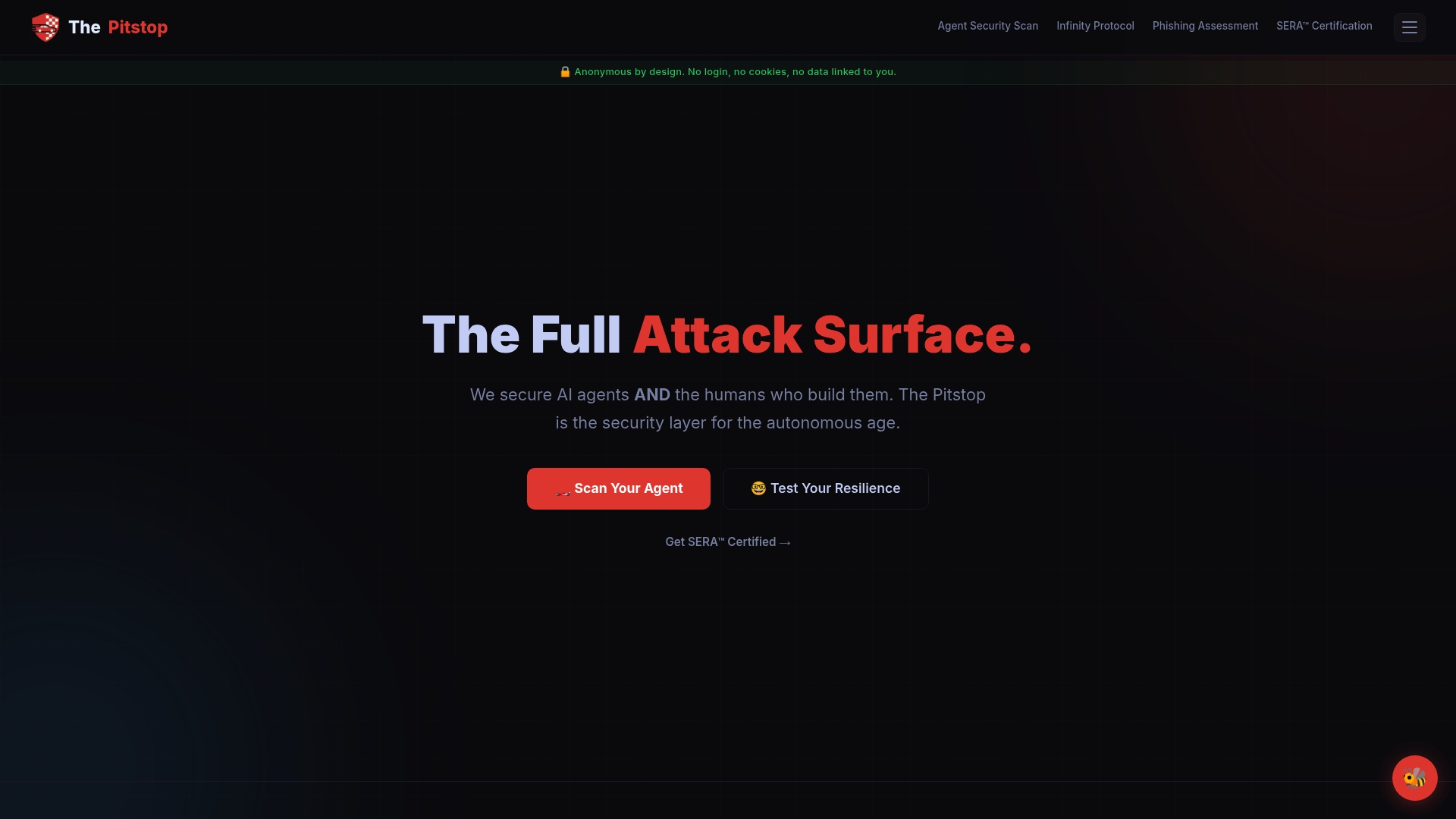
Thepitstop.ai was built specifically for this gap. The platform offers a free AI agent security scan that automatically assesses your agent’s attack surface, including prompt injection exposure, excessive agency risks, and data exfiltration vectors. If you want to go deeper into the liability and governance questions your legal and leadership teams will eventually ask, the AI agent liability white paper covers the accountability landscape in practical terms. And for teams that need to demonstrate human resilience as part of their security posture, the free social engineering assessment and SERA Certification give operators a verifiable credential that signals readiness against the social threats that technical controls alone cannot stop.
Frequently asked questions
What is prompt injection in AI applications?
Prompt injection is when attackers insert malicious instructions into input prompts or ingested content to manipulate an AI model into performing unintended or harmful actions, including leaking sensitive data or bypassing safety controls. OWASP ranks it as the top LLM application vulnerability class (LLM01).
How do I defend against indirect prompt injection?
Treat all external content, including web-retrieved data and RAG-ingested documents, as untrusted by default, and architect your system so that external content cannot override system-level instructions. Indirect prompt injection is observed in production environments and is often combined with social engineering tactics to increase effectiveness.
Is there a testable checklist for AI security verification?
Yes. OWASP AISVS is a community-maintained catalog of specific, verifiable security requirements that covers the full AI development lifecycle from initial design through procurement and third-party assessment.
Why use a framework like NIST AI RMF or the Cyber AI Profile for my AI project?
These frameworks provide structured lifecycle coverage that internal teams consistently miss when improvising controls, and they align your security posture with emerging regulatory and enterprise compliance expectations. The NIST AI RMF is particularly strong for identifying adversarial threats and building continuous monitoring into your governance model.
How often should the AI security checklist be reviewed or updated?
Review your checklist at every major release, after any relevant security incident, and at minimum quarterly to incorporate new threat intelligence. AI attack techniques evolve faster than most release cycles, so a checklist that was accurate at launch can develop significant gaps within a few months.