AI Cybersecurity Best Practices for IT Teams: 2026

AI cybersecurity best practices are defined as an integrated framework combining identity management, continuous risk assessment, and adversarial testing to protect AI systems from threats unique to machine learning environments. These threats include prompt injection, data exfiltration, model inversion, and privilege escalation. Frameworks like the NIST AI Risk Management Framework, MITRE ATLAS, the OWASP GenAI Security Project, and the Microsoft Azure Cloud Adoption Framework each address distinct layers of this problem. Understanding AI security risks is the prerequisite for building any defense that holds.
1. apply AI cybersecurity best practices starting with identity
Every AI agent must have a distinct, cryptographically anchored identity. This is not optional. Without it, you cannot attribute actions, revoke access, or investigate incidents with any precision.
Microsoft advises CISOs never to rely on AI model outputs for access control decisions. Access control must be deterministic. That means a separate, non-AI enforcement layer decides what the agent can and cannot do, regardless of what the model requests.
Apply Zero Trust principles across every AI workload:
- Assign each AI agent a unique managed identity, not a shared service account
- Grant least-privilege access scoped to the minimum required for each task
- Use just-in-time access provisioning for elevated permissions
- Revoke credentials immediately when an agent’s role changes or is decommissioned
- Require human approval for any irreversible action such as file deletion, financial transactions, or external communications
Pro Tip: Treat your AI agents the same way you treat privileged human accounts. Audit their access quarterly, rotate credentials on a schedule, and log every permission change. The cryptographic trust model for AI agents makes this auditable at scale.
Privilege creep is the silent killer in AI deployments. An agent provisioned with broad access “just in case” becomes a high-value target the moment it is compromised.
2. conduct continuous risk assessments and adversarial testing
Static security reviews miss dynamic attack vectors. Microsoft’s Cloud Adoption Framework explicitly recommends running real-world adversarial simulations and regular vulnerability testing because AI threat surfaces shift as usage patterns evolve.
Start with your existing threat models, then extend them. STRIDE covers spoofing, tampering, repudiation, information disclosure, denial of service, and elevation of privilege. AI systems require additional coverage from MITRE ATLAS and the OWASP Generative AI Risk inventory, which catalog AI-specific attack patterns that STRIDE does not address.
“Traditional threat modeling frameworks need supplementation by AI-specific threat libraries like MITRE ATLAS and OWASP GenAI to fully cover AI risks.” — Microsoft Cloud Adoption Framework
A practical adversarial testing cycle for AI systems includes:
- Prompt injection testing: Submit crafted inputs designed to override system instructions or extract training data
- Indirect injection simulation: Embed malicious instructions in documents, emails, or web content the AI will process
- Pipeline transformation testing: Validate that data integrity holds through every preprocessing and postprocessing step
- Runtime behavior testing: Monitor model outputs under adversarial conditions, not just clean inputs
- Red-team exercises: Assign a dedicated team to simulate real attacker behavior against your deployed AI systems
Risk assessments must cover models, data pipelines, and deployment environments to prioritize mitigation effectively over time. Running these assessments once is insufficient. Schedule them quarterly at minimum, and trigger unplanned assessments after any significant model update or infrastructure change.
3. enforce authorization at every tool invocation

Agentic AI systems operate differently from chatbots. A chatbot generates text. An agentic AI calls APIs, reads files, sends emails, and executes code. That expanded capability creates an expanded attack surface.
OWASP’s Top 10 for agentic applications identifies tool misuse, goal manipulation, resource exhaustion, and privilege escalation as the leading risks. Each tool invocation is a potential attack vector. Authorization must be enforced at the tool level, not just at the model level.
| Security Control | Traditional Generative AI | Agentic AI |
|---|---|---|
| Access scope | Conversation context only | Persistent across sessions and tools |
| Authorization point | Model input/output filters | Every tool call and API request |
| Privilege risk | Low, text generation only | High, real-world actions with consequences |
| Monitoring requirement | Output review | Internal reasoning, tool calls, state changes |
| Human oversight trigger | Content policy violations | Any irreversible or high-impact action |
Pro Tip: Pin tool versions in your agentic AI configurations. An unpinned tool dependency is a supply chain vulnerability. If a tool updates silently, your authorization policies may no longer apply correctly.
Agent security failures mostly stem from authorization and observability lapses. Detailed logging that links every action to both the agent identity and the originating user identity is the foundation of effective incident response.
4. secure AI communication channels and data pipelines
AI systems transmit sensitive data constantly. Model inputs, outputs, retrieved documents, and API responses all move across network boundaries. Each boundary is a potential interception point.
Secure communication endpoints using managed identities, virtual network isolation, and API management tools. Azure API Management, for example, can enforce authentication, rate limiting, and logging on Model Context Protocol server endpoints before any request reaches your AI model.
Key controls for securing AI data pipelines:
- Isolate AI workloads in dedicated virtual networks with strict ingress and egress rules
- Encrypt all data in transit using TLS 1.3 or higher, including internal service-to-service calls
- Apply API gateways to every external-facing AI endpoint to enforce authentication and audit logging
- Classify data before it enters any AI pipeline and restrict model access to the minimum classification level required
- Monitor for data exfiltration risks including unusually large outputs, unexpected external API calls, and repeated queries targeting sensitive fields
Insider threats are a real concern in AI data workflows. Microsoft Purview Insider Risk Management integrates with security operations suites to flag anomalous data access patterns before exfiltration occurs. Do not treat this as a compliance checkbox. Treat it as an active detection layer.
5. build observability into every AI system from day one
Observability is not a feature you add after deployment. It is a design requirement. Security teams that cannot see what an AI agent is doing cannot defend it.
Linking every action to agent and user identity improves incident attribution and makes credential revocation effective. Without this linkage, you cannot determine which agent took a harmful action or which user session triggered it.
Effective AI observability requires structured logging of internal reasoning steps, not just final outputs. Log the tool calls an agent makes, the data it retrieves, the permissions it requests, and the decisions it reaches. This creates an audit trail that supports both forensic investigation and compliance reporting.
Why AI security matters becomes concrete when you have a breach and no logs. Teams that invested in observability from the start resolve incidents in hours. Teams that did not spend weeks reconstructing what happened.
6. implement the NIST AI RMF as your governance backbone
The NIST AI Risk Management Framework organizes AI risk management into four functions: Govern, Map, Measure, and Manage. Each function addresses a distinct layer of organizational accountability. Together they create a repeatable, auditable process for managing AI risk at scale.
The Govern function establishes policies, roles, and accountability structures. The Map function identifies AI systems, their contexts, and associated risks. The Measure function generates comparable evidence over time using regression tests and red-team exercises. The Manage function prioritizes and executes mitigations based on that evidence.
A staged implementation approach works best for most organizations:
- Inventory all AI systems including third-party models, embedded AI features, and experimental deployments
- Map each system to its risk profile using MITRE ATLAS and OWASP GenAI threat catalogs
- Establish baseline measurements with red-team exercises and automated vulnerability scans
- Define confidence criteria that must be met before increasing any AI system’s autonomy or access scope
- Schedule recurring assessments tied to model updates, infrastructure changes, and threat intelligence feeds
- Document and report risk trends over time to demonstrate measurable improvement to leadership and auditors
The Measure function is where most programs fall short. One-off evaluations produce a snapshot. Comparable measurement methods over time produce a trend line. A trend line tells you whether your defenses are improving or degrading relative to the threat environment.
7. establish human-in-the-loop controls for high-impact actions
CISA’s agentic AI adoption guide identifies four key risk themes for autonomous AI systems: expanded attack surface, behavioral misalignment, orchestration flaws, and accountability gaps. Human-in-the-loop checkpoints directly address three of these four.
A human checkpoint is a mandatory approval gate before an AI agent executes an irreversible or high-impact action. Define “high-impact” explicitly in your security policy. Examples include sending external communications on behalf of the organization, modifying production databases, executing financial transactions above a defined threshold, and granting or revoking user access.
The checkpoint does not need to be manual for every action. Automate low-risk approvals and reserve human review for actions that meet your defined risk criteria. The goal is accountability, not friction. Build social engineering defense workflows into these checkpoints so that human operators are also tested against manipulation attempts that could bypass the control.
Key takeaways
Effective AI security requires deterministic access controls, continuous adversarial testing, and human oversight at every high-impact decision point.
| Point | Details |
|---|---|
| Identity is foundational | Assign each AI agent a unique cryptographic identity and enforce least-privilege access with deterministic controls. |
| Test adversarially and continuously | Run prompt injection, pipeline, and red-team exercises on a recurring schedule, not just at deployment. |
| Authorize at the tool level | Agentic AI requires authorization enforcement at every tool call, not just at model input and output boundaries. |
| Observe everything | Log internal reasoning, tool calls, and identity attribution from day one to support incident response. |
| Govern with NIST AI RMF | Use the Govern, Map, Measure, and Manage functions to build a repeatable, auditable AI risk program. |
The part most teams get wrong
Most AI security programs I have seen fail at the same point: they treat the AI model as the security boundary. They put guardrails on the model’s outputs and call it done. That is the wrong mental model entirely.
The model is not the boundary. The model is the actor. The boundary is the authorization layer that sits between the model and everything it can touch. When you conflate the two, you end up with an AI agent that can be manipulated through indirect prompt injection to take actions your guardrails never anticipated. I have watched this happen in production environments where the security team was genuinely confident in their defenses.
The other failure I see consistently is treating AI security as a one-time project. You deploy, you test, you ship. Six months later the model has been updated, the threat actors have new techniques, and nobody has run a red-team exercise since launch. The NIST AI RMF’s Measure function exists precisely to prevent this. Build the recurring assessment cycle into your program from the start, or you will be rebuilding your defenses reactively after an incident.
Agentic AI is the area where the stakes are highest right now. Autonomous agents with real-world tool access are a fundamentally different risk category than a chatbot. The OpenClaw incident is a useful case study in what happens when privilege boundaries are not enforced at the tool level. Read it before you deploy your next autonomous agent.
— Nicholas
Secure your AI agents with Thepitstop
Thepitstop builds security tools specifically for AI agents and the humans who operate them. If you are working through an AI cybersecurity checklist for 2026, the AI Agent Liability Gap white paper is the right starting point. It maps the accountability gaps that CISA and OWASP have identified to concrete mitigation strategies your team can implement immediately.
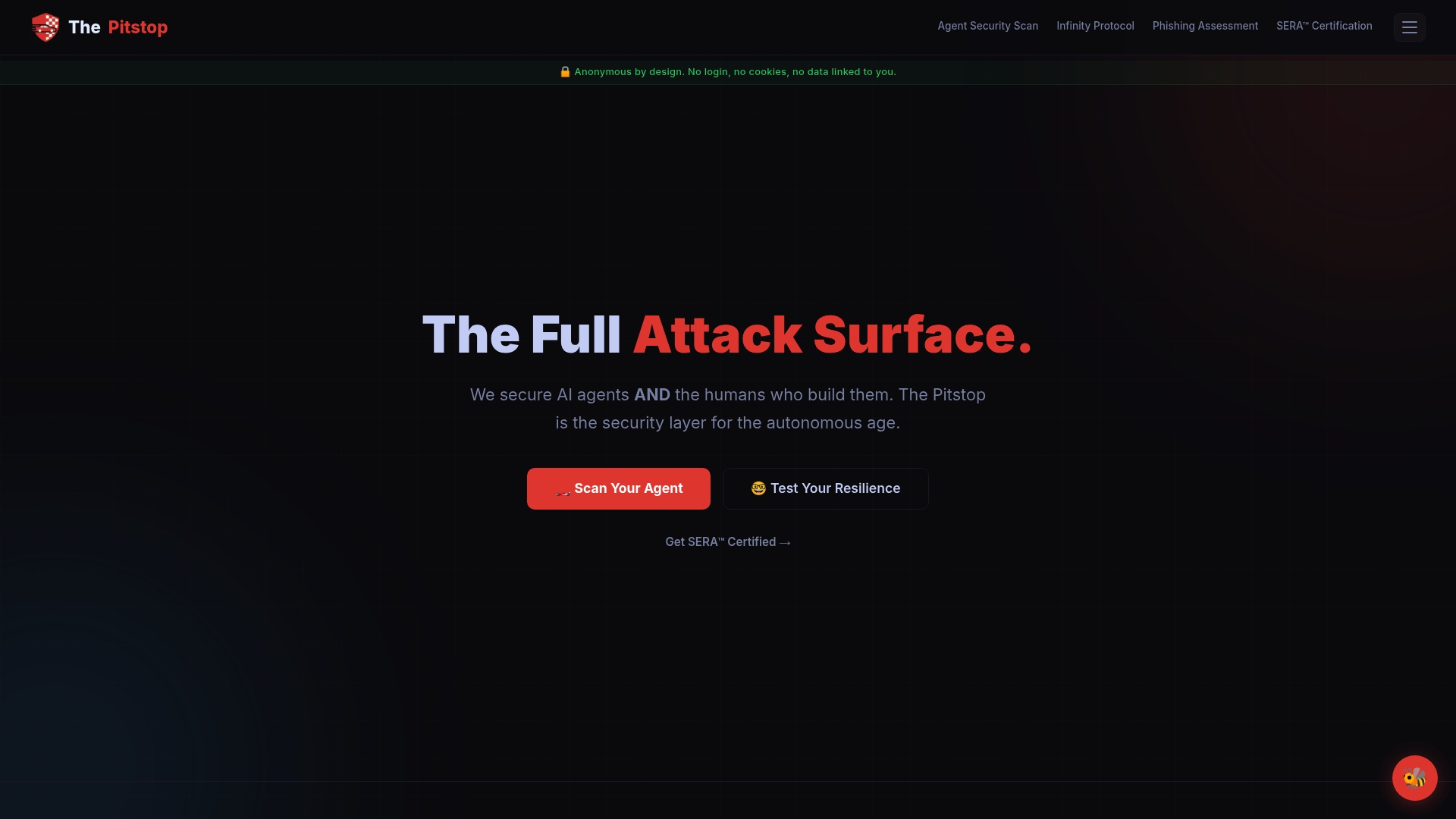
The free AI Agent Security Scan gives you an automated assessment of your agent’s attack surface, covering OWASP Top 10 risks, prompt injection exposure, and authorization gaps. Thepitstop also offers the OWASP coverage mapping tool to help you prioritize which vulnerabilities to address first. For teams that need to demonstrate human resilience alongside machine security, the SERA™ Certification program provides a credentialed assessment of social engineering resistance.
FAQ
What are the core AI cybersecurity best practices?
The core practices are identity management with least-privilege access, continuous adversarial testing using MITRE ATLAS and OWASP GenAI threat catalogs, authorization enforcement at every tool invocation, and governance through the NIST AI Risk Management Framework.
How does prompt injection threaten AI systems?
Prompt injection embeds malicious instructions in content the AI processes, overriding its intended behavior. Microsoft identifies indirect prompt injection as a pronounced threat, recommending tools like Prompt Shield and thorough adversarial input testing as mitigations.
Why is agentic AI riskier than standard generative AI?
Agentic AI executes real-world actions including API calls, file operations, and database writes, creating an attack surface that extends far beyond text generation. CISA’s 2026 guide highlights expanded attack surface, behavioral misalignment, and accountability gaps as the primary risk themes.
How often should AI risk assessments run?
AI risk assessments should run at minimum quarterly, with additional unplanned assessments triggered by model updates, infrastructure changes, or new threat intelligence. The NIST AI RMF Measure function requires comparable evidence over time, which means recurring assessments, not one-off evaluations.
What is the role of human-in-the-loop in AI security?
Human-in-the-loop controls are mandatory approval gates for irreversible or high-impact AI actions such as financial transactions, external communications, and access changes. CISA’s agentic AI guidance identifies these checkpoints as a primary mitigation for orchestration flaws and accountability gaps in autonomous systems.