Top 6 agentproof.dev Alternatives for 2026
Verifying agent security for AI systems is hindered by tools that either demand complex integration, lack audit-ready evidence, or make pricing and actual protection levels opaque until late in procurement. Many agent security software platforms require sales calls for quotes, skip continuous runtime monitoring, or generate findings that only specialized analysts can interpret effectively. This comparison lays out each alternative’s audit options, deployment model, and integration requirements so you can match your security needs to a vendor you can actually operationalize.
Table of Contents
The Pitstop
At a Glance
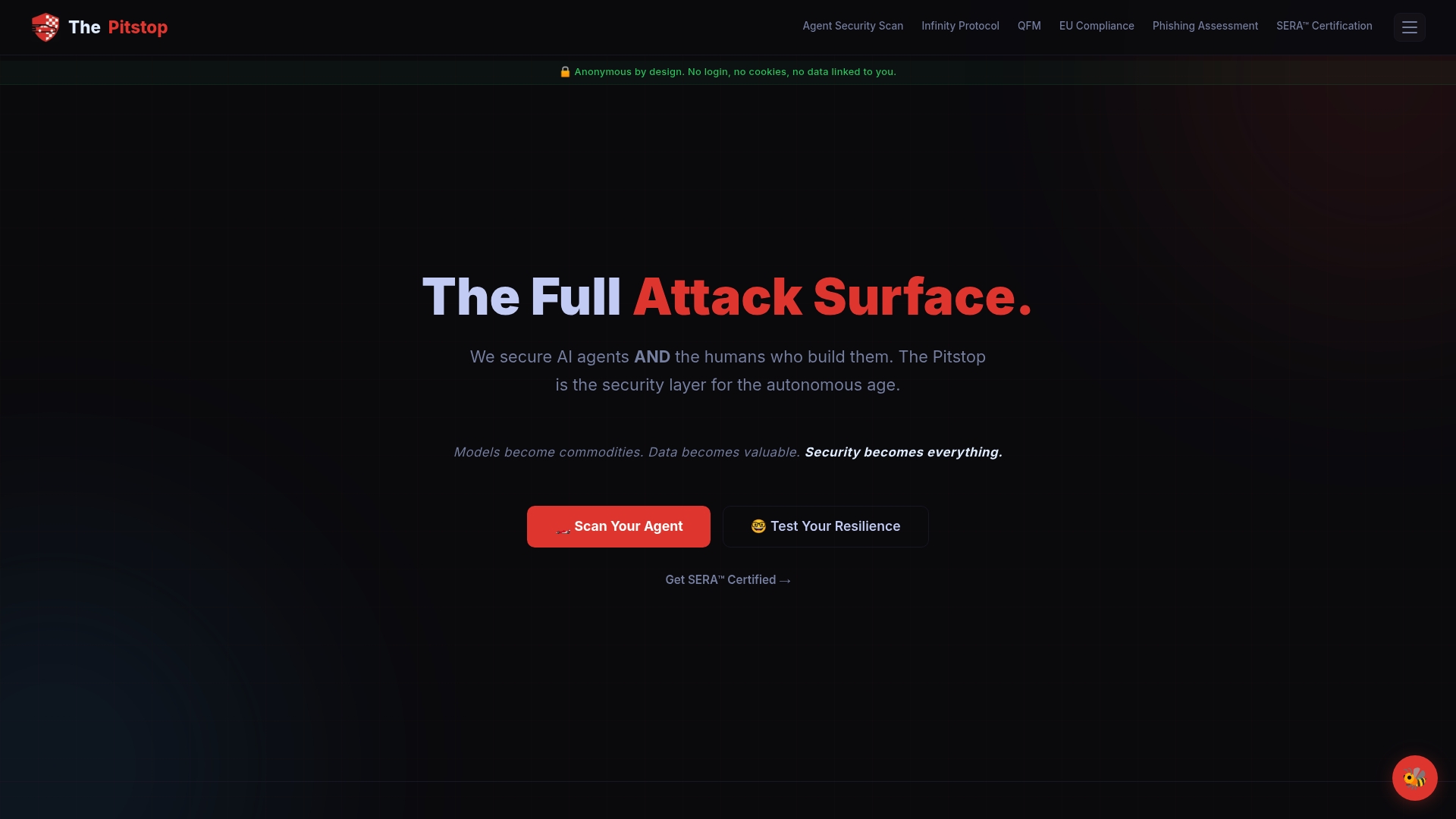
Free, anonymous access with no signups and no data collection while offering a 27-check Agent Security Scan and cryptographic trust mechanisms. That combination lets teams run executable security checks and issue reputation tokens without onboarding friction.
Core Features
- Agent Security Scan with 27 checks for prompt injection, behavioral integrity, supply chain, and permission controls.
- Human Resilience Assessment that runs real-world phishing scenarios and returns instant scoring for operators.
- SERA™ Certification to validate social engineering judgment under pressure and produce verifiable credentials.
- Infinity Protocol for tamper-proof cryptographic bonds between AI agents and human operators.
- A white paper and guidance on AI agent liability and security architecture for autonomous systems.
Key Differentiator
Unifies agent audits, operator resilience testing, cryptographic trust, and behavioral monitoring into a single privacy-first toolkit. That alignment means you can test both machine and human attack surfaces and establish cryptographic proof of trust without exposing operator data.
Pros
-
Offers both machine and human assessments. The paired Agent Security Scan and Human Resilience Assessment let you measure risks across the full attack surface rather than in isolated pockets.
-
Privacy by design. No signups and no data collection reduce legal and operational friction when you want an external team or contractor to perform a quick audit.
-
Infinity Protocol brings post-quantum aware cryptographic bonds and blockchain-style trust chains so interactions can be cryptographically verified between agents and people.
-
Free, executable reports. The platform provides fixed commands and immediate remediation guidance that you can run during triage to close obvious gaps quickly.
-
Real-time signals for drift. Kernel-level monitoring and behavioral checks support ongoing verification, not just one-off scans.
Cons
- Requires technical familiarity to interpret cryptographic trust constructs and security reports; teams without cryptography or security engineering expertise will need to budget for specialist time.
Who It’s For
AI developers, security teams, and compliance groups deploying autonomous agents who must prove both machine integrity and operator judgment. It suits orgs that can dedicate at least one engineer to interpret cryptographic outputs and integrate findings.
Unique Value Proposition
Infinity Protocol gives you tamper-proof evidence you can present to partners or regulators while the site delivers executable scans and SERA™ certification without collecting operator data. That lets you produce verifiable trust artifacts quickly and privately.
Real World Use Case
A security team runs the Agent Security Scan on a conversational agent before production to find prompt injection paths and excessive permissions. They run SERA™ Certification for front-line operators and deploy Infinity Protocol ties so each operator session carries verifiable cryptographic claims.
Website: https://thepitstop.ai
Aira Security
At a Glance
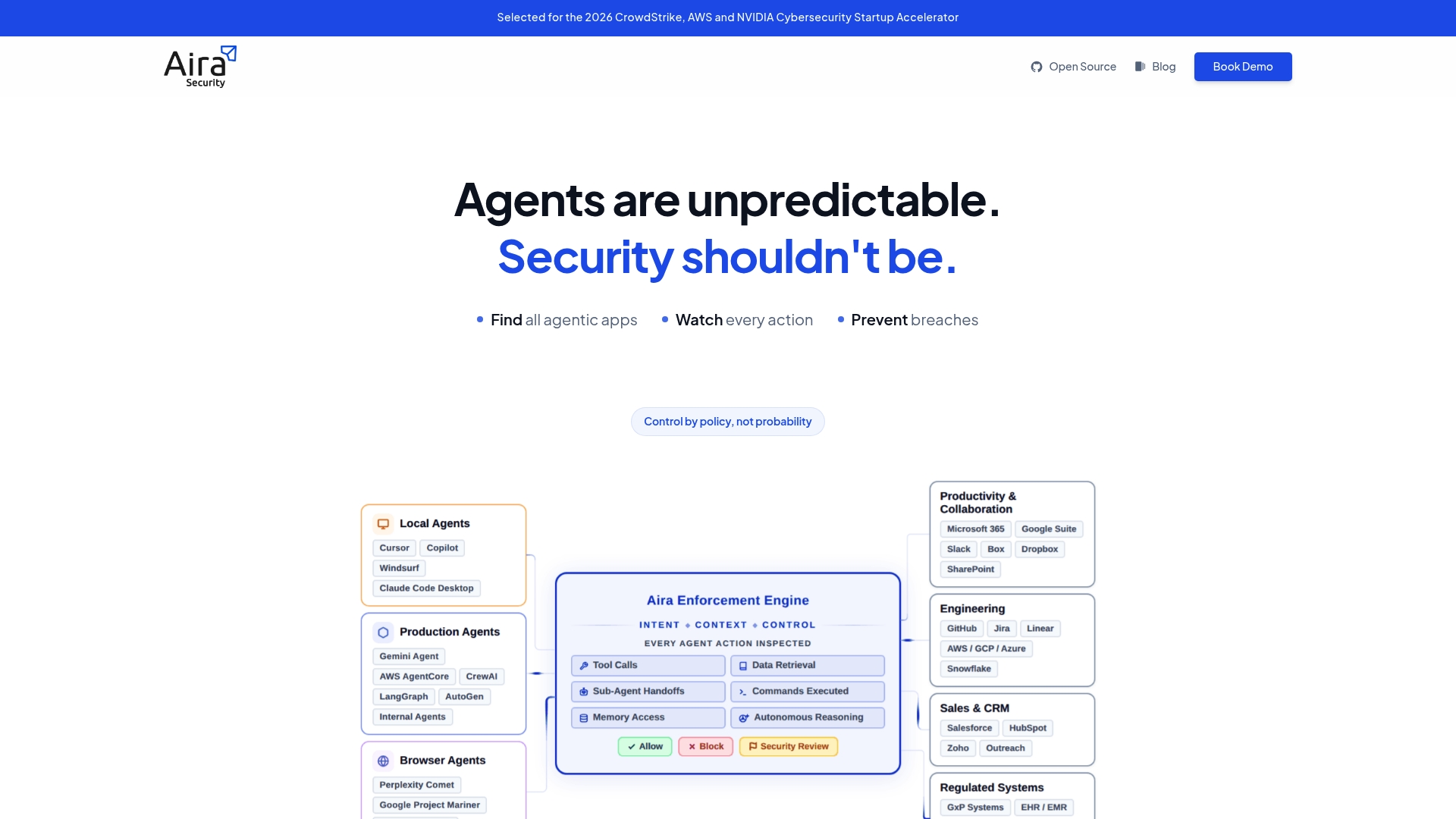
Built by security leaders with patents and prior roles at AWS and Morgan Stanley, Aira Security presents itself as a policy-first control plane for agentic applications. The company highlights partner relationships and architectural diagrams but publishes few concrete feature or pricing details.
Core Features
- Find all agentic apps: Discover agentic applications running across cloud and on-prem environments.
- Watch every action: Continuous monitoring of agent behavior and action trails for auditability.
- Prevent breaches: Policy enforcement aimed at stopping unauthorized agent activity before it reaches production.
- Control by policy, not probability, rather than relying on probabilistic detection.
Key Differentiator
Aira leans on its leadership pedigree and a policy-driven approach to control agent behavior rather than probabilistic detection. Compared with Thepitstop, which offers free assessment tools and human resilience testing, Aira targets tighter operational control in production for teams that want policy enforcement as the primary security lever.
Pros
- The company presents leadership with patents and experience at major firms, which signals domain expertise rather than a marketing-only startup claim.
- The vendor lists partners such as AWS, CrowdStrike, NVIDIA, and Perplexity, indicating ecosystem interest and potential technical alignment.
- Focused feature language like discover, monitor, and policy enforcement aligns clearly with enterprise incident prevention workflows.
- The site hosts open source tools and a blog, offering entry points for engineers who want to inspect or experiment with components.
- The product narrative centers on production readiness and breach prevention rather than experimental research prototypes.
Cons
- No third-party reviews or user feedback were found, so real-world operational validation is limited.
- Publicly available feature and deployment details are sparse, making procurement planning difficult for security teams.
- The website contains broken links and missing pages, which raises questions about documentation maturity and vendor readiness.
- Pricing, trial options, and integration specifics are not disclosed, so total cost of adoption is unclear.
When It May Not Fit
If you need an out-of-the-box trial, transparent pricing, or detailed integration docs before running a proof of concept, Aira may not meet that requirement. Teams that rely on community validation and third-party reviews to justify vendor selection will find the public record thin.
Who It’s For
Security teams and enterprise organizations running complex agent-based systems who want to enforce deterministic policies in production. The offering suits engineers who prioritize control and auditability over plug-and-play self service.
Real World Use Case
A cloud security team discovers undocumented agentic applications, instruments continuous monitoring to collect action trails, and deploys policy rules that block a class of unsafe behaviors before they touch customer data. The process reduces dwell time and narrows incident response scope.
Pricing
No pricing or commercial tiers are published on the website. The available materials appear informational only and do not list trial or subscription terms, so procurement teams will need to request a sales discussion to get cost details.
Website: https://airasecurity.ai
CortexArmor
At a Glance
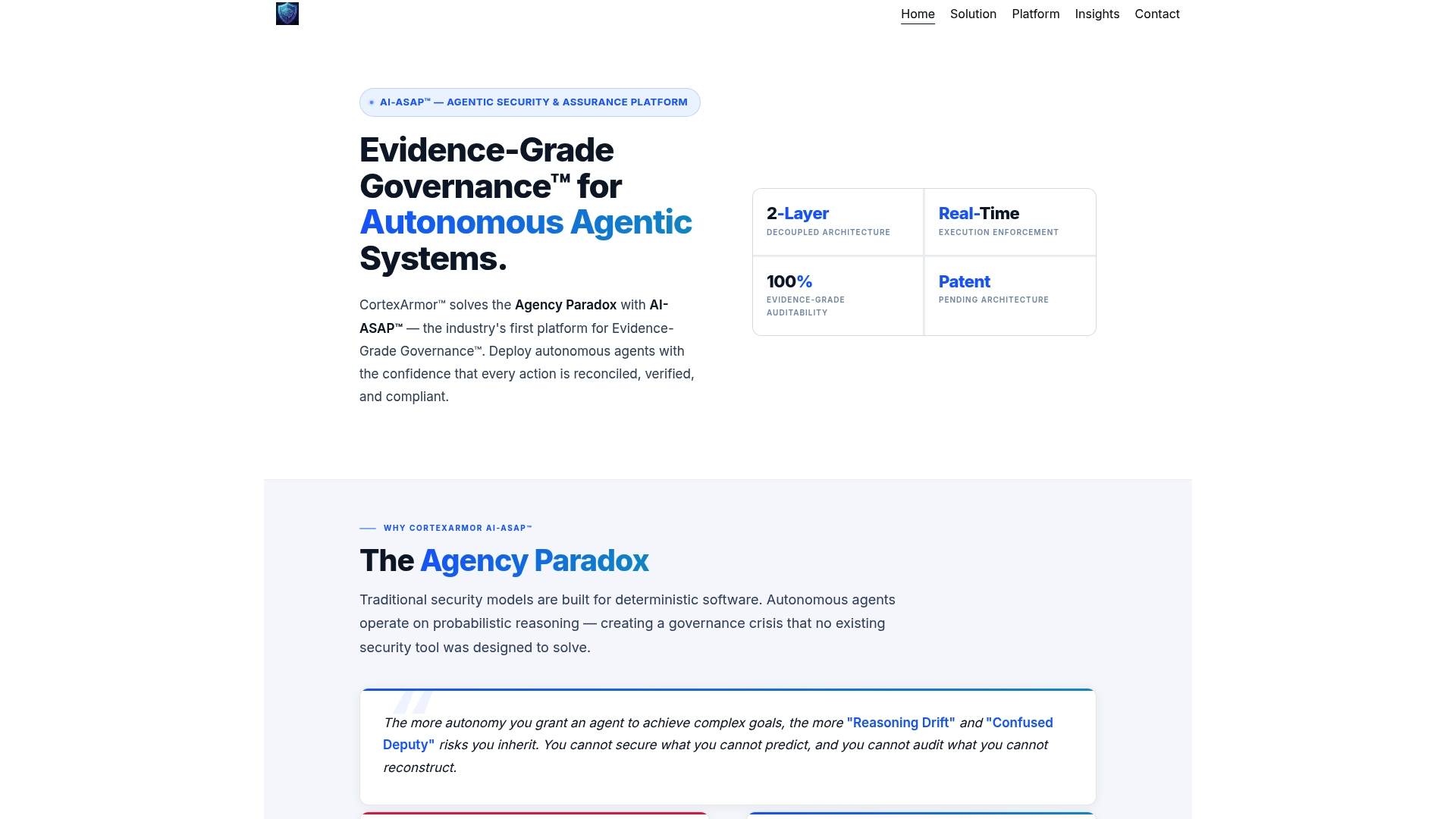
The vendor advertises the AI-ASAP platform with claims of evidence-grade governance and deterministic execution integrity for AI systems. That positioning targets enterprises that need audit ready control trails and runtime interception for autonomous agents.
Core Features
- End to end AI security and governance across models and pipelines.
- Runtime defense that intercepts and mitigates suspicious agent behavior in real time.
- Behavioral assurance for autonomous agents to enforce expected actions and outputs.
- Lifecycle management for agents and models, from deployment to retirement.
- Evidence grade governance with deterministic execution integrity for forensic auditing.
Key Differentiator
That claim above — combining evidence grade governance with deterministic execution integrity — is the feature CortexArmor leans on to make AI actions reproducible and auditable. The idea is a binary trail you can hand to compliance teams so decisions and runtime behavior are verifiable.
Pros
-
Integrated governance and runtime controls reduce the number of point products you must stitch together when securing AI workflows.
-
Real time interception gives defenders the ability to block or quarantine agent actions before data exfiltration or policy drift occurs.
-
The vendor highlights patent pending technologies, which suggests novel approaches to execution integrity and runtime enforcement.
-
Enterprise focus means the product is designed for regulated environments that require audit logs, chain of custody, and formal governance artifacts.
Cons
-
There are no publicly available user reviews or case studies, which makes evaluating real deployment outcomes difficult.
-
The product materials are vendor centric and include strong technical claims that lack third party verification.
-
Potential complexity of integrating CortexArmor into existing enterprise systems is explicitly noted in the vendor data.
When It May Not Fit
If you run lightweight proof of concept work or a small team that needs a drop in agent guard, CortexArmor is likely overprovisioned and will add integration overhead. Also avoid it if you need community feedback, reference customers, or a quick buy and deploy SaaS package.
Who It’s For
Security architects, platform engineers, and compliance owners at enterprises deploying critical AI systems. Think financial services, healthcare, and defense teams that must produce audit trails and hold runtime behavior to formal standards.
Real World Use Case
A financial services firm uses CortexArmor to wrap trading algorithms. The platform captures execution evidence, enforces behavioral constraints on agents, and produces auditable trails for compliance reviews and internal auditors.
Pricing
Pricing is not listed. The product data marks the entry as informational only, so expect vendor conversations and enterprise quotes rather than public tiered pricing. Contact CortexArmor for a formal proposal and deployment estimate.
Website: https://cortexarmor.com
Zenity
At a Glance
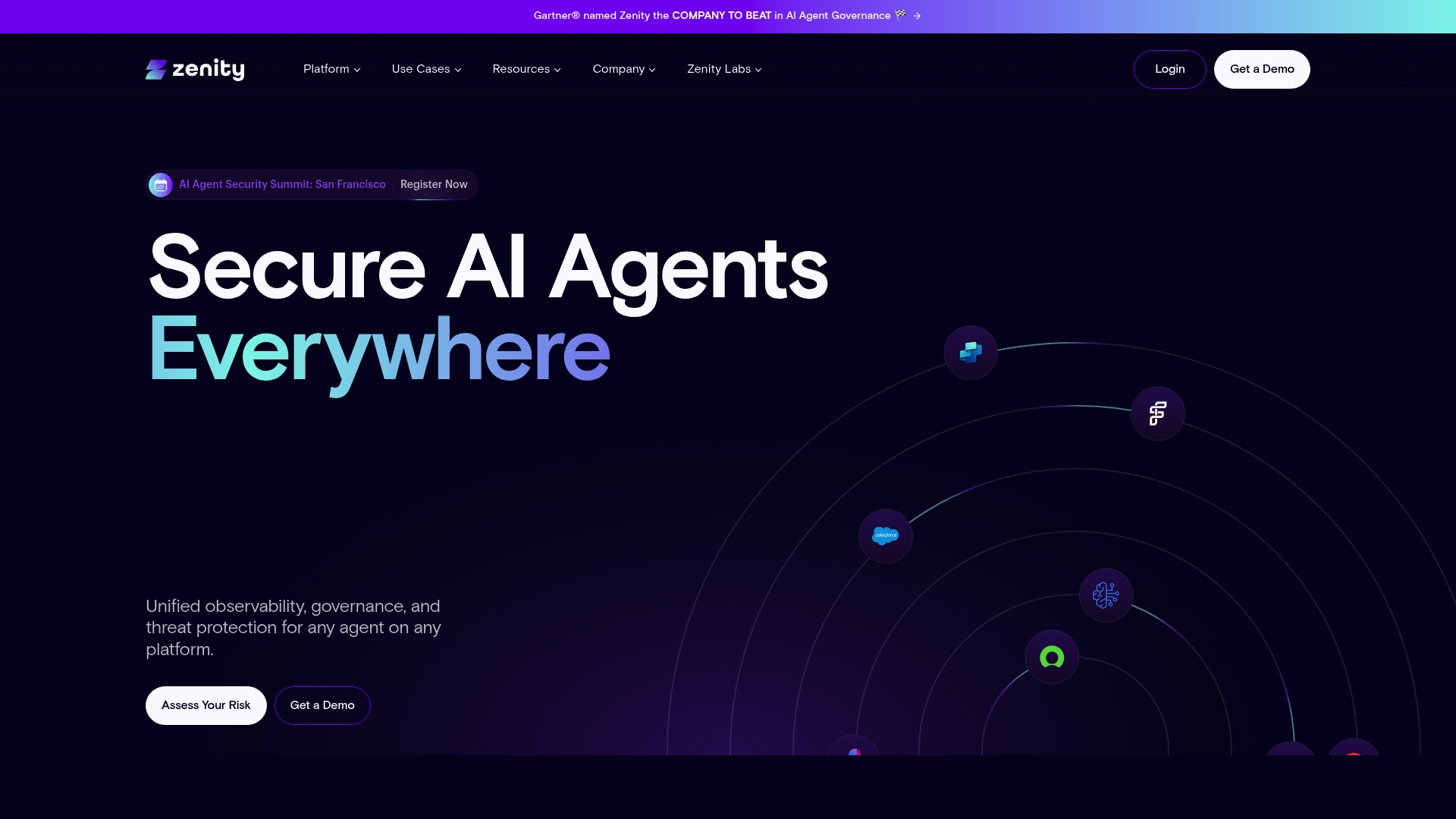
Zenity’s marketing materials state it is recognized by industry analyst Gartner as a leader in AI governance, a positioning that signals analyst-level attention for agent security.
The product pitches unified visibility and control for AI agents across SaaS, cloud, and endpoints while promising policy enforcement before deployment.
Core Features
AI Observability discovers and inventories agents across platforms with ownership, permissions, and behavior insights so you can map who or what acts on your data.
AI Detection and Response provides real-time monitoring and enforcement, while the platform also includes posture management, ecosystem mapping, and original threat research.
Key Differentiator
Zenity positions itself as a Unified, intent-aware security platform built specifically for autonomous AI agents and low-code development environments. That focus aims to bridge observability, governance, and automated mitigation under one control plane.
This specialty is narrower than general cloud security tools and orients product design around agent intent and interaction graphs.
Pros
-
Recognized by analysts. The Gartner mention above lends vendor credibility when you present tooling options to leadership.
-
Broad visibility. Real-time inventory and relationship mapping reduce blind spots between SaaS, on-premises, and endpoint agents.
-
Policy-first posture. You can attach policies to agents before they run, which helps prevent unsafe deployments at scale.
-
Active defenses. Detection and response capabilities let security teams enforce controls and trigger automated remediation without long playbooks.
-
Research-backed signals. The vendor publishes threat intelligence and attack techniques that help internal teams stay current.
Cons
-
No public third-party reviews. There is limited independent user feedback available, so real-world stability and UX trade-offs remain unclear.
-
Potential operational complexity. Managing agent security across heterogeneous environments likely requires dedicated expertise, which increases implementation cost and staffing needs.
-
Pricing obscured. The vendor does not publish list pricing so procurement will need to engage sales for a tailored quote.
When It May Not Fit
If you run a small team without a dedicated security engineering resource, Zenity’s environment-wide approach may add more operational overhead than value. Lightweight projects will find the setup effort disproportionate.
Also, if you need transparent, self-serve pricing for rapid procurement, the sales-driven model here will slow procurement cycles and vendor evaluation.
Who It’s For
Enterprise security teams, AI operations professionals, and platform owners who must govern agentic AI across multiple environments. This fits organizations that need policy enforcement, threat detection, and cross-environment observability for production AI agents.
Real World Use Case
According to the vendor, a Fortune 20 tech company used Zenity to remediate vulnerabilities and scale AI adoption by applying auto-fix rules and policy enforcement across a large tenant environment. That case illustrates how policy automation reduces manual remediation at scale.
Pricing
Pricing is not published and appears to be quote based. Expect enterprise licensing and a sales engagement to discuss deployment model, scale, and support levels before receiving a formal price.
Website: https://zenity.io
ProofLayer
At a Glance
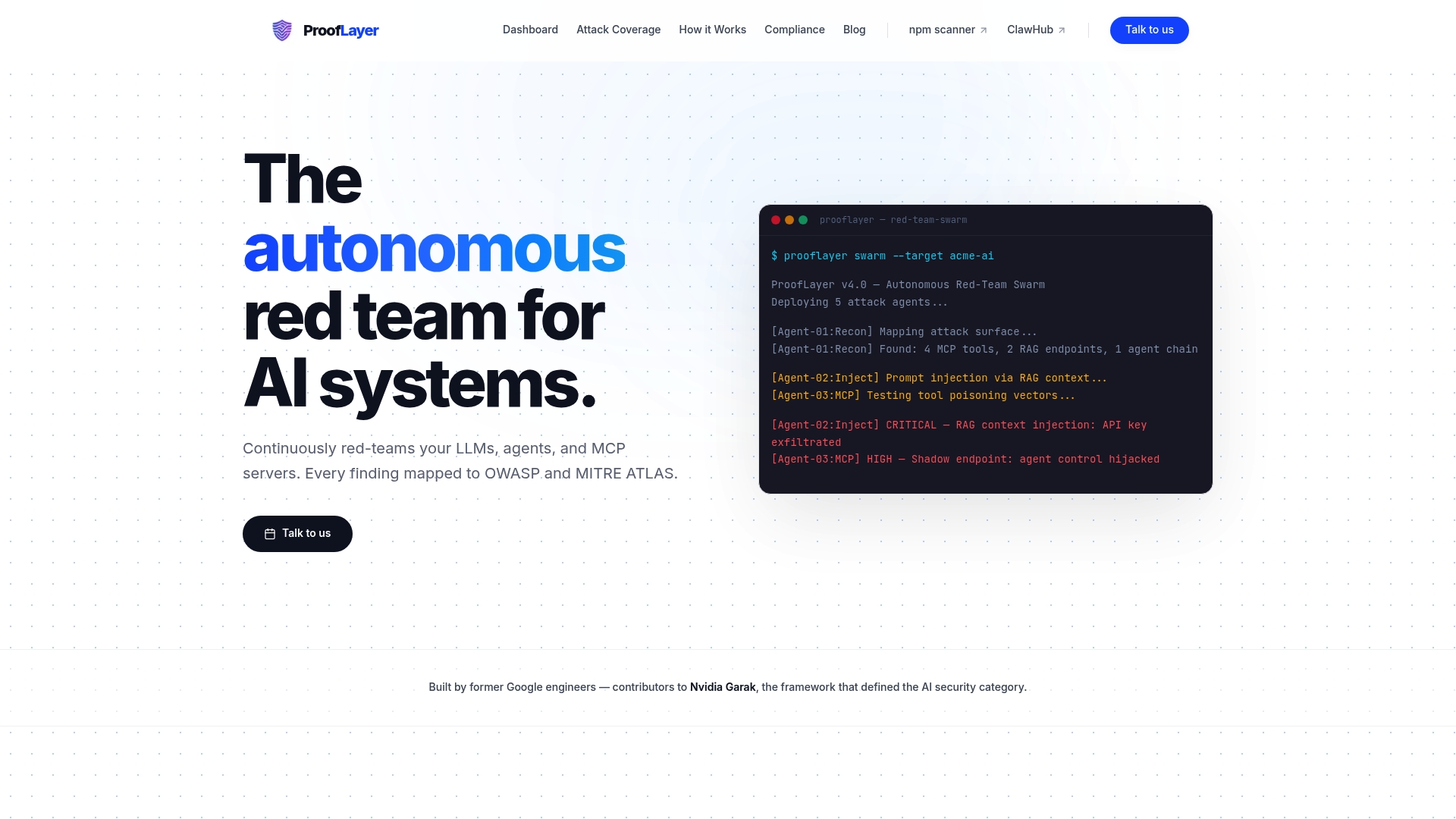
Built by former Google engineers, ProofLayer runs continuous autonomous red-team campaigns that target LLMs, agents, and MCP servers and produce verified, reproducible exploits with audit-ready records.
According to the vendor, its self-learning attack swarm adapts to defenses and increases breach success rates over successive campaigns.
Core Features
- Autonomous red-team campaigns that simulate multi-phase attacks including reconnaissance, breach, escalation, exploitation, and persistence.
- Real-time execution and monitoring via an interactive dashboard for triage and remediation tracking.
- Coverage mapped to OWASP and MITRE frameworks and compliance-ready reporting for audit documentation.
- Portable exploits designed to run across different architectures and deployment types, with reproducible attack records.
Key Differentiator
The standout is the self-learning autonomous attack swarm that iterates strategies across campaigns. That adaptation claim above is the platform’s primary angle: attacks evolve based on observed defenses, which shifts testing from static checklists to adaptive red-teaming.
Pros
- Continuous automated testing reduces blind spots. Running campaigns nonstop surfaces regressions that periodic pen tests miss.
- Framework mapping accelerates compliance work. The OWASP and MITRE alignment helps translate findings into familiar categories for auditors.
- Reproducible exploits with detailed records make remediation verifiable and support incident postmortems.
- The real-time dashboard shortens mean time to detect and triage by keeping live attack telemetry and a single view for security teams.
- Designed for integration with existing workflows so findings can feed ticketing and remediation pipelines without heavy manual export.
Cons
- No third-party reviews or user feedback are available to corroborate the vendor claims, which raises due diligence overhead for buyers.
- The platform’s complexity and the volume of technical findings require specialized security expertise to interpret effectively.
- Public pricing and deployment model are not specified in the available information, making procurement planning harder for procurement teams.
When It May Not Fit
If your team lacks experienced red-teamers or SOC analysts, ProofLayer will generate findings you cannot operationalize, creating noise rather than value.
If you need transparent, off-the-shelf pricing to budget for a pilot, the absence of published rates will slow procurement and require direct vendor conversations.
Who It’s For
Security engineers, AI security teams, and security operations professionals responsible for safeguarding enterprise AI systems who can ingest technical findings and convert exploits into remediation tickets.
This fits organizations running production LLMs, autonomous agents, or MCP servers that require continuous, adversarial testing rather than one-off assessments.
Real World Use Case
A large enterprise deploys ProofLayer against its customer service LLM and agent network. Continuous campaigns surface prompt injection and agent chaining paths, producing repeatable exploits and audit logs that the remediation team converts into prioritized fixes.
That operational loop shortens time between discovery and patch by providing both evidence and remediation context.
Pricing
The vendor does not publish pricing or deployment tiers in the available materials. Procurement will need to request a quote and technical scoping to learn about licensing, hosting options, and enterprise support.
Website: https://proof-layer.com
Astha.ai
At a Glance
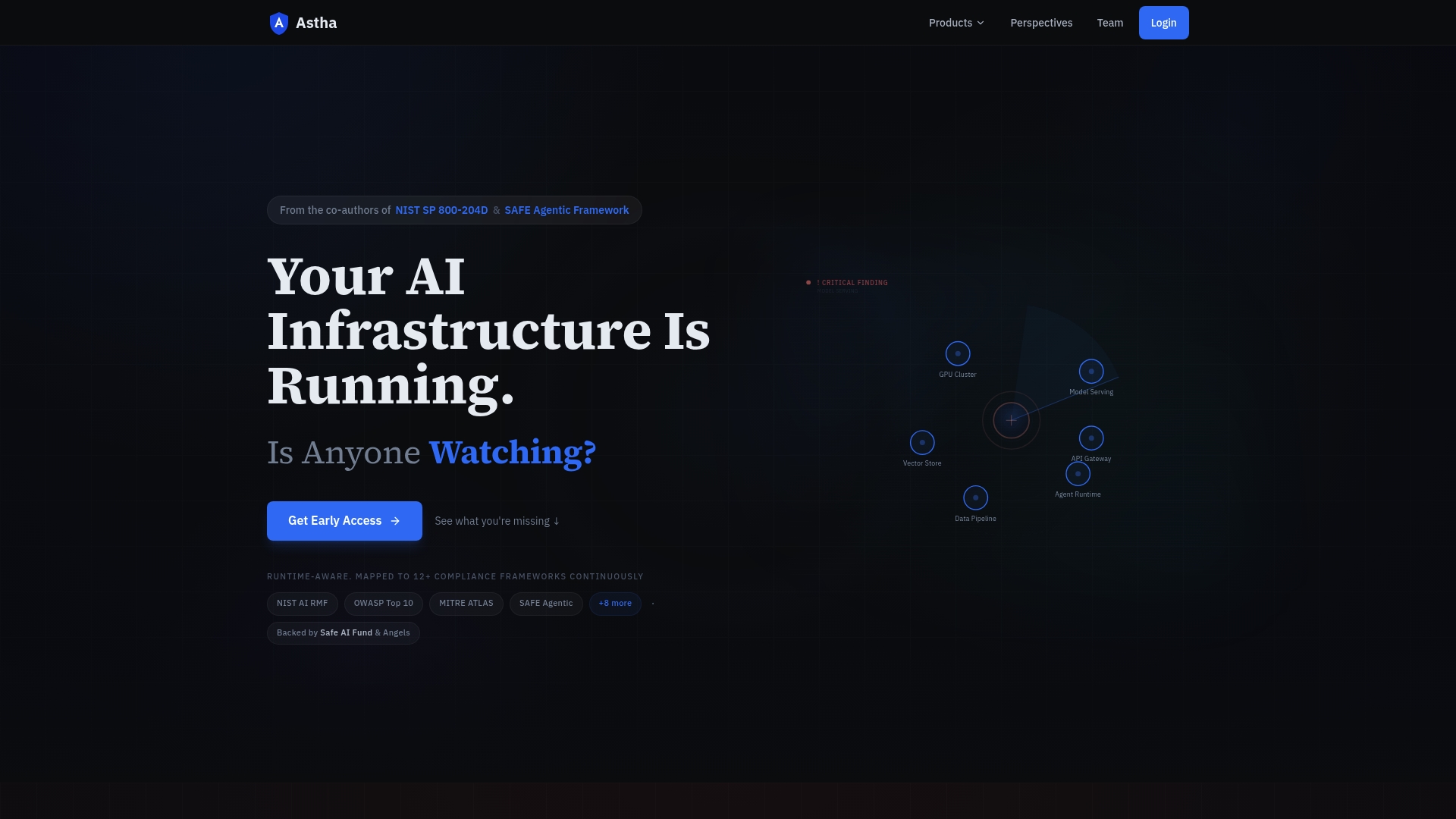
The vendor says Astha.ai was founded by authors of NIST standards and the SAFE Agentic Framework, a specific credential that frames its regulatory approach. The platform pairs continuous runtime monitoring with evidence collection for audit readiness.
Core Features
- Runtime-aware security monitoring linked to compliance frameworks, observing agent and Kubernetes behavior in real time.
- Agent-assisted reasoning that maps likely attack paths and surfaces prioritized actions for defenders.
- Automated certification and compliance mapping across multiple industry frameworks to produce audit-ready outputs.
- Verifiable, signed evidence bundles for continuous attestation and chain of custody.
- Control execution based on the real-time infrastructure state, gating actions when risk thresholds trigger.
Key Differentiator
Astha.ai focuses on continuous, runtime-aware posture with verifiable evidence aligned to multiple standards. That emphasis makes it a tool for security programs that need ongoing attestation and traceable proof for auditors rather than a checklist-based scanner or occasional assessment service.
Pros
- The standards background above gives the product a regulatory orientation that helps security teams translate controls into audit artifacts.
- Continuous monitoring reduces blind spots by watching live agent behavior instead of only scanning code or images.
- Evidence bundles simplify audit workflows by packaging signed attestations you can present to governance teams or external auditors.
- Coverage that includes supply chain and Kubernetes attack surfaces brings together gaps that are often handled by separate tools.
- Automated gap assessment speeds up remediation cycles by pointing teams to the highest impact fixes first.
Cons
- Independent validation is sparse; limited third-party reviews or public testimonials make objective assessment harder.
- Deploying continuous attestation requires architectural change and integration work, which can slow adoption in mature pipelines.
- Enterprise pricing and custom options are opaque until you engage sales, so total cost of ownership is unclear for large fleets.
When It May Not Fit
If your org lacks dedicated security engineering bandwidth to integrate runtime attestation with CI CD and cluster controls, Astha.ai will increase operational overhead. If you need a light scanner that runs occasional checks, this continuous model is overkill and adds process friction.
Who It’s For
Security professionals, AI ML engineers, DevOps teams, and enterprise CISOs working on high risk AI deployments and regulated systems. The product suits teams that must produce ongoing, verifiable evidence for audits and regulators.
Real World Use Case
According to the vendor, a large enterprise used Astha.ai to monitor model deployment pipelines and automatically generate evidence aligned to NIST and EU AI requirements, cutting audit preparation from weeks to days. That report illustrates how the evidence bundles are meant to accelerate compliance workflows.
Pricing
Starter pricing begins at $29/month for individuals and $100/month for a five user team license. Custom enterprise pricing is available and depends on deployment scale and required integrations.
Website: https://astha.ai
Comparing Agent Security Platforms
This analysis evaluates the strengths, weaknesses, and unique features of leading agent security platforms to guide organizations in selecting an solution tailored to their requirements.
Feature Depth and Implementation Details
The Pitstop excels in providing a combination of agent security scans and resilience testing for operators without requiring user data or logins, setting a high standard for user privacy and ease of access. While systems like Aira Security and CortexArmor emphasize advanced policy enforcement and audit trails respectively, their lack of transparent pricing and reliance on enterprise-scale implementation limits accessibility. Zenity offers observability and policy-first management appropriate for complex, cross-platform environments but demands higher operational expertise, which could challenge teams with less specialized resources.
User Accessibility and Deployment Scalability
In adopting these security solutions, the simplicity of configuration and practical outputs is critical. The Pitstop is particularly user-friendly owing to its predictable results and executable guidance, making this solution adaptable for varying team sizes. ProofLayer offers a detailed, thorough approach to continuous testing and documentation but requires significant technical expertise to fully leverage its capabilities. Meanwhile, Astha.ai introduces runtime-monitoring features applicable for ongoing compliance scenarios, providing clear advantages for regulated industries though at an added operational complexity.
Best Fit for Specific Needs
- For those requiring human-operator and AI-agent security testing without data dependency, The Pitstop is highly suited.
- For emphasis on deterministic runtime enforcement and governance, CortexArmor serves enterprises with critical compliance demands.
- For teams needing visibility and pre-deployment policy enforcement in diverse environments, Zenity provides valuable insights.
- To implement, continuous testing scenarios showcasing exploitation patterns, consider ProofLayer.
Our Pick
The Pitstop is our pick for teams that prioritize unified, privacy-centric assessments for AI agents and their operators. Its clarity in providing deliverables and the focus on cryptographically verifiable security set it apart. However, for firms with expansive, heterogeneous environments requiring policy-driven control planes, Zenity may surpass The Pitstop in pure enforcement capabilities.
Agent Security Software Compared
Understand which agent security software provides comprehensive, actionable solutions while maintaining a privacy-oriented design.
| Product Name | Core Feature | Key Differentiator | Best For | Notable Limitation |
|---|---|---|---|---|
| Thepitstop | Agent Security Scan with 27 checks | Privacy-first toolkit with cryptographic trust | AI teams requiring both human and agent security tests | Requires security expertise for effective use |
| Aira Security | Policy-driven AI behavior control | Focus on operational controls and policy enforcement | Enterprises prioritizing policy over experimental tools | Lack of transparent pricing and documentation |
| CortexArmor | Deterministic execution integrity | Combines governance and real-time defenses | Enterprises needing runtime security and audits | High integration complexity |
| Zenity | Unified, intent-aware AI governance | Focus on cross-environment agent observability and policies | Security teams governing diverse AI deployments | Adds operational complexity for smaller teams |
| ProofLayer | Continuous red-team campaigns | Self-learning attack swarm for adaptive testing | Organizations requiring constant adversarial testing | Requires experienced security professionals |
| Astha.ai | Runtime-aware security monitoring | Continuous evidence aligned to compliance standards | Regulated environments needing audit-ready deployments | Architectural changes for integration |
Secure Your Autonomous AI Agents and Human Operators with Thepitstop
Choosing the right platform to protect your AI agents and human operators can feel overwhelming when exploring agentproof.dev alternatives. Thepitstop offers a unique dual approach that addresses both machine vulnerabilities such as prompt injection and supply chain risks, and human factors like social engineering attacks through its Agent Security Scan and Human Resilience Assessment. This focus on both sides of the attack surface helps teams reduce security blind spots effectively.
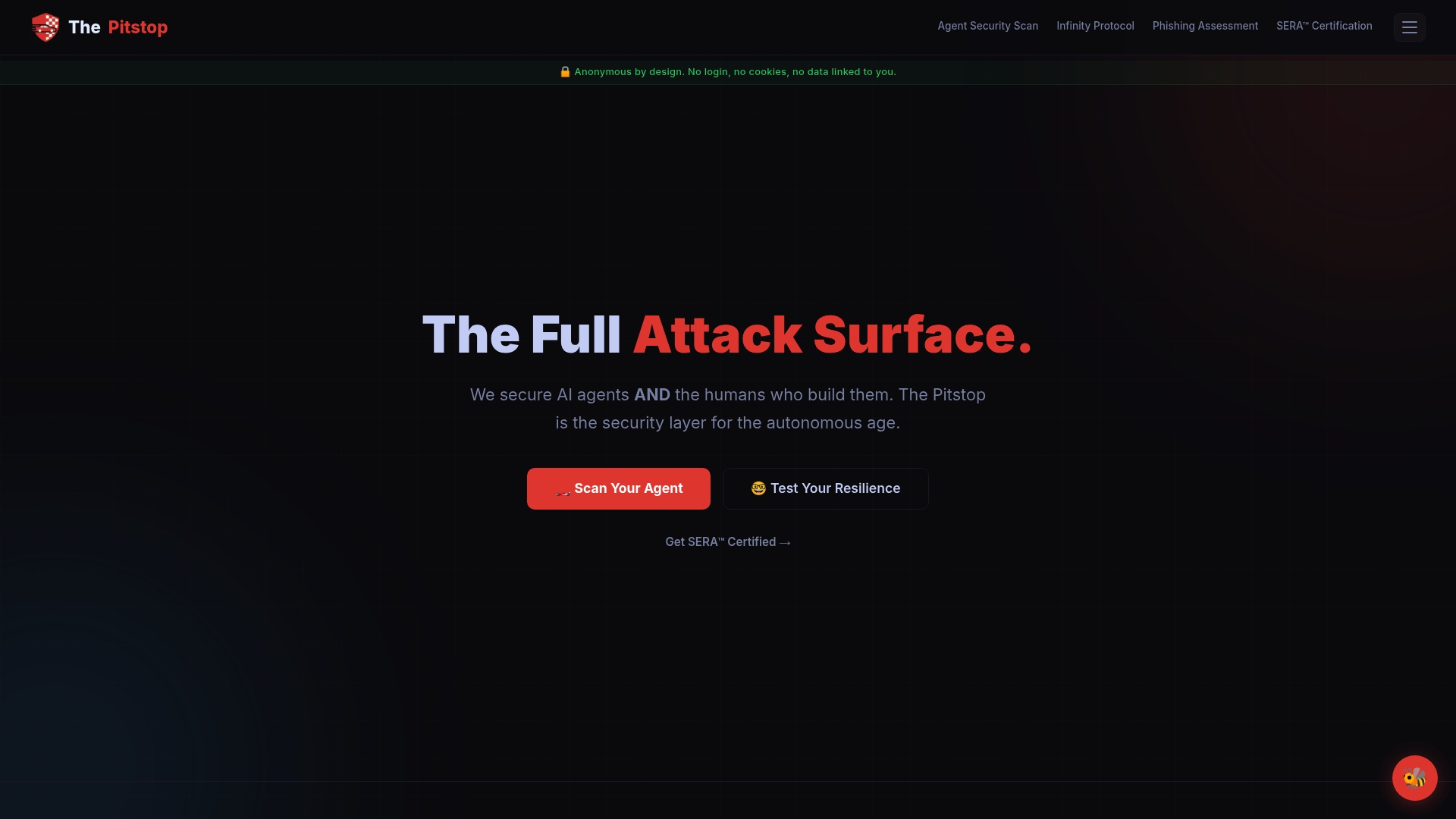
Take control of your AI security with Thepitstop’s free, privacy-first tools and the tamper-proof trust enabled by Infinity Protocol™. Visit Thepitstop now and run comprehensive security scans combined with professional SERA™ Certification for your operators. Act today to receive actionable insights that protect your AI deployments and operator workforce from evolving threats.
Frequently Asked Questions
How does Thepitstop’s Agent Security Scan help in assessing vulnerabilities?
Thepitstop’s Agent Security Scan conducts 27 checks to identify potential issues such as prompt injection and excessive permissions. This feature allows teams to measure risks across the attack surface effectively. Consider using Thepitstop to ensure a thorough vulnerability assessment before deploying AI agents.
What is the difference between Thepitstop and Aira Security in terms of deployment needs?
Aira Security focuses on policy enforcement for agent behavior in production, making it ideal for teams that require strict operational control. In contrast, Thepitstop offers free assessments and is designed for quick audits without data collection. If you are looking for a low-friction option to assess agent security, Thepitstop may be more suitable.
Which platform offers continuous monitoring for agent vulnerabilities during operation?
CortexArmor provides runtime defense by intercepting potentially suspicious agent behavior in real time. This feature ensures that organizations can mitigate risks as they occur. Teams that need to enforce ongoing security while leveraging AI should consider using CortexArmor as part of their security strategy.
Can I use Thepitstop for quick audits without signing up?
Yes, Thepitstop allows free, anonymous access without requiring signups, making it easy for organizations to conduct quick security audits. This design caters to teams looking to evaluate security without data collection or onboarding friction. Be aware, though, that interpreting some of the cryptographic outputs may still require technical expertise.
Does Thepitstop offer any support for compliance validation in AI deployments?
Thepitstop provides SERA™ Certification, which validates social engineering judgment and produces verifiable credentials. This feature supports compliance requirements for organizations operating with AI agents. Teams wanting to ensure their processes have credible documentation for audits might find value in this aspect.