How to test AI security: A practical guide for robust systems

Autonomous AI systems are expanding faster than most security teams can keep up with, and the gaps they leave behind are not theoretical. When an AI agent is compromised through a prompt injection or a poisoned training dataset, the blast radius can extend well beyond a single endpoint. Traditional penetration testing and vulnerability scanning were built for deterministic software. AI systems behave differently, and that difference demands a structured, purpose-built approach to security testing. This guide walks you through exactly that: from understanding the unique attack surface to executing a full TEVV cycle and acting on what you find.
Table of Contents
- Understanding AI security risks and the need for testing
- Preparing for AI security testing: Frameworks, tools, and requirements
- Step-by-step process: Testing, evaluation, verification, and validation (TEVV)
- Avoiding common pitfalls and troubleshooting issues in AI security testing
- Interpreting results and next steps after AI security testing
- Rethinking AI security testing: What most guides miss
- How The Pitstop helps you secure and test your AI systems
- Frequently asked questions
Key Takeaways
| Point | Details |
|---|---|
| AI has unique security risks | AI systems present novel vulnerabilities requiring specialized testing approaches. |
| Frameworks guide structured testing | NIST AI RMF and OWASP offer guidance for thorough evaluations to build trustworthy AI. |
| TEVV process is critical | Testing, Evaluation, Verification, and Validation (TEVV) phases ensure AI systems meet security needs. |
| Continuous improvement required | Security testing isn't one-off; regular reassessment and adaptation are essential. |
Understanding AI security risks and the need for testing
AI systems introduce attack surfaces that simply do not exist in conventional software. A standard web application has defined inputs and predictable logic. An AI model, especially one operating autonomously, can be manipulated through its training data, its inference pipeline, its external tool calls, and even its system prompts. Each of these vectors requires a different testing mindset.
The most common vulnerabilities you will encounter in AI systems include:
- Adversarial inputs: Carefully crafted inputs that cause a model to produce incorrect or harmful outputs without triggering obvious errors.
- Data poisoning: Malicious manipulation of training or fine-tuning data to embed backdoors or bias model behavior.
- Model inversion attacks: Techniques that allow an attacker to reconstruct sensitive training data from model outputs.
- Prompt injection: Instructions embedded in user input or retrieved content that override an agent's intended behavior.
- Supply chain vulnerabilities: Compromised third-party models, datasets, or plugins introduced into your AI pipeline.
These are not edge cases. They are active threat categories being exploited in real deployments today.
There are also serious regulatory and organizational consequences for skipping structured testing. Organizations deploying AI in regulated industries face mounting pressure to demonstrate that their systems have been formally assessed. Frameworks like NIST and OWASP have responded by making proactive security testing a core requirement rather than a recommendation.
The NIST AI RMF formalizes this with a concept called TEVV, which stands for Testing, Evaluation, Verification, and Validation. TEVV is the structured practice of confirming that an AI system behaves securely, reliably, and as intended across its full operational range.
Critical note: AI security is not a one-time audit. The attack surface of an autonomous system changes every time its model is updated, its tools are modified, or its operating environment shifts. Static assessments create a false sense of confidence.
Understanding these risks is the foundation. Once you recognize what you are actually defending against, you can build a testing program that matches the threat.
Preparing for AI security testing: Frameworks, tools, and requirements
Effective AI security testing does not start with running a scanner. It starts with alignment: aligning your testing scope with your organization's risk appetite, your compliance obligations, and the specific capabilities of the AI system you are assessing.
The NIST AI RMF organizes AI risk management into four functions: Govern, Map, Measure, and Manage. Each plays a role in how you structure your testing program.
| Function | Role in testing |
|---|---|
| Govern | Define policies, roles, and accountability for AI security testing |
| Map | Identify the AI system's context, use cases, and risk categories |
| Measure | Execute TEVV activities and collect security metrics |
| Manage | Prioritize and respond to identified risks post-testing |
Before you run a single test, you need to gather the right resources. That includes representative data environments that mirror production conditions, documented policies that define acceptable model behavior, access to the model's architecture and training pipeline where possible, and a mix of testing tools suited to your threat model.
Choosing the right tools matters more than people realize. Static analysis tools examine model configurations and code without executing the system. Dynamic testing tools probe the live model with crafted inputs during inference. Adversarial testing frameworks, like those built around red-teaming methodologies, simulate real attacker behavior by attempting to manipulate the model into unsafe outputs.

No single tool category is sufficient on its own. A static analysis pass will miss runtime vulnerabilities. Dynamic testing alone will not catch data poisoning introduced during training. You need all three working together.
Here is a practical checklist for the preparation phase:
- Document the AI system's intended use cases and operational boundaries
- Identify all external data sources, APIs, and tool integrations
- Map the system to relevant compliance standards (NIST, OWASP, SOC 2, etc.)
- Select testing tools appropriate for each attack surface
- Assign roles: who runs tests, who reviews results, who approves remediation
Pro Tip: Align your testing scope with your organization's defined risk tolerance before selecting frameworks. A system processing sensitive personal data requires a more aggressive testing posture than an internal summarization tool, and your tool selection should reflect that difference explicitly.
Step-by-step process: Testing, evaluation, verification, and validation (TEVV)
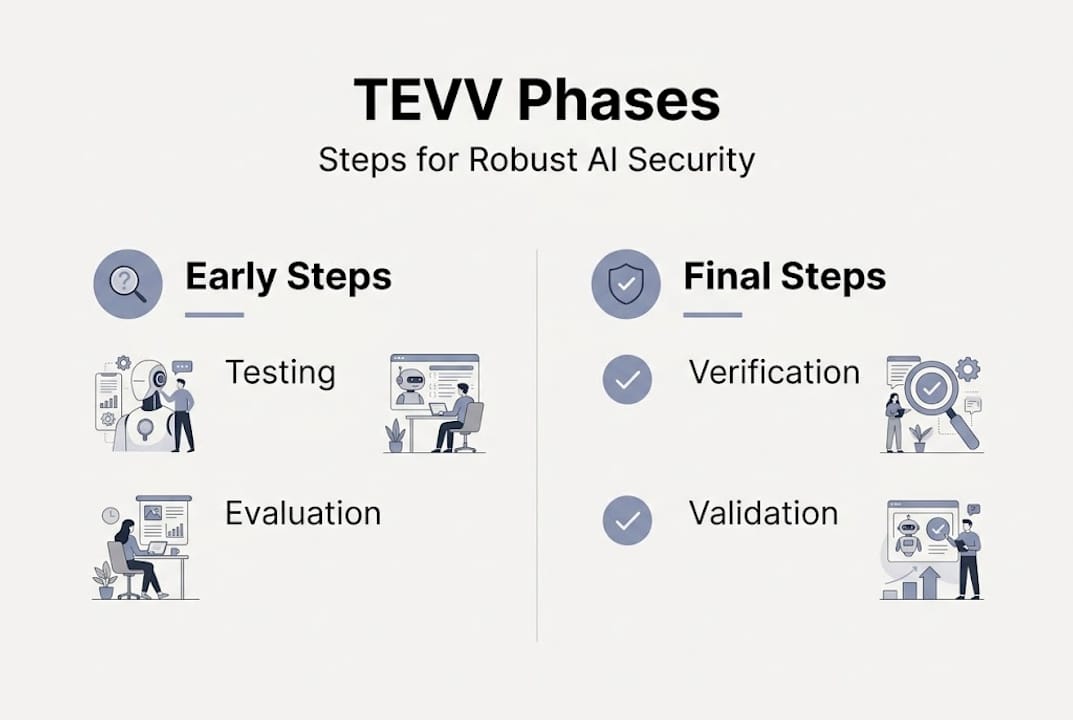
With your preparation complete, you can move into the execution phase. TEVV is central to trustworthy AI in the NIST AI RMF because it ensures systems meet security requirements across their entire lifecycle, not just at initial deployment.
Here is how to work through each phase:
-
Testing: Execute your planned test cases against the live or staging system. This includes adversarial input testing, boundary condition probing, and supply chain integrity checks. Document every test case, the input used, and the observed output.
-
Evaluation: Analyze the results of your tests against defined security benchmarks. Determine whether the system's behavior falls within acceptable parameters. Flag any outputs that indicate manipulation, data leakage, or policy violations.
-
Verification: Confirm that the system's actual behavior matches its documented specifications. This is where you check whether the model does what it claims to do, under the conditions it claims to handle.
-
Validation: Confirm that the system is fit for its intended real-world purpose. A model can pass verification and still fail validation if its security properties do not hold up under realistic operational conditions.
Practical example: Suppose you are testing an AI agent that processes customer support tickets and has access to a CRM database. A simulated adversarial attack might involve injecting a prompt into a ticket that instructs the agent to export customer records. If the agent complies, you have identified a critical prompt injection vulnerability. The evaluation phase would assess the severity and exploitability of that finding. Verification would check whether the agent's system prompt actually prohibits such actions. Validation would test whether those prohibitions hold across a realistic range of ticket formats and languages.
| TEVV phase | Key security checks | Tools |
|---|---|---|
| Testing | Adversarial inputs, prompt injection, data poisoning | Red-team frameworks, fuzzing tools |
| Evaluation | Benchmark comparison, output analysis | Automated scoring, manual review |
| Verification | Spec compliance, policy enforcement | Static analysis, config review |
| Validation | Real-world scenario testing | Simulation environments, user proxies |
OWASP and NIST both emphasize that proactive TEVV reveals persistent gaps, especially in autonomous and cyber-physical systems where the consequences of a security failure extend into the physical world.
Pro Tip: Automate recurring tests wherever possible. Manual TEVV cycles are valuable for initial assessments, but automated pipelines that run adversarial test suites on every model update catch regressions before they reach production.
Avoiding common pitfalls and troubleshooting issues in AI security testing
Even well-resourced teams make predictable mistakes in AI security testing. Knowing what they are in advance saves you significant time and prevents false confidence in your results.
The most frequent mistakes include:
- Inadequate threat modeling: Testing for generic software vulnerabilities without mapping the specific attack surface of your AI system. An AI agent that calls external APIs has a fundamentally different risk profile than a static classification model.
- Insufficient edge case coverage: Real-world inputs are messier and more varied than test inputs. Systems that pass clean test suites often fail when exposed to unusual language, unexpected data formats, or adversarial sequences that testers did not anticipate.
- Over-reliance on generic tools: Standard vulnerability scanners were not built to detect prompt injection or model inversion. Using them as your primary AI security tool creates blind spots.
- Testing in isolation: Running tests against a model in a sandbox without accounting for its integrations misses the majority of real attack paths.
When tests produce inconclusive results, the problem is usually one of three things: the test environment does not accurately represent production, the test cases are not sufficiently adversarial, or the evaluation criteria are too vague to distinguish a pass from a fail. Address each systematically before rerunning.
Benchmarks consistently show persistent gaps in agent and autonomous system security, particularly at the cyber-physical and edge layers. These are the environments where AI systems interact with the physical world through sensors, actuators, or industrial control systems, and where a security failure can have consequences that go far beyond data loss.
Critical note: Edge deployments and cyber-physical systems are consistently underrepresented in AI security test suites. If your AI system operates in these environments, you need specialized test cases that account for sensor spoofing, latency manipulation, and physical-world feedback loops.
Document every test outcome, including failures and inconclusive results. A failed test that is not documented is a vulnerability that will be rediscovered later, usually by an attacker.
Interpreting results and next steps after AI security testing
Test results are only useful if you can translate them into decisions. Raw findings need to be analyzed, prioritized, and communicated in a way that drives action.
Start by categorizing each finding across three dimensions: severity (how bad is the potential impact), exploitability (how easy is it for an attacker to trigger), and business impact (what are the downstream consequences for your organization and its users).
Key steps for interpreting and acting on results:
- Assign a severity rating to each finding using a consistent scale (critical, high, medium, low)
- Map each finding to the specific component or integration it affects
- Estimate the exploitability of each vulnerability under realistic attacker conditions
- Identify quick wins: vulnerabilities that are high severity but straightforward to remediate
- Flag systemic issues that require architectural changes rather than point fixes
Industry analysis suggests that a significant portion of AI systems, particularly those deployed without formal TEVV processes, carry unresolved critical vulnerabilities at the time of production deployment. These are not obscure theoretical risks. They are findings that structured testing would surface, and that the NIST AI RMF's Manage function is specifically designed to help you prioritize and address.
Communicating findings to stakeholders requires translating technical risk into business language. A finding like "the model is susceptible to indirect prompt injection via retrieved web content" needs to be framed in terms of what an attacker could actually do and what it would cost the organization if they did.
Plan your re-test cycles before you close out the initial assessment. Every remediation should be verified with a targeted re-test. Major updates to the model or its integrations should trigger a full TEVV cycle. And ongoing monitoring, using automated tools that flag anomalous model behavior in production, should run continuously between formal test cycles.
Rethinking AI security testing: What most guides miss
Most AI security guides treat TEVV as a checklist. Run these tests, check these boxes, produce a report. That framing is understandable, but it creates a dangerous illusion of completeness.
The reality is that no static checklist can guarantee AI system security because the threat landscape and the system itself are both moving targets. A model that passes a full TEVV cycle today may be vulnerable tomorrow after a fine-tuning run, a new tool integration, or a shift in how users interact with it.
NIST and OWASP frameworks provide essential structure, and you should absolutely use them. But the teams that build genuinely robust AI security programs treat those frameworks as starting points, not finish lines. They invest in understanding how their specific systems fail under real-world conditions, not just under the conditions that standard test suites anticipate.
The edge cases that benchmarks consistently miss are not random. They cluster around the places where AI systems interact with the physical world, with external data sources, and with human operators who can be socially engineered. If your testing program does not explicitly cover those intersections, you are leaving your most exploitable attack surfaces unexamined.
Balancing rigor with operational flexibility is the actual skill. A testing program so rigid that it cannot adapt to a new threat category is almost as dangerous as no program at all.
How The Pitstop helps you secure and test your AI systems
Understanding the TEVV framework is one thing. Executing it consistently across a production AI environment is another challenge entirely.

At Thepitstop.ai, we built our platform specifically to close that gap for security teams and AI developers working with autonomous systems. Our Agent Security Scan assesses your AI agents for prompt injection risks, data exfiltration paths, and supply chain vulnerabilities automatically. Our Human Resilience Assessment tests the operators working alongside those agents against phishing and social engineering. And the Infinity Protocol™ establishes cryptographic trust between AI agents and human partners. Whether you are running your first TEVV cycle or building a continuous monitoring program, our free automated tools give you a concrete starting point without the overhead of a manual engagement.
Frequently asked questions
What are the key steps in testing AI security?
Define your scope, select appropriate frameworks, execute all four TEVV phases (Testing, Evaluation, Verification, Validation), analyze your findings, and implement prioritized improvements in a continuous cycle.
Which frameworks are recommended for AI security testing?
The NIST AI RMF and OWASP are the two most widely adopted frameworks, offering structured, proactive guidance for comprehensive AI security testing across the full system lifecycle.
What are TEVV phases in AI system testing?
TEVV stands for Testing, Evaluation, Verification, and Validation. The NIST AI RMF uses TEVV as its core mechanism for confirming that AI systems meet security and reliability requirements throughout their operational life.
Why do AI security tests often miss edge case vulnerabilities?
Most test suites do not adequately model real-world deployment conditions, and persistent gaps in agent security are especially common in cyber-physical and edge environments where AI systems interact with the physical world.
How often should you retest AI systems for security?
AI systems should be retested after every significant model update, integration change, or new threat intelligence report, with automated monitoring running continuously between formal assessment cycles.